Insurance is both a licensing requirement in many states and a financial safety net that can determine whether a daycare survives a serious claim.
This article breaks down what daycare small business insurance costs across operation types, which policies you actually need, and what drives premiums up or down.
Key Takeaways
- Home daycare general liability typically runs $56–$78/month for most operators; commercial centers pay more
- No single policy covers all daycare risks — you need multiple coverage types working together
- Abuse and molestation coverage is routinely excluded from standard GL policies — and most operators don't catch it until it's too late
- Infant care and child transportation trigger higher premiums — or outright carrier declinations — more than any other factors
- One application through a specialty childcare broker gets you competing quotes across multiple carriers without the legwork
How Much Does Small Business Insurance for a Daycare Cost?
Daycare insurance has no single fixed price. Costs vary based on operation type, the policies purchased, and several risk factors insurers evaluate. Choosing coverage based on the lowest premium alone can leave a daycare exposed to claims that dwarf whatever was saved on premiums.
Home Daycare (Entry-Level Coverage)
For sole operators running a small home-based daycare with no employees and no transportation, general liability is the starting point.
According to NEXT Insurance, 67% of daycare GL customers paid $56–$78/month, with a minimum policy price starting around $20.83/month. Annual GL costs for home daycares generally fall in the $400–$1,500 range depending on child capacity and location.
Best for: Solo providers watching a small number of children at home, no staff, no transport.
Commercial Daycare Center (Standard to Comprehensive Coverage)
Licensed centers operating from a dedicated facility with multiple employees face a broader risk profile — and higher premiums to match. Insureon's daycare data shows a general liability average of $91/month among human and social services businesses, with BOP (business owner's policy) averages around $135/month.
Total package costs for commercial centers — including GL, professional liability, property, and workers' comp — can run significantly higher depending on enrollment, staff count, and services offered.
Best for: Licensed centers with dedicated facilities, multiple employees, and higher child enrollment.
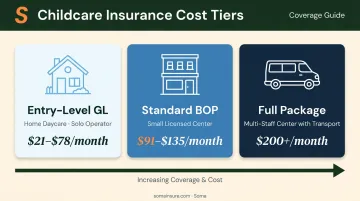
| Coverage Tier | Operation Type | Typical Monthly Cost |
|---|---|---|
| Entry-level GL | Home daycare, solo operator | $21–$78/month |
| Standard BOP | Small licensed center | $91–$135/month |
| Full package | Multi-staff center with transport | $200+/month (varies widely) |
Full Coverage Package
A comprehensive daycare program covers more than GL and property. Full coverage typically includes:
- General liability
- Professional liability (E&O)
- Workers' compensation
- Commercial property
- Abuse and molestation liability
- Commercial auto (if transporting children)
- Umbrella/excess liability
- Cyber liability (if storing digital child records)
The premium difference between basic and full coverage is usually modest. The financial risk difference is not. Even an unfounded abuse or molestation claim can generate six-figure legal defense costs — costs a standard GL policy won't cover.
What Types of Insurance Do Daycares Need?
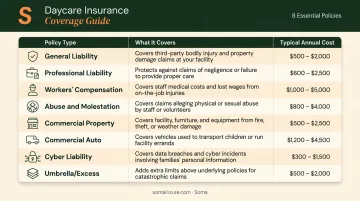
Daycares need a layered insurance approach because no single policy covers all their exposures. Here's a reference overview:
| Policy | What It Covers | Typical Annual Cost |
|---|---|---|
| General Liability | Third-party bodily injury, property damage, personal injury | $400–$1,500+ (home); higher for centers |
| Professional Liability | Negligence, inadequate supervision claims | ~$99/month (Insureon average) |
| Workers' Compensation | Employee injury, medical costs, lost wages | ~$31–$61/month (NEXT: 34% of daycare customers) |
| Abuse & Molestation | Legal defense and settlements from abuse allegations | Varies; often excluded from standard GL |
| Commercial Property | Building, equipment, supplies | Varies by facility size |
| Commercial Auto | Child transportation by van or bus | Varies by vehicle count and route |
| Cyber Liability | Data breaches, ransomware, online enrollment platforms | Varies by data volume |
| Umbrella/Excess | Additional limits above base policies | Varies by underlying limits |
General Liability Insurance
This is the foundation for any daycare. It covers third-party bodily injury (a child injured on premises), property damage, and personal injury claims. Many states require it for licensing — though requirements vary significantly. Tennessee, for example, requires $300,000 per occurrence/$300,000 aggregate for family and group homes, and $500,000/$500,000 for licensed centers — not the $1M/$2M often cited as a universal standard.
Professional Liability Insurance
Also called errors and omissions (E&O), this covers claims of negligence or inadequate supervision — distinct from GL's handling of physical accidents. Worth carrying regardless of program type, since supervision claims can arise at any operation. Insureon lists an average of $99/month across human and social services businesses.
Workers' Compensation Insurance
Workers' comp covers employee medical costs and lost wages from work-related injuries — a staff member injuring their back lifting a child, for instance. It's legally required in nearly every state for any business with employees. Texas is the primary exception where most private employers can opt out, though employers who opt out face specific state reporting requirements. Always verify your state's threshold and exemption rules before assuming you're not required to carry it.
NEXT Insurance reports 34% of daycare customers paid $31–$61/month for workers' comp.
Abuse and Molestation Insurance
Standard GL policies frequently exclude abuse and molestation claims entirely — yet this is among the most commonly overlooked gaps in daycare coverage. This policy handles legal defense costs and settlements from allegations against staff, regardless of whether those allegations prove founded.
State mandates vary. Tennessee requires $100,000 per occurrence/$300,000 aggregate for all licensed child care agencies; Washington DC similarly lists it as required proof of coverage. For states that don't mandate it, operating without this coverage leaves a significant uninsured exposure.
Additional Coverage Options
Beyond the core policies above, most daycares will need at least one of the following:
- Commercial property — covers the building, equipment, and supplies for facilities operating from a dedicated space
- Commercial auto — required if transporting children by van or bus; Tennessee requires $300,000 combined single limit for transporting homes and $500,000 for centers, plus $5,000 in child medical payments
- Cyber liability — relevant for any daycare storing digital child health records or using online enrollment platforms; covers data breaches, ransomware, and regulatory response costs
- Umbrella/excess — extends liability limits above base policies, useful for centers with high enrollment or state-mandated higher limits
Key Factors That Affect Daycare Insurance Costs
Insurers conduct a risk evaluation of each daycare before setting premiums. These are the primary drivers.
Operation Type and Scale
Home-based operations with few children represent a lower risk profile. Larger commercial facilities result in higher premiums due to greater liability exposure. Insurers typically ask about total child capacity and facility square footage.
Ages of Children Served
Insureon's daycare insurance data notes that providers responsible for infants pay higher premiums than those serving school-age children. Supervision intensity is greater and incident severity potential is higher with younger children. Soma identifies infant care as "the hardest segment to insure" — a category that standard markets routinely decline or heavily surcharge.
Staff Count
More employees means higher workers' comp costs (calculated on payroll) and greater professional liability exposure. Carriers also evaluate whether the daycare conducts background checks on staff. Underwriting applications from carriers like PHLY and Markel specifically ask about criminal background screening frequency, which can affect quote eligibility.
Services Offered
Transportation, overnight care, field trips, swimming, and specialized programs each add distinct risk exposures. Transportation is one of the most consistent triggers for higher premiums or carrier declinations in the standard market.
Location and Claims History
Urban areas and states with active litigation environments carry structurally higher GL and professional liability premiums. A prior claim raises renewal premiums; a clean record can work in your favor. Choosing a higher deductible lowers the premium but increases out-of-pocket cost per claim, a trade-off worth evaluating based on your cash flow.
How to Estimate the Right Daycare Insurance Budget
The right budget matches your actual risk profile — not the minimum needed to satisfy a licensing requirement.
Start by mapping out your operation before getting quotes. Answer these questions:
- What does my state require for licensing? Requirements vary significantly by state and provider type.
- Do I have employees? If yes, workers' comp is almost certainly required.
- Do I transport children? If yes, commercial and hired/non-owned auto coverage is essential.
- Do I own or lease the facility? If yes, commercial property coverage is needed.
- Do I serve infants or toddlers? If yes, expect higher premiums and fewer standard market options.
- Do I store digital child records or use online enrollment? If yes, cyber liability should be on your list.
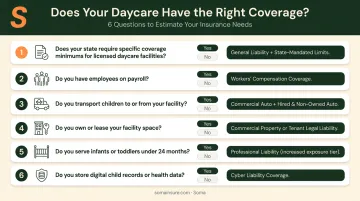
Each "yes" adds a coverage line — budget for it.
Once you know what you need, getting the right quotes fast matters — especially when licensing deadlines are involved. Soma places daycare coverage across all of these lines (GL, professional liability, abuse and molestation, workers' comp, commercial auto, and cyber) through specialty carriers that specifically write childcare risk. One application covers every policy line, so there's no chasing multiple brokers or waiting on carriers that don't understand the space.
Common Mistakes Daycare Owners Make When Buying Insurance
Three coverage mistakes come up repeatedly among daycare operators — and each one can leave a business exposed when a real claim hits.
- Assuming homeowners insurance covers childcare activities
- Skipping abuse and molestation coverage
- Choosing the cheapest policy without checking exclusions
Relying on Homeowners Insurance
Home-based daycare operators frequently assume their homeowners policy extends to childcare activities. It doesn't. The Texas Department of Insurance states directly that because a listed family home daycare is a business, homeowners insurance will not cover losses related to it.
Maryland's Insurance Administration confirms the same: standard homeowners policies generally do not cover claims from paid family childcare activities. Maryland law only requires insurers to offer registered providers a minimum of $300,000 in liability coverage — which may not hold up against a serious claim.
Home-based operators need a separate commercial liability policy or a qualifying business endorsement with adequate limits.
Skipping Abuse and Molestation Coverage
Many daycare operators assume this is bundled into general liability. Most GL policies explicitly exclude it. Given that even unfounded allegations generate significant legal defense costs, omitting this coverage is one of the costliest coverage gaps a daycare can have.
Choosing the Cheapest Policy Without Reading the Exclusions
A low-premium quote may omit professional liability, exclude abuse and molestation, or carry sub-standard limits that won't hold up against a real claim. Always compare what a policy excludes — not just what it includes — before purchasing based on price alone.
Conclusion
Daycare insurance costs vary based on operation type, services offered, staff count, location, and the policies purchased. A solo home-based provider watching school-age children and a licensed commercial center running infant care with a van and six employees are not in the same insurance category — and shouldn't be budgeted as if they are.
The right coverage accounts for every real exposure your operation faces, not just the most obvious ones. Daycares operating with coverage gaps — particularly around abuse and molestation or professional liability — face financial risks that can far exceed what they saved on a cheaper premium.
Soma works with multiple specialty carriers that write daycare coverage, which means one application gets you quotes across carriers — not just the one a captive agent can offer. That comparison is how you find the right balance of price and protection for your specific operation.
Frequently Asked Questions
How much is business insurance for a daycare?
General liability for a home daycare typically runs $56–$78/month for most operators, based on NEXT Insurance data. Commercial daycare centers pay more, with GL averaging around $91/month per Insureon's displayed figures. Total annual costs for a comprehensive coverage package depend heavily on staff count, services offered, and whether transportation or infant care is involved.
What type of insurance do daycares need?
Core policies include general liability, professional liability, workers' compensation, commercial property, and abuse and molestation coverage. Commercial auto is required if you transport children; cyber liability is worth adding if you store digital health records or use online enrollment platforms.
Does homeowners insurance cover a home daycare?
No. Standard homeowners policies exclude business activities, including paid childcare — Texas DOI and the Maryland Insurance Administration both confirm this. Home-based daycare operators need a separate commercial liability policy with limits adequate for a real claim.
Is workers' compensation required for daycare employees?
Yes, in nearly every state. Texas is the primary exception, where most private employers can opt out — though nonsubscribers carry specific state obligations. Workers' comp covers medical costs and lost wages when staff injuries occur from lifting, repetitive tasks, or illness exposure.
Does daycare insurance cover abuse and molestation claims?
Standard general liability policies typically exclude them. Separate abuse and molestation coverage is essential — it covers legal defense costs and settlements from allegations regardless of whether claims are ultimately proven, and defense costs alone can be substantial.
How can I lower my daycare insurance costs?
Start by bundling multiple policies with one carrier, maintaining a clean claims history, and documenting staff training and safety protocols. Running background checks on all employees and comparing quotes across specialty carriers through a broker also help. A slightly higher deductible can reduce premiums if your cash flow can absorb per-claim costs.