Introduction
A single construction site incident can trigger six-figure losses in seconds. Fire damage at construction sites causes an average of $376 million in direct property losses annually, and equipment and material theft costs the industry up to $1 billion yearly.
Third-party injury claims compound that exposure further — claim severity has surged, adding $231 billion to $281 billion to liability losses between 2015 and 2024.
Despite these numbers, many construction businesses treat builders risk and general liability as equivalent coverage — they're not. Builders risk protects the physical project and materials during construction. General liability protects against third-party injury and property damage claims. Getting that distinction wrong means the right loss hits the wrong policy, and you're left covering the gap.
Key Takeaways
- Builders risk is a temporary, project-based policy covering physical damage to structures under construction, including materials and equipment
- General liability is an ongoing policy covering third-party bodily injury, property damage, and advertising injury claims across all work locations
- The two policies are complementary, not interchangeable — builders risk protects the structure itself, while general liability covers harm to people and third-party property
- Builders risk is tied to a single project and expires at completion; general liability runs continuously across all your work
- Most contractors need both to be fully protected
Builders Risk vs. General Liability: Quick Comparison
The two policies differ fundamentally in what they protect, who they cover, and how long they last.
What Each Policy Protects:
- Builders risk: The physical structure, building materials, equipment, and temporary structures at a construction site
- General liability: Third parties (clients, visitors, vendors) who suffer bodily injury or property damage due to your operations
Policy Duration and Cost Structure:
- Builders risk: Project-based; typically priced at 1% to 5% of total construction value; ends at project completion
- General liability: Ongoing annual policy; cost varies by business size, revenue, and claims history; renews yearly
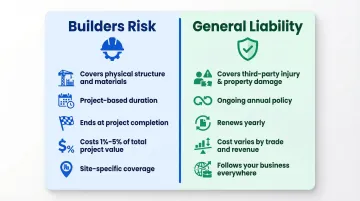
Builders risk is site-specific, covering only the designated construction location. General liability follows your business wherever work happens: a client's home, a commercial site, or a public space.
What is Builders Risk Insurance?
Builders risk insurance — also called "course of construction insurance" — is a specialized property insurance policy covering a building or structure during active construction or renovation. It bridges the gap between standard commercial property insurance (which doesn't cover work in progress) and the real financial exposure on a live construction site.
What Does Builders Risk Insurance Cover?
Builders risk policies cover a wide range of physical property and project-related costs:
- Physical damage to the building or structure being built
- Building materials (on-site, in transit, and in storage)
- Temporary structures like scaffolding and cribbing
- Installed fixtures, wiring, and machinery
- Theft and vandalism of materials on the job site
- Soft costs like construction delays or debris removal (with extended coverage)
Coverage limits are typically tied to the total completed value of the project. Extended coverage options can include equipment breakdown, testing, and modular components. Some policies also cover materials owned by others while located at the insured's site.
What Is NOT Covered by Builders Risk Insurance
Builders risk does NOT cover:
- Third-party bodily injury or property damage claims (that's general liability's job)
- Employee injuries, which fall under workers' compensation
- Floods, earthquakes, and hurricanes — excluded from most standard policies
- Government action, war, or collapse caused by design flaws
- Any damage occurring after project completion or occupancy
Once a project is complete and occupied, coverage ends — which is why coordinating the handoff to a permanent commercial property policy matters.
Who Purchases Builders Risk Coverage?
Either the general contractor or the property owner typically purchases builders risk insurance, with responsibility defined in the construction contract. The AIA A201-2017 standard form defaults to the Owner, while ConsensusDocs 200 requires the Constructor (General Contractor).
Lenders universally require builders risk insurance for financed construction projects. Fannie Mae requires coverage equaling "at least 100% of the completed value, on a non-reporting basis" before closing financing.
What is General Liability Insurance?
General liability (GL) insurance is an ongoing, year-round policy that protects a business from third-party claims of bodily injury, property damage, personal injury, and advertising injury. Unlike builders risk — which is tied to a specific project and site — GL follows the contractor wherever they work: a client's home, a commercial property, or a public space.
What Does General Liability Insurance Cover?
Core covered scenarios include:
- A client or visitor injured on a job site (slip-and-fall)
- Damage your crew accidentally causes to a client's existing property (breaking a water main during renovation)
- Product liability claims arising from completed work
- Personal and advertising injury claims such as defamation or copyright infringement
GL covers legal defense costs, settlements, and court-ordered judgments. Under standard policy language, defense costs are paid as "Supplementary Payments" — meaning outside the policy limits, so legal fees don't eat into the money available for settlements.
Most states require general contractors to carry GL as a condition of obtaining a business license. Many clients and contracts mandate a minimum coverage limit — commonly $1 million per occurrence — before work can begin.
What Is NOT Covered by General Liability Insurance
GL is built to protect third parties, not the contractor's own operations. It does not cover:
- Damage to the contractor's own property, tools, or equipment
- Employee injuries (workers' compensation handles this)
- Errors in professional advice or design (covered by professional liability/E&O)
- Damage to the structure being built (that's builders risk territory)
A contractor who relies solely on GL leaves their in-progress work, tools, and on-site materials completely unprotected — which is exactly the gap builders risk is designed to fill.
Builders Risk vs. General Liability: Key Differences
The core distinction comes down to what each policy protects: builders risk is a property insurance policy — it pays to repair or replace physical things. General liability is a casualty policy — it pays when your business is held legally responsible for harming someone else.
Real-World Scenario Comparison:
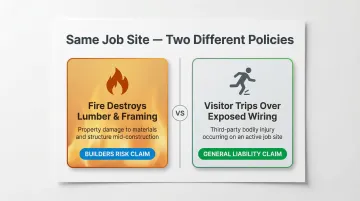
- Fire destroys lumber and installed framing on your job site → Builders risk claim
- Subcontractor's visitor trips over exposed wiring and breaks their arm → General liability claim
Both events happen on the same job site, but they trigger entirely different policies — illustrating why having only one leaves a critical gap.
Coverage Geography:
- Builders risk: Site-specific, covering only events at the designated construction site named in the policy
- General liability: Extends to any location where your business operations take you
The financial structure of each policy reflects this difference in scope.
Policy Duration and Financial Structure:
- Builders risk: Temporary, project-specific policy ending at project completion or occupancy; every new project may require a new policy; costs 1% to 5% of total completed project value
- General liability: Continuous annual policy renewing regardless of individual projects; average annual premiums range from $684 for electricians to $3,200 for roofers for a $1M/$2M policy
Do You Need Both Policies?
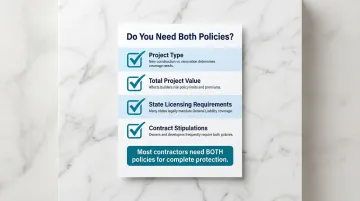
For most contractors, general contractors, subcontractors, and property developers, carrying both builders risk and general liability insurance is the industry standard — not a luxury. The two policies work together: one protects the physical asset being built, the other protects the business from liability claims while building it.
Relying on just one leaves gaps — either the physical asset is exposed or the business is open to liability claims.
Key Factors Determining Your Specific Needs:
- Whether the project is new construction or a renovation
- The total project value (affects builders risk limits)
- Your state's licensing requirements (many states mandate GL to hold a contractor's license)
- Contract stipulations from property owners or developers who often require both policies before work begins
Once you know which coverage your project requires, the next step is finding both policies quickly. Soma works with hundreds of carrier partners — including Chubb, Liberty Mutual, Markel, and Nationwide — to help construction businesses get the right combination of coverage, often with a single application. Reach out for a quote tailored to your project type and risk profile.
Conclusion
Builders risk and general liability aren't competing options — they answer different questions. Builders risk asks "what happens if the project itself is damaged?" General liability asks "what happens if someone else is harmed because of my work?" Most construction operations face both risks at once, which is why both policies belong in a complete coverage strategy.
The gaps are expensive either way:
- No builders risk on a large project means absorbing fire, theft, or storm damage out of pocket
- No general liability means a single lawsuit from an injured visitor could threaten the entire business
Work with a broker who understands construction coverage to confirm your policies match the scope and location of your project — before the next job starts.
Frequently Asked Questions
What is the difference between general liability and builder's risk?
General liability covers third-party bodily injury and property damage claims (people harmed by your operations), while builders risk covers physical damage to the structure and materials during construction. They protect different things and are typically both needed on a construction project.
Is builder's risk the same as property insurance or liability insurance?
Builders risk is a form of property insurance — not liability insurance. It covers the physical structure and materials under construction, similar to how commercial property insurance covers a finished building, but specifically designed for the construction phase.
What is not covered by a builder's risk policy?
Builders risk typically excludes employee injuries, third-party bodily injury claims, flooding, earthquakes, design errors, and damage after project completion or occupancy. Contractors need separate workers' compensation and general liability policies to cover these gaps.
Who pays for builders risk insurance?
Responsibility is defined in the construction contract — either the general contractor or property owner can purchase it. In some cases, both parties share the cost, or a project lender may require the owner to carry it.
How much does a $1,000,000 general liability insurance policy cost?
The cost varies widely based on business size, revenue, trade type, and claims history. Small contractors typically pay between $684/year for electricians and $3,200/year for roofers for a $1M per occurrence / $2M aggregate policy. Your actual premium depends on your trade, payroll, and loss history.
Do contractors carry builder's risk insurance?
Contractors — especially general contractors — often purchase builders risk coverage, but it depends on the contract and project type. Property owners or developers may also be required to carry it. Confirming responsibility before work begins prevents either party from being left uninsured.