Introduction
Picture this: a customer slips on a wet floor in your retail store and breaks their wrist. On the same day, an employee throws out their back lifting inventory in your warehouse. Two injuries, same day — but which insurance policy covers which claim?
That confusion costs business owners thousands of dollars in uncovered claims every year. The average slip-and-fall claim now costs $45,000, while the average workers' compensation claim exceeds $47,000. Without the right coverage in place, either incident could devastate your business financially.
Knowing which policy covers which situation is what protects your business when it matters most. This guide breaks down what each policy covers, who they protect, what they cost, and how to decide whether you need one or both.
Key Takeaways
- General liability protects your business from third-party claims (customers, clients, vendors) for bodily injury, property damage, and advertising injury
- Workers' comp covers employees for work-related injuries — medical costs, lost wages, and death benefits
- These policies protect entirely different groups with no overlap
- Workers' comp is legally required in most states once you hire employees; general liability isn't mandated but often contractually required
- Most businesses need both to avoid critical coverage gaps
General Liability vs. Workers' Comp: Quick Comparison
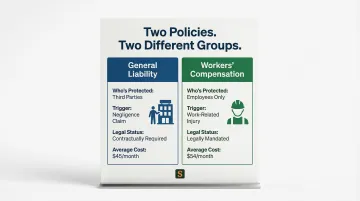
| Feature | General Liability (GL) | Workers' Compensation (WC) |
|---|---|---|
| Who's Protected | Third parties (customers, clients, vendors, public) | Employees only |
| Typical Monthly Cost | $45/month | $54/month |
| Legally Required | No (but often required by contracts/leases) | Yes, in 49 states once you have employees |
| Claim Trigger | Third party alleges your business caused harm | Employee files claim for work-related injury |
| Fault Basis | Negligence/fault-based system | No-fault system |
Both policies cover bodily injury, but they protect entirely different people. A customer hurt on your premises triggers GL. The same fall involving one of your employees triggers WC. That distinction — who got hurt — is where most business owners get tripped up.
What is General Liability Insurance?
General liability insurance (also called commercial general liability or CGL) protects your business against claims from people outside your company — customers, clients, vendors, or anyone else who isn't on your payroll.
What GL Covers
GL covers four core exposures:
- Bodily injury to third parties — pays medical costs and legal defense when a customer or client gets hurt on your premises or because of your operations
- Property damage to others — covers repair or replacement when you damage a client's property
- Personal and advertising injury — defends against libel, slander, copyright infringement, or false advertising claims
- Products liability — applies when goods you sell or manufacture cause harm to someone
What GL Does NOT Cover
Business owners often assume GL is comprehensive. It's not. Standard policies exclude:
- Employee injuries (that's workers' comp)
- Professional errors or advice (that's E&O/professional liability)
- Damage to your own business property (that's commercial property insurance)
- Auto accidents involving business vehicles (that's commercial auto)
Real-World GL Scenarios
Retail: A customer slips on a wet floor in your store and breaks their ankle. GL covers their medical bills and your legal defense if they sue.
Construction: Your contractor accidentally damages a client's hardwood flooring during a renovation. GL pays for the replacement — this is exactly the third-party property damage coverage GL is built for.
Hospitality: A patron claims they got food poisoning at your restaurant and files a lawsuit. GL covers legal defense costs and any resulting settlement.
Trucking: During a delivery, your driver's hand truck damages a client's loading dock door. Note that this falls under GL — not your commercial auto policy, which only applies to vehicle accidents themselves.
Use Cases for General Liability
GL is non-negotiable for:
- Any business with in-person customer interaction
- Companies working on client property
- Businesses with physical storefronts
- Service providers who advertise or sell products
General contractors and commercial landlords require certificates of insurance showing GL coverage before signing contracts. Without it, you're effectively locked out of those opportunities — and personally exposed to any claim that arises.
What is Workers' Compensation Insurance?
Workers' compensation is a state-regulated insurance program that provides benefits to employees injured or made ill by their job. It replaces the employee's right to sue the employer in most cases, creating a no-fault system that protects both parties without the delay and cost of a lawsuit.
What WC Pays
Four key benefit categories:
- Medical expenses: treatment, surgery, hospital stays, and rehabilitation for work-related injuries
- Lost wages: typically two-thirds of the worker's average weekly wage during recovery
- Disability benefits: payments for temporary or permanent impairment, partial or total
- Death benefits: funeral costs and ongoing support for the employee's family
Employer's Liability Component
Most WC policies include a second part: Employer's Liability Insurance. This protects your business if an injured employee sues you for negligence beyond the standard WC claim — for example, if a third party files an "over-action" claim or family members sue for loss of consortium.
Legal Requirements
Workers' comp is mandatory in 49 states once you have at least one employee. Texas is the only state allowing private employers to opt out entirely.
Strictest requirements: California, Nevada, and Wyoming require coverage the moment you hire your first employee, including part-time workers.
Monopolistic states: North Dakota, Ohio, Washington, and Wyoming operate state-run funds — private insurers can't sell WC policies in these states.
Severe penalties for non-compliance: In California, failing to carry required WC triggers immediate Stop Orders halting operations, fines up to $100,000 for compensable injuries, and misdemeanor charges carrying up to one year in jail.
What WC Does NOT Cover
Standard exclusions include:
- Injuries from employee intoxication or drug use
- Injuries from willful misconduct or intentional self-harm
- Injuries to independent contractors (in most states)
- Non-work-related illnesses
Gray area alert: The contractor vs. employee classification is a common dispute. Misclassifying employees as contractors to avoid WC requirements can result in back-pay of premiums, regulatory fines, and personal liability for any injury claims filed during the misclassification period.
Use Cases for Workers' Compensation
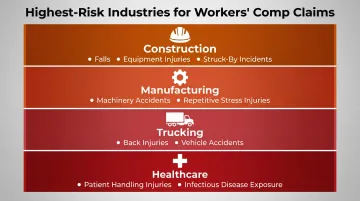
Highest-risk industries:
- Construction workers face falls, equipment injuries, and struck-by incidents
- Manufacturing employees deal with machinery accidents and repetitive stress injuries
- Trucking involves back injuries from loading and vehicle accidents on the job
- Healthcare workers encounter patient handling injuries and infectious disease exposure
Even lower-risk industries need WC. Office workers file claims for repetitive stress injuries, break room slips, and increasingly, mental health conditions related to workplace stress.
Key Differences: General Liability vs. Workers' Comp
Who Is Covered
- GL protects your business from claims made by third parties — customers, clients, vendors, and the general public
- WC protects your employees for injuries or illnesses that happen in the course of their work
Example: A delivery driver for your company slips on ice at a customer's loading dock. If the driver is injured, that's a WC claim. If a customer standing nearby also slips and gets hurt, that's a GL claim.
What Triggers a Claim
GL: A third party alleges your business caused them harm, filing a lawsuit or legal demand. You're dealing with a fault-based system where negligence must be proven.
WC: An employee files a claim for a work-related injury. It's a no-fault system — the employee doesn't need to prove you were negligent, and you can't argue they were at fault.
Legal vs. Contractual Requirements
WC is a statutory requirement in nearly every state the moment employees are on payroll. Non-compliance exposes you to fines, penalties, and in some states, criminal charges.
GL carries no universal legal mandate, but contracts, leases, client agreements, and licensing boards — especially in construction and professional services — routinely require it before you can work.
How you're required to carry each coverage shapes how their costs are structured.
Cost Structure
GL premiums are based on:
- Annual revenue
- Number of employees
- Industry risk class
- Coverage limits and deductibles
- Claims history
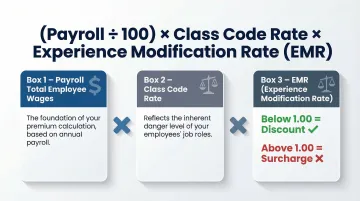
WC premiums follow a different formula entirely: (Payroll ÷ 100) × Class Code Rate × Experience Modification Rate
Each variable plays a specific role: payroll is your total employee wages, class codes are NCCI-assigned ratings based on job risk, and the EMR compares your claims history to the industry average — below 1.00 earns a discount, above 1.00 adds a surcharge.
Current median costs for small businesses:
- General Liability: $45/month ($538/year)
- Workers' Compensation: $54/month ($643/year)
High-risk industries like construction or manufacturing can pay multiples of these figures, while low-risk office-based businesses often land well below them.
Do You Need Both?
Short answer: Yes, if you have employees.
GL and WC are complementary, not interchangeable. Without GL, a single customer lawsuit can bankrupt your business. Without WC, an employee injury exposes you to direct liability and regulatory penalties.
The Coverage Gap Scenario
- GL only: Standard GL policies explicitly exclude employee injuries. Medical bills, lost wages, and any resulting lawsuit fall entirely on you.
- WC only: No protection when a client is injured on your premises or their property is damaged. A slip-and-fall lawsuit from a customer could cost $45,000 or more with no coverage.
A 2025 Hiscox report found that 77% of U.S. small businesses are underinsured, with many mistakenly believing their GL policy covers employee injuries or property damage to their own assets.
Coverage for Sole Proprietors
For solo operators with no employees, GL is typically the minimum baseline. However, even one-person businesses in physical trades should consider WC for themselves — standard health insurance often excludes work-related injuries, leaving you exposed.
Once you hire even one part-time employee, WC should be in place immediately.
How Soma Can Help
Soma works with businesses across trucking, construction, hospitality, and manufacturing — including operations that are difficult to insure — to place both GL and WC coverage through a single application. With access to hundreds of carrier partners including Chubb, Liberty Mutual, Markel, Kinsale, and Nationwide, Soma identifies the right fit and binds coverage quickly, without requiring you to contact multiple brokers.
Frequently Asked Questions
Is general liability insurance the same as workers' comp?
No. These are two completely separate policies. GL covers third-party claims from customers or clients for bodily injury and property damage. WC covers employee injuries, medical costs, and lost wages. They protect different people with no overlap.
What is typically not covered by general liability insurance?
GL does not cover:
- Employee injuries — that's workers' comp
- Professional errors or advice — that's E&O insurance
- Damage to your own business property — that's commercial property insurance
- Auto accidents involving business vehicles — that's commercial auto insurance
What is an example of general liability coverage?
A customer visiting your retail store slips on a wet floor and breaks their wrist. GL covers their medical expenses and your legal defense costs if they file a lawsuit against your business.
What is the average cost of general liability insurance for a small business?
Current data shows a median cost of $45 per month ($538 annually) for small businesses. Actual premiums vary by industry, revenue, location, and coverage limits.
How much does workers' compensation insurance cost for a small business?
The median cost is $54 per month ($643 annually) for low-risk small businesses. WC costs are primarily driven by payroll size, job classification codes, and your business's claims history.
Why would a trucker need general liability insurance?
Commercial auto insurance covers accidents involving the truck itself. GL fills the gaps — covering third-party bodily injury or property damage during loading/unloading, at delivery sites, and from business operations that don't involve vehicle movement. For trucking and freight businesses, both policies together are essential.