

Introduction
A marketing consultant delivers a six-month brand strategy to a client. Three months later, the client's sales decline, and they file a lawsuit claiming the consultant's advice caused $200,000 in lost revenue. The consultant assumes their general business insurance will cover the claim — but it won't. General liability policies explicitly exclude financial harm arising from professional advice, leaving the consultant personally exposed to both legal defense costs and potential damages.
If you provide advice, services, or expertise for a fee, that gap in coverage applies to you. Professional liability insurance — also called errors and omissions (E&O) insurance — exists specifically to cover claims of negligence, mistakes, or failure to deliver promised results.
This guide covers who needs it, what it covers, when it's legally required, and what it costs.
TLDR:
- Professional liability insurance covers legal defense and settlements for claims alleging negligence or errors in professional services
- Consultants, healthcare providers, IT professionals, attorneys, accountants, designers, and engineers all face potential claims
- Even baseless lawsuits cost an average of $87,338 to defend in medical malpractice cases
- Many states, clients, and contracts legally require proof of coverage before engagement
- Annual premiums range from $500 to $2,500 for most small businesses, scaling higher for medical and legal professionals
What Is Professional Liability Insurance?
Professional liability insurance is a policy that protects businesses and individuals from claims alleging negligence, mistakes, omissions, or failure to deliver a promised service. The International Risk Management Institute (IRMI) defines it as coverage designed to protect professionals from liability arising from errors, omissions, mistakes, or negligence in performing their professional services.
Why Different Names for the Same Coverage
This coverage is also commonly called errors and omissions (E&O) insurance or malpractice insurance. The terminology varies by industry convention:
- Malpractice — Reserved for medical and legal professionals
- E&O — Used for technology, real estate, and consulting sectors
- Professional liability — The umbrella term used across all other service professions
Despite the different names, these policies provide the same core protection: financial coverage when a client alleges your professional work caused them harm.
Not Included in Standard Business Policies
Regardless of what it's called, this coverage must be purchased separately. Professional liability is explicitly excluded from standard Business Owner's Policies (BOP) and in-home business policies. The Insurance Services Office (ISO) standard BOP program covers general property and liability but requires separate endorsements or standalone policies for professional services.
Who Needs Professional Liability Insurance?
The core principle is straightforward: anyone who provides professional services, advice, or expertise for a fee is exposed to claims — regardless of whether they made an actual error. Even a baseless lawsuit can cost tens of thousands of dollars to defend. According to the Washington State Office of the Insurance Commissioner, the average defense cost for a medical malpractice claim is $87,338, jumping to $120,371 when a lawsuit is formally filed.
Primary Professional Categories That Need PLI
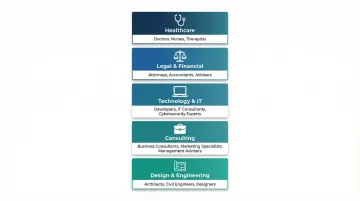
Each profession carries its own claim profile — the common thread is that a client paid for expertise and believes something went wrong.
Healthcare professionals — patient care decisions, treatment outcomes, misdiagnosis:
- Doctors and surgeons
- Nurses and nurse practitioners
- Physical therapists and chiropractors
- Mental health therapists and counselors
Legal and financial professionals — negligent advice that leads to measurable financial loss:
- Attorneys and paralegals
- Accountants and CPAs
- Financial advisors and tax preparers
- Investment advisors and RIAs
Technology and IT professionals — system failures, data errors, or project scope disputes:
- Software developers and SaaS companies
- IT consultants and cybersecurity firms
- Systems integrators and cloud service providers
Consulting and management professionals — strategy advice that clients allege caused harm:
- Business consultants and HR consultants
- Marketing agencies and PR firms
- Management consultants and strategy advisors
Design and engineering professionals — design errors, specification disputes, or cost overruns:
- Architects and structural engineers
- Interior designers and landscape architects
- Civil engineers and mechanical engineers
Solo Practitioners Are Especially Vulnerable
Even a single self-employed professional with no employees can face the same magnitude of claims as a large firm. In fact, solo practitioners are often more financially vulnerable without this coverage. The State Bar of California's 2024 Attorney Discipline Disparities Study found that solo practitioners accounted for the highest investigation rate (41%) across all firm sizes. Additionally, the American Bar Association notes that 70% of all insured legal malpractice claims are brought against lawyers in firms with one to five attorneys.
A solo consultant defending a $100,000 claim without insurance faces the full cost of legal fees, expert witnesses, and potential settlement — expenses that could bankrupt an independent practice.
That financial exposure is the same whether you run a one-person consulting firm or a mid-sized engineering company. Soma's Risk Management Team helps businesses in these categories find coverage fast — including hard-to-place professions that standard carriers often decline.
When Is Professional Liability Insurance Required?
Professional liability insurance isn't always optional — many professions face legal mandates, contract requirements, or licensing conditions that make coverage non-negotiable.
State-Level Legal Mandates
Some professions face explicit state-level requirements:
- Idaho requires active attorneys representing private clients to carry a minimum of $100,000 per occurrence / $300,000 annual aggregate in professional liability insurance
- Wisconsin requires defined healthcare providers to carry primary medical malpractice insurance of at least $1,000,000 per occurrence / $3,000,000 per policy year under Wisconsin Stat. ch. 655
- Oregon requires private practice attorneys to maintain $300,000 in coverage through the state's mandatory Professional Liability Fund (PLF)
These aren't suggestions — they're licensing requirements. Practicing without the mandated coverage can result in suspension or loss of professional license.
Client Disclosure Laws
Even when coverage isn't mandatory, some states require professionals to disclose when they lack it:
- California Rule of Professional Conduct 1.4.2 requires attorneys who lack PLI to inform clients in writing at the time of engagement if the representation will reasonably exceed four hours
- Washington and Alaska both require attorneys to provide written disclosure to clients if their malpractice insurance falls below $100,000 per occurrence and $300,000 in the aggregate
Contractual and Procurement Requirements
Even without a legal mandate, clients and government procurement processes routinely require proof of PLI before awarding contracts:
- The New York State Insurance Fund requires consultants to carry $2,000,000 per occurrence / $2,000,000 aggregate in PLI to bid on state consulting contracts
- The Texas State University System requires A/E firms to carry $1,000,000 per claim / $2,000,000 aggregate for competitive sealed proposals
- The Federal Acquisition Regulation (FAR) 52.236-23 explicitly holds Architect-Engineer contractors liable for damages caused by negligent performance
- Many industry memberships and certifications require active PLI coverage as a condition of membership — meaning a lapsed policy can cost you more than just a claim
What Does Professional Liability Insurance Cover — and What Doesn't It Cover?
What PLI Typically Covers
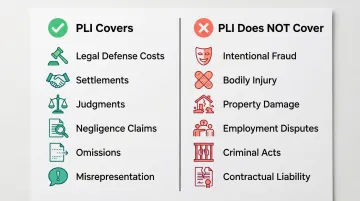
Professional liability insurance covers:
- Legal defense costs — Attorney fees, court costs, and expert witness expenses
- Settlements — Amounts paid to resolve claims before trial
- Judgments — Court-ordered damages when a professional is found liable
- Claims arising from:
- Negligence or errors in professional work
- Omissions or failure to perform promised services
- Misrepresentation or inaccurate advice
Defense costs alone can be substantial even when the professional is found not liable. CNA reports that the average expense payment for nursing claims closed without an indemnity payment is $17,915.
Understanding "Claims-Made" Policies
Most PLI policies are written on a "claims-made" basis, meaning the policy must be active both when the alleged incident occurred and when the claim is filed. The structure reflects professional errors' "long-tail" exposure — years can pass between delivering a service and discovering an error.
Key terms to understand:
- Retroactive date — The specified date from which coverage applies for past acts. Claims arising from services performed before the retroactive date are excluded, regardless of when the claim is made
- Tail coverage — Also known as an Extended Reporting Period (ERP), this allows an insured professional to report claims after a policy has expired or been canceled, provided the incident occurred during the active policy period
Professionals switching insurers need to be careful about coverage gaps. If your new policy has a retroactive date after your old policy's expiration, you could have a gap in coverage for work performed during the transition period.
Understanding how your policy is structured makes the exclusions easier to anticipate — here's what PLI won't protect against.
What PLI Does NOT Cover
Common exclusions include:
- Intentional wrongdoing or fraud — Deliberate acts or dishonest behavior
- Bodily injury and property damage — Covered under general liability insurance (medical malpractice is an exception: it covers bodily injury from professional negligence, which is why it's a specialized form of PLI)
- Employment disputes — Covered under Employment Practices Liability Insurance (EPLI)
- Criminal acts — No insurance covers illegal activity
- Contractual liability — Liability assumed under a contract beyond your normal professional duties
Policy Limits and Deductibles
Choosing the right limit matters — too low and a single judgment can exceed your coverage. The right limit depends on:
- Contract minimums required by clients or project agreements
- The revenue at risk if a client suffers a significant loss tied to your work
- The scale and complexity of services you deliver
- Industry standards
Most PLI policies feature "defense within limits," meaning the insurer's payment of attorney fees and court costs directly reduces the available policy limits left to pay potential settlements or judgments.
Professional Liability vs. General Liability Insurance
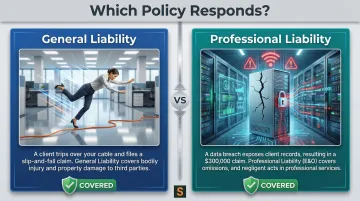
General liability insurance covers physical/third-party bodily injury and property damage claims. Example: A client slips and falls in your office, breaking their arm. General liability covers their medical bills and any lawsuit that follows.
Professional liability insurance covers financial harm claims arising from your professional advice or services. Example: An IT consultant recommends a server configuration that fails, causing a client's data breach and $500,000 in recovery costs. Professional liability covers the claim — general liability does not.
Consider an IT consultant working on-site at a client's office:
- General liability scenario: The consultant's laptop power cable stretches across a hallway. A client employee trips over it, falls, and suffers a concussion. General liability insurance covers the medical bills and legal defense.
- Professional liability scenario: The same consultant recommends a cloud storage solution that experiences a data breach, exposing the client's customer records. The client sues for $300,000 in notification costs, credit monitoring, and regulatory fines. Professional liability insurance covers this claim.
Do You Need Both?
Most service-based businesses need both policies because they face exposure on both fronts. Carrying only one leaves real coverage gaps. A consultant could face a slip-and-fall claim (general liability) and a negligent advice claim (professional liability) in the same week and need both policies to respond.
How Much Does Professional Liability Insurance Cost?
Professional liability insurance premiums vary widely based on several factors, but understanding the typical ranges helps set realistic expectations.
Typical Premium Ranges
For standard small businesses and independent professionals, annual premiums typically range from $500 to $2,500. The Hartford reports average minimum monthly premiums of $62 for standalone miscellaneous PLI, and $146 for technology E&O.
Premiums scale based on the profession's risk level. A graphic designer may pay a few hundred dollars annually, while the American Medical Association reports that high-risk medical specialists like OB/GYNs and general surgeons face annual premiums between $30,000 to over $243,000 annually, depending on the state.
Primary Factors That Affect PLI Premiums
- Profession risk level — structural engineering and medical specialties carry far higher exposure than marketing or design work
- Annual revenue — larger contracts mean greater potential damages if something goes wrong
- Team size — more people delivering services creates more opportunities for errors or omissions
- Policy limits and deductibles — higher limits and lower deductibles push premiums up
- Claims history — a prior claim can significantly increase what you pay at renewal
- Time in business — newer businesses typically pay more until they establish a track record

Opting for a higher deductible is one of the most practical ways to reduce premiums — just make sure the deductible amount is one you could realistically cover out of pocket if a claim arises.
Once you know what affects your rate, the next step is getting actual numbers. Soma works with multiple carriers to place professional liability coverage for businesses across industries, including those that are harder to insure — with quotes returned quickly rather than after weeks of back-and-forth.
Frequently Asked Questions
How much should I pay for professional liability insurance?
Cost varies widely based on industry, risk level, policy limits, and revenue. Most small businesses and independent professionals pay between $500 and $2,500 annually, though high-risk professions like surgeons or attorneys can pay $30,000 or more depending on specialty and location.
How much PI insurance do I need?
Coverage limits should reflect the size of contracts, client revenue at risk, and any contractual minimums. $1 million per occurrence / $2 million aggregate is a common starting point, but many industries and contracts require higher limits. Medical professionals typically need $1 million / $3 million to obtain hospital privileges.
Who needs professional liability insurance?
Any professional providing paid services, advice, or expertise — including consultants, healthcare providers, IT professionals, attorneys, accountants, designers, and engineers — faces potential claims and should carry PLI. Even solo practitioners are vulnerable to costly lawsuits.
Do I need professional liability insurance if I have an LLC?
Yes. An LLC protects personal assets from business debts but does NOT protect the business itself from professional liability claims. PLI covers legal defense costs and settlements that could otherwise deplete the LLC's assets. Professionals also remain personally liable for their own negligence.
Do I need both general liability and professional liability insurance?
Most service-based businesses need both. General liability covers physical harm claims — slip-and-fall, property damage — while professional liability covers financial harm from advice or services. Carrying only one leaves serious gaps in your coverage.