Daycare insurance is a category of commercial coverage built specifically around these risks. It's not one policy but a layered program combining general liability, professional liability, property coverage, workers' compensation, and several specialty add-ons. The right combination depends on whether your operation is home-based or a commercial center, how many children you enroll, and whether you have employees.
This guide covers what each core policy actually covers, which add-ons are worth considering, what standard policies typically exclude, and what drives your premium.
Key Takeaways
- Standard homeowners policies exclude business-related liability — home daycare operators need separate commercial coverage
- Most licensed daycare facilities must carry liability insurance as a condition of their operating license
- A complete daycare insurance program typically includes GL, professional liability, commercial property, and workers' comp
- Abuse and molestation coverage is a critical add-on — it's explicitly excluded from most standard GL policies
- Small daycares face real cyber exposure — ransomware appeared in 88% of breaches at organizations under 1,000 employees
Why Daycare Providers Can't Rely on Personal Insurance
This is where many home-based providers get caught off guard. Assuming a homeowners policy covers daycare activity is wrong, and discovering that gap during a claim is a costly mistake.
The Homeowners Policy Gap
The ISO HO 00 03 form (the standard homeowners policy) explicitly excludes liability arising from business activities at an insured location. It also caps business property at $2,500 on-premises and just $500 off-premises. Once you're being paid to care for other people's children, that's a business — and personal coverage stops applying.
Florida statute 627.70161 goes further, stating that residential property insurance does not cover family-daycare liability unless specifically added by endorsement. The NAIC's consumer guidance is direct: a person paid to provide daycare at home must purchase additional insurance.
Getting written confirmation from your homeowners carrier isn't enough. The gap in personal coverage is the reason a separate commercial policy is required — and for licensed centers, that requirement is written into state law.
The Licensing Requirement
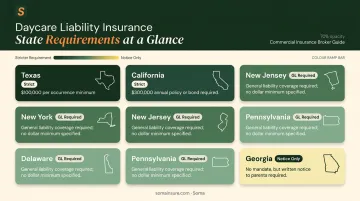
For commercial daycare centers, insurance is a compliance requirement, not just a financial safeguard. Most states tie liability coverage directly to childcare licensing:
- Texas requires at least $100,000 per negligence occurrence for licensed, registered, and listed operations
- California requires a $300,000 annual policy or bond (or signed parent affidavits as an alternative)
- New York, New Jersey, Delaware, and Pennsylvania all require documented general liability coverage — though without specifying dollar minimums
- Georgia does not mandate insurance but requires uninsured programs to provide written parent notice
Operating without proper coverage creates more than financial exposure. It can result in license suspension, revocation, or denial of renewal — shutting down your center entirely.
What Does Daycare Insurance Cover? Core Policies Explained
Most daycare insurance programs are built from four foundational policies. Here's what each one does and why it matters.
General Liability Insurance
General liability (GL) is the foundation. It covers:
- Third-party bodily injury — a child hurt on playground equipment, a parent who slips in your lobby, a visitor injured on your premises
- Third-party property damage — a parent's belongings damaged at your facility, or property damage you cause off-site
- Legal defense costs — attorney fees and court costs if a lawsuit is filed, typically paid outside the policy limits
GL covers incidents involving non-employees — children, parents, and visitors. It does not cover staff injuries (that's workers' comp) or professional errors like inadequate supervision (that's professional liability).
Texas requires a minimum of $100,000 per occurrence for licensed facilities. Many operators and lenders require higher limits — $1M per occurrence and $2M aggregate is a common commercial standard.
Professional Liability Insurance
Also called errors and omissions (E&O), professional liability covers claims that your negligence, failure to supervise, or professional error caused a child harm — even if the claim turns out to be unfounded.
A practical example: a parent sues alleging inadequate supervision led to their child's injury at your facility. Even if the claim has no merit, you still need a legal defense. Professional liability covers those defense costs and any resulting settlement.
These are separate policies for a reason — each covers a distinct category of risk:
- General liability — premises accidents (slip-and-falls, property damage, visitor injuries)
- Professional liability — supervision errors, failure-to-act claims, and professional negligence allegations
Commercial Property Insurance
Commercial property insurance covers your physical assets — building (if owned), furniture, cribs, toys, educational equipment, computers, and supplies — against fire, theft, vandalism, wind damage, and burst pipes.
Commercial water damage is among the most frequent and expensive small-business claims, with 75% of losses involving plumbing, HVAC, or appliance failures. A single burst pipe or HVAC failure can shut a facility down for days — or longer.
A Business Owners Policy (BOP) bundles GL and commercial property into one policy and often includes business interruption coverage — which replaces lost income if your daycare must close temporarily due to a covered property event. The Hartford specifically markets BOPs to daycare centers, and Insureon's pooled data puts the median BOP cost at $135/month for daycare businesses.
Workers' Compensation Insurance
Workers' comp covers medical expenses and a portion of lost wages for employees injured on the job. Childcare work is physically demanding — lifting children, moving furniture, being on your feet all day. Back injuries from lifting are a documented occupational hazard in this field.
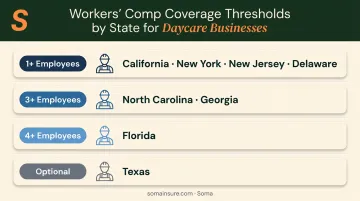
State requirements vary considerably:
| State | Threshold for Required Coverage |
|---|---|
| California | 1 or more employees |
| New York | 1 or more employees |
| New Jersey | 1 or more employees |
| Delaware | 1 or more employees |
| North Carolina | 3 or more employees |
| Georgia | 3 or more employees |
| Florida | 4 or more employees |
| Texas | Optional for most private employers |
Workers' comp also protects the employer — in most states, it's the employee's exclusive remedy, meaning they generally cannot sue the employer civilly for a covered workplace injury.
Additional Coverages That Strengthen Your Daycare's Protection
Beyond the core four, several specialty coverages address risks that are unique to childcare — and that standard policies often leave unaddressed.
Abuse and Molestation Coverage
This is the most critical add-on for any childcare operation. Standard GL policies explicitly exclude claims of physical or sexual abuse — endorsements like the ARK-GL-017 exclusion are common across the industry.
Abuse and molestation coverage responds to actual, threatened, or alleged acts — including allegations that are never proven. The coverage pays legal defense costs and settlements. Federal FY2023 data identified 1,000 child-daycare-provider perpetrators across all CPS cases — but the real risk for operators is that an allegation alone triggers costly legal proceedings.
Always ask your insurer or broker specifically about the abuse/molestation exclusion before purchasing any policy. Soma includes this as a standard component of its daycare insurance program — not an optional add-on you have to ask for separately.
Cyber Liability Insurance
Even a small daycare collects sensitive data: parent names, addresses, payment information, medical records, immunization histories, and custody arrangements. A stolen laptop or compromised billing system triggers breach notification requirements in multiple states, including California, Texas, New York, New Jersey, Florida, and Pennsylvania.
Notification thresholds vary: Texas requires reporting to the state AG within 30 days if 250 or more residents are affected; California triggers at 500. Cyber liability covers breach notification costs, credit monitoring for affected families, and associated legal fees.
Commercial Auto and Umbrella Coverage
Beyond liability and cyber risk, two additional coverages fill gaps that catch many operators off guard:
- Commercial auto — If your daycare transports children in a business-owned van, personal auto insurance won't cover it. Commercial auto covers accidents, injuries, and vehicle damage from business-related driving. Soma explicitly places this for programs transporting children by van or bus.
- Umbrella liability — Provides an additional layer of coverage above the limits of your existing GL and commercial auto policies. Useful for larger enrollment operations or facilities in areas where a single large judgment could exceed base policy limits.
What Daycare Insurance Typically Does Not Cover
Exclusions can leave serious gaps in coverage if you don't know where to look. Common exclusions across daycare policies include:
- Intentional acts of abuse: without a separate abuse/molestation endorsement, this is explicitly excluded from GL
- Motor vehicle use: accidents involving vehicles used during operations require commercial auto; GL alone won't respond
- Animal incidents: some carriers exclude incidents involving animals on the premises, particularly relevant for home-based operations with pets — check your specific policy terms
- Off-premises activities: field trips and outings may not be covered under a standard GL policy unless specifically included
Exclusions vary by carrier and policy form. Before purchasing any policy, review the exclusions section directly — don't rely on assumptions. Ask your broker specifically about:
- Abuse/molestation exclusions and available endorsements
- Whether field trips and off-premises activities are covered
- Communicable disease transmission (some policies exclude this)
- Coverage for incidents involving animals on the property
How Much Does Daycare Insurance Cost?
Premiums vary based on several factors. Insureon's pooled data for daycare businesses shows these median monthly costs:
| Coverage Type | Median Monthly Cost |
|---|---|
| General liability only | $91/month |
| Business owner's policy | $135/month |
| Professional liability | $99/month |
These are medians across a mix of daycare operation types and sizes — your actual premium will depend on your specific circumstances.
Key factors that affect your premium:
- Type of operation (home-based vs. commercial center)
- Number of children enrolled and age groups served (infant care is the hardest segment to insure)
- Number of employees and payroll
- Whether you transport children
- Coverage limits and deductibles selected
- Claims history
- State and location
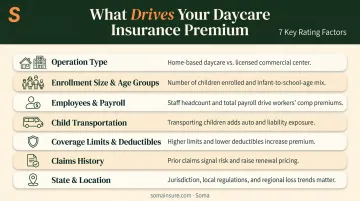
Higher deductibles lower your premium but increase out-of-pocket costs at claim time. Higher limits increase premiums but reduce financial exposure in a serious incident. For most daycare operators, insurance is a fixed cost of staying licensed and operational, not an optional expense.
Soma places daycare insurance across California, Texas, Florida, New York, and eight other states through specialty carriers that specifically underwrite hard-to-insure childcare risks — including infant care programs, faith-based operations, and multi-site franchises that standard markets often decline. One application is enough to compare options across carriers, without weeks of back-and-forth.
Frequently Asked Questions
How much does daycare insurance cost per month?
Monthly costs depend on operation type, enrollment size, and coverage selected. Based on Insureon's pooled daycare data, general liability runs around $91/month, a business owner's policy around $135/month, and professional liability around $99/month as median figures. Higher enrollment, prior claims, and specialized care (such as infant rooms) typically push premiums higher.
What does daycare insurance coverage include?
Core coverage includes general liability, professional liability, commercial property, and workers' comp. Common add-ons are abuse and molestation coverage, cyber liability, commercial auto, and umbrella policies — each addressing risks the base policy doesn't reach.
Is daycare insurance required by law?
Most states require licensed daycare facilities to carry minimum liability insurance as a condition of their operating license. Texas mandates at least $100,000 per occurrence; California requires a $300,000 annual policy or bond. Requirements vary significantly by state and facility type.
Does homeowners insurance cover a home daycare?
Standard homeowners policies exclude liability arising from business activities and cap business property at $2,500 on-premises. Home daycare operators generally need a separate commercial liability policy — personal coverage stops applying once you're being paid to care for others' children.
What does daycare insurance NOT cover?
Most standard policies exclude intentional abuse acts unless you add a specific endorsement, vehicle use during operations, and off-premises activities like field trips. Animal-related incidents may also be excluded depending on the carrier — always check the exclusions before binding coverage.