Insurance costs have been rising across the childcare sector. According to a January 2024 NAEYC survey of over 10,000 childcare professionals, 50% reported higher insurance costs in the preceding six months — a sector-wide pressure that home-based providers are not immune to.
What most providers don't know is that there's no fixed price for this coverage. Cost depends heavily on what you're buying, how many children you care for, whether you have employees, and where you operate. This article breaks down:
- Typical cost ranges by protection tier
- What each coverage type costs and covers
- The key factors that push premiums up or down
- The most common budgeting mistakes providers make
Key Takeaways
- Basic general liability for solo in-home providers typically runs $500–$1,500/year; full coverage packages can exceed $2,500/year
- Premiums rise with enrollment size, employee headcount, state mandates, and transportation services
- Homeowners insurance almost never covers paid daycare activities; providers need a separate commercial policy
- Skipping professional liability or abuse & molestation coverage creates serious gaps that standard GL won't fill
- Compare 3–5 quotes with identical coverage limits — it's the only reliable way to evaluate cost differences
How Much Does In-Home Daycare Insurance Cost?
There's no single price for in-home daycare insurance. Two providers in the same city can pay very different premiums based on how many children they serve, whether they employ staff, and what coverage limits they select.
That variability leads providers in two directions: underinsuring by assuming a homeowners policy is sufficient, or overbuying coverage they don't actually need. Knowing what each tier includes — and what it leaves out — is the starting point.
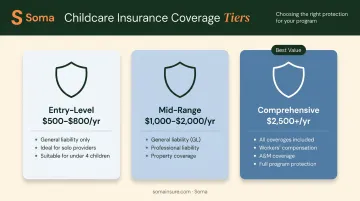
Typical Cost Ranges by Protection Tier
| Tier | Annual Cost | Best For | What's Included | |------|-------------|----------|-----------------|| | Entry-Level | $500–$800 | Solo providers, fewer than 4 children, no employees | General liability only: bodily injury, property damage, third-party claims | | Mid-Range | $1,000–$2,000 | Licensed providers with 4–6 children | GL + professional liability and/or business property; some bundle into a BOP | | Comprehensive | $2,500+ | Providers with employees, higher enrollment, or transportation | GL + professional liability + business property + abuse & molestation + workers' comp |
What's excluded at the entry level matters as much as what's included. A basic GL policy won't cover:
- Professional negligence claims
- Employee injuries
- Incidents involving transportation
Each added protection increases your premium. Skipping them creates coverage gaps that can result in out-of-pocket losses far exceeding the cost of the policy itself.
General liability for an in-home provider is typically less expensive than for a commercial daycare center, which faces higher foot traffic, greater staffing exposure, and more complex property risks.
Types of In-Home Daycare Insurance Coverage and Their Costs
Most home daycare providers need more than one policy to be adequately protected. Here's what each coverage type addresses and what it costs.
General Liability Insurance
The foundational policy for any in-home daycare. It covers:
- Third-party bodily injury (a child falls and breaks an arm at your home)
- Property damage caused to others
- Reputational harm claims such as defamation
Annual cost typically runs $500–$1,500 for in-home providers. The Hartford reports that most small businesses start with $1 million per occurrence / $2 million aggregate limits — a widely used benchmark, though not a legal mandate for every state.
Many states require proof of general liability as a condition of childcare licensure. The exact minimum varies — more on that in the factors section below.
Professional Liability (Errors & Omissions)
This coverage protects against claims of negligence or inadequate supervision. Think: a parent sues claiming a lapse in your oversight led to their child's injury. Standard GL won't cover that — professional liability will.
Annual cost typically runs $750–$1,200 for small professional service providers. This coverage is frequently skipped by new providers who reason that nothing has gone wrong yet. That logic fails the moment a good-faith mistake leads to a lawsuit — and the more children you enroll, the greater the exposure.
Business Property Insurance
Covers damage to daycare-specific equipment, learning materials, and home modifications used for business purposes. Homeowners insurance typically excludes business-use property beyond a low dollar threshold — often $2,500 or less.
Annual cost typically falls in the $500–$900 range. This coverage is particularly relevant for providers who have invested in playground equipment, commercial appliances, or structured learning tools.
Workers' Compensation and Additional Coverages
Beyond the core policies, three additional coverages affect your total cost and protection:
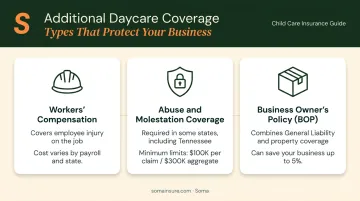
- Workers' comp: Required in most states the moment you hire even one employee. Covers medical expenses and lost wages for work-related injuries — a staff member injuring their back while lifting a child, for example. Cost varies significantly by state, payroll size, and claims history; NCCI classification Code 8869 governs how most carriers price childcare risks.
- Abuse & molestation (A&M) coverage: Markel's in-home daycare program explicitly includes A&M protection, and Tennessee's licensing rules require a minimum of $100,000 per occurrence / $300,000 aggregate for this coverage specifically. Many providers treat it as optional — a gap that licensing boards in several states are actively closing.
- Business Owner's Policy (BOP) bundling: Combining general liability and property coverage into a BOP can lower your total premium. Hiscox advertises savings of up to 5% when policies are bundled — a more conservative figure than the 10% often cited elsewhere.
Key Factors That Affect In-Home Daycare Insurance Premiums
Insurers evaluate multiple variables when pricing a home daycare policy. Two providers in the same zip code can pay very different premiums based on how their operations are structured.
Number of Children and Enrollment Size
More children in care means greater liability exposure. Most carriers tier their pricing by enrollment bracket:
- 1–3 children: Lowest risk tier, lowest premiums
- 4–6 children: Mid-tier pricing, often triggers professional liability recommendations
- 7+ children: Higher premiums; may require a licensed group home classification in some states
Providers who care for infants or children with special needs typically face higher rates due to elevated supervision demands and increased injury risk.
Location and State Regulations
Where you operate matters for two reasons: litigation rates and legal mandates.
State minimum coverage requirements vary considerably:
| State | Requirement |
|---|---|
| Tennessee | $300,000 per occurrence / $300,000 aggregate GL; A&M minimum $100,000/$300,000 |
| Texas | $100,000 per occurrence of negligence (effective January 1, 2026) |
| California | $300,000 annually via insurance or bond — or a signed parental affidavit on file |
These are floors, not recommendations. A Tennessee provider meeting the state minimum carries less protection than Hartford's standard $1M/$2M small-business benchmark suggests most operations need.
Urban areas with higher lawsuit rates also produce higher premiums than rural markets — even for identical coverage limits.
Employees, Payroll, and Claims History
Workers' compensation premiums are calculated partly on total payroll. More staff means higher workers' comp costs — that relationship is direct and predictable.
Claims history is a separate lever, but it affects every line of coverage at renewal. Per Nationwide's liability pricing guidance, prior losses are an explicit rating factor. One filed claim can push premiums noticeably higher at renewal. Providers who avoid claims and invest in the following often qualify for lower rates:
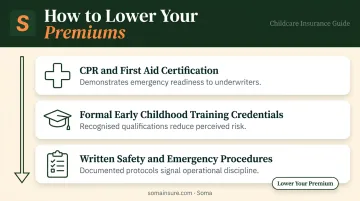
- CPR and first aid certification
- Formal early childhood training credentials
- Written safety and emergency procedures on file
Coverage Limits and Deductibles
Higher per-occurrence and aggregate limits cost more. A policy with $1M/$2M limits costs more than one at $300K/$300K — but the gap in protection is significant if a serious claim is filed.
Deductible choices follow a straightforward trade-off:
- Higher deductible → lower annual premium, more out-of-pocket when a claim hits
- Lower deductible → higher premium, less financial shock at claim time
Most small providers find a $500–$1,000 deductible to be a workable balance between affordability and claim-time exposure.
How to Budget for In-Home Daycare Insurance
The Three Most Common Budgeting Mistakes
1. Assuming homeowners insurance covers daycare activities. The NAIC's consumer guide is explicit: a person paid to operate a daycare at home must purchase additional insurance. Standard homeowners policies exclude commercial activities. Some insurers offer limited endorsements, but these rarely provide sufficient coverage for full-time providers.
2. Skipping professional liability because "nothing has gone wrong yet." Negligence claims can be filed even when a provider acted in good faith. A parent doesn't need to prove intentional wrongdoing — just that your level of care fell short of what a reasonable provider would have done. That's a low bar in a lawsuit.
3. Buying the cheapest policy without checking state minimums. A policy that doesn't meet your state's licensing requirements can result in license denial or revocation at renewal — making the "savings" far more costly than the premium difference.
Getting Accurate Quotes
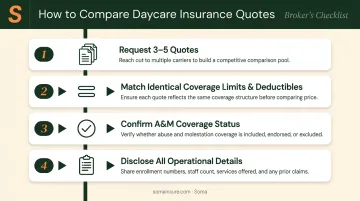
The only reliable way to budget for in-home daycare insurance is to request quotes — not rely on industry averages. When comparing options:
- Request at least 3–5 quotes
- Ensure each quote uses identical coverage limits and deductibles
- Ask specifically whether A&M coverage is included, endorsed separately, or excluded
- Disclose all relevant details: enrollment size, employee count, services offered, and prior claims
Working with a brokerage that specializes in childcare insurance cuts down on legwork. Soma places coverage for in-home daycares, licensed centers, preschools, and infant care programs — and can return quotes from multiple carriers through a single application, so providers aren't chasing coverage one carrier at a time.
Frequently Asked Questions
What type of insurance do daycares need?
At minimum, in-home daycares need general liability insurance. Professional liability, business property, abuse & molestation coverage, and workers' compensation (for providers with employees) are also commonly required depending on operation size and state licensing rules.
Does homeowners insurance cover a home daycare?
Standard homeowners insurance almost always excludes commercial activities like paid daycare. Some insurers offer a limited endorsement, but this is rarely sufficient for full-time providers — a separate commercial policy is the standard solution.
How much does general liability insurance cost for an in-home daycare?
General liability for an in-home daycare typically costs $500–$1,500 per year, depending on location, enrollment size, coverage limits, and claims history. Specialty carriers like Markel offer daycare-specific programs — exact premiums require a direct quote based on your operation.
Is in-home daycare insurance required by law?
Requirements vary by state. Many states require proof of general liability insurance to obtain or renew a childcare license, while others — like California — permit alternatives such as a bond or signed parental affidavit. Check your state's childcare licensing agency for current requirements.
Can I get in-home daycare insurance if I have a prior claim?
Yes, coverage is generally still available after a prior claim, but expect higher premiums — insurers view claims history as an indicator of elevated risk. A multi-carrier broker can shop your risk across specialty markets, which often means better pricing and broader terms than a single standard carrier can offer.
How can I lower my in-home daycare insurance costs?
- Bundle policies into a BOP when possible
- Maintain a clean claims record
- Complete professional certifications (CPR, early childhood education)
- Choose a higher deductible if cash reserves allow
- Compare quotes from multiple carriers using identical limits