The pressure is real and growing. A 2024 NAEYC survey of 1,173 childcare educators across 49 states found that 80% reported higher total liability insurance costs over the prior year, and 62% said finding affordable coverage had become harder. Among commercial center operators, 13% saw annual increases of $10,000 or more.
So what does daycare insurance actually cost — and what drives those numbers? Costs vary considerably based on whether you operate from home or a commercial facility, how many children and employees you have, what services you offer, and where you're located. This article breaks down realistic price ranges, the coverage types every daycare needs, the factors that move premiums up or down, and how to build a budget that matches your actual operation.
Key Takeaways
- Home-based daycares typically pay $400–$1,500/year for general liability; a full package runs $1,000–$2,500
- Commercial centers commonly pay $1,100–$4,000+ for GL alone; comprehensive packages reach $3,000–$15,000+
- Infant care, transportation, and prior claims can push premiums significantly higher — sometimes doubling base rates
- Homeowners insurance does not cover home daycare operations — separate commercial coverage is required
- Most standard GL policies exclude abuse and molestation coverage — request it as a standalone endorsement
How Much Does Daycare Insurance Cost?
There is no single price for daycare insurance. Premiums depend on your operation type, coverage combination, number of children, staff count, and state — and buying less coverage to cut costs is one of the most common mistakes providers make.
Home Daycare Insurance Cost
Small home-based providers generally pay less because their liability exposure is more contained. Here are typical annual ranges:
- General liability only: $400–$1,500 per year
- Full package (GL + property + abuse and molestation): $1,000–$2,500 per year
A basic home daycare GL policy usually covers third-party bodily injury and property damage claims. What it typically does not include:
- Workers' compensation (only relevant if you have employees)
- Commercial auto (required separately if you transport children)
- Professional liability (available as an add-on)
- Abuse and molestation coverage (often excluded from GL — see below)
Commercial Daycare Center Insurance Cost
Commercial centers carry more children, more employees, and greater premises liability — which means more coverage types and higher premiums across all of them.
- General liability only: $1,100–$4,000+ per year
- Full package (GL, professional liability, property, workers' comp, abuse and molestation): $3,000–$15,000+ per year
The upper end applies to larger centers with significant payroll, infant care programs, or operations in high-litigation states.
A mid-size center with five to ten employees and standard age groups will typically land in the $4,000–$8,000 range for a comprehensive package.
Daycare Insurance Cost by Coverage Type
The table below is based on Insureon's 2025 human and social services sector medians. These figures cover a broader sector that includes daycare — not daycare-only averages — so use them as ballpark reference points rather than expected quotes.
| Coverage Type | Annual Benchmark | Notes |
|---|---|---|
| General Liability | ~$1,097/year | $1M per occurrence / $2M aggregate typical |
| Business Owner's Policy (GL + Property) | ~$1,624/year | Bundles GL and property coverage |
| Professional Liability (E&O) | ~$1,191/year | Covers negligence and supervision claims |
| Workers' Compensation | ~$1,744/year | Scales with payroll; class-code rated |
| Commercial Auto | ~$2,942/year | Required for any child transportation |
| Abuse & Molestation | No published benchmark | Often excluded from GL; must be added |
| Commercial Umbrella | No published benchmark | Excess limits above primary policies |
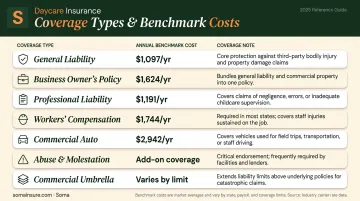
Source: Insureon 2025 human and social services medians. Daycare-specific standalone figures are not publicly published by carriers.
Types of Daycare Insurance and What They Cover
No single policy covers everything a daycare faces. The right combination depends on your facility type, whether you have employees, and the services you provide.
General Liability Insurance
GL is the foundational policy every daycare needs. It covers third-party claims for bodily injury and property damage: a child injured on your premises, a visitor's property accidentally damaged. Most states require a minimum GL policy as a condition of licensing.
Recommended limits: $1 million per occurrence / $2 million aggregate. Some states set their own minimums, and landlords may require higher limits.
Professional Liability Insurance
Also called errors and omissions (E&O), professional liability covers claims of negligence, improper supervision, or failure to meet professional care standards. These claims fall outside standard GL coverage — for example, a parent who alleges their child was harmed due to inadequate supervision won't necessarily trigger your GL policy.
This coverage is particularly important for commercial centers and any provider with staff. Allegations of negligent supervision frequently target organizational decisions, not just individual actions.
Property Insurance
Property coverage protects your building (if owned), furniture, equipment, play materials, and supplies against fire, theft, and vandalism.
Critical note for home-based providers: Standard homeowners policies exclude business activities. The Texas Department of Insurance explicitly states that homeowners insurance will not cover home-daycare losses. New York's Department of Financial Services says compensated daycare requires additional coverage. Home-based providers need either a daycare endorsement or a separate commercial property policy.
Workers' Compensation and Abuse & Molestation Coverage
Workers' compensation covers employee medical expenses and lost wages for work-related injuries. It is legally required in nearly every state once you have employees (Texas and South Dakota are the main exceptions). Daycare work involves real physical demands (lifting children, repetitive movements), and the Bureau of Labor Statistics reports a 2024 total-recordable-case incidence rate of 1.9 per 100 full-time workers for child day care services. Cost is calculated per $100 of payroll.
Abuse and molestation coverage is one of the most commonly overlooked gaps in daycare insurance. The ISO CG 21 46 exclusion (used widely across standard GL forms) explicitly excludes injury arising from actual or threatened abuse or molestation. It also excludes related negligent hiring, supervision, reporting, and retention allegations.
Without a separate endorsement or standalone policy, a GL claim involving abuse allegations will almost certainly be denied. Soma includes abuse and molestation liability as a named coverage line within its childcare programs — a deliberate response to how consistently standard policies exclude it.
Additional Coverage Types
- Commercial auto: Required if you transport children. Personal auto policies exclude business use — you need coverage in place before the first pickup or drop-off.
- Commercial umbrella: Provides excess liability limits above your primary policies. Useful when a landlord requires higher limits than your base GL provides.
- Cyber liability: Any center storing digital enrollment records, child health data, or processing online payments carries real data breach exposure. A breach involving minors' information creates both regulatory and reputational risk.
Key Factors That Affect Daycare Insurance Premiums
Two daycares of similar size can pay significantly different rates. Underwriters look at a combination of operational, facility, and risk management factors — not just headcount.
Location and State Regulations
State-level litigation environments affect premiums directly. High-litigation states like California and New York tend to produce higher GL and professional liability rates, both because jury verdicts are larger and because courts process more claims. States that mandate higher minimum coverage limits as a licensing condition also push baseline premiums up.
Carriers price differently by state based on local court costs and verdict trends. A daycare in rural Georgia and one in Los Angeles with identical enrollment and staffing profiles will receive different quotes.
Number and Age of Children Served
More children means more exposure, which means higher premiums. Age matters too. Centers serving infants and toddlers pay more than those serving school-age children because:
- Younger children require closer, more intensive supervision
- Injury severity risk is higher for infants
- Staff-to-child ratios are stricter (California requires 1 adult per 3 infants; Texas requires 1 caregiver per 4 infants under 12 months)
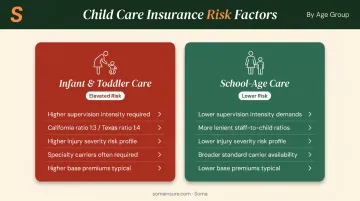
Infant care is explicitly the hardest segment to insure in the childcare market — many standard carriers decline it entirely. Specialty carriers are often the only option.
Employees, Payroll, and Staff Ratios
Workers' comp cost scales directly with payroll, so more employees means a higher workers' comp bill. Larger staff also affects GL and professional liability pricing, since organizational supervision decisions become a bigger factor in underwriting.
State-mandated ratios determine minimum staffing levels, which sets a floor on payroll — and workers' comp cost. Underwriters look favorably on documented procedures that show active risk management, including:
- Background checks completed before staff start
- Signed training records and supervision protocols
- Incident logs maintained consistently
Services Offered and Facility Condition
- Transportation: Adds commercial auto exposure immediately; must be priced and covered separately
- Overnight care, swimming, or field trips: Each introduces a distinct liability category with its own underwriting treatment
- Facility condition: Aging infrastructure, lack of fire suppression systems, or deferred maintenance affects commercial property pricing and signals elevated risk to underwriters
Philadelphia Insurance Companies' child care application requests information on playground details, transportation controls, sprinkler systems, building type, and abuse-prevention procedures — all of which factor into how risk is assessed.
Claims History and Risk Management
A prior claims history raises premiums across all lines. A clean record does the opposite. Underwriting credits are available for documented practices that reduce risk:
- Written supervision protocols
- Fenced outdoor play areas with secured entry
- Incident reporting logs
- Regular staff safety training
- Background checks on all staff and volunteers
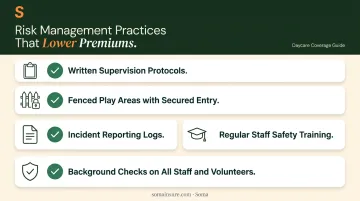
At renewal, carriers review this documentation directly. A well-documented operation often qualifies for credits that an otherwise identical facility without records does not.
How to Estimate the Right Insurance Budget for Your Daycare
Start with your operational profile, not an industry average. These are the inputs that actually drive your premium:
- Home-based vs. commercial facility
- Number and ages of children enrolled
- Employee count and total payroll
- Whether you offer transportation
- State licensing requirements for minimum coverage
- Whether you own or lease your facility
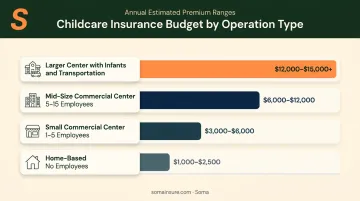
Practical budget ranges:
| Operation Type | Estimated Annual Budget |
|---|---|
| Home-based, no employees, standard ages | $1,000–$2,500 (GL + property) |
| Small commercial center, 1–5 employees | $3,000–$6,000 (full package) |
| Mid-size commercial center, 5–15 employees | $6,000–$12,000 (full package) |
| Larger center, infants, transportation | $12,000–$15,000+ (full package) |
When comparing quotes, use consistent parameters — same per-occurrence limit, aggregate limit, and deductible across all carriers. Otherwise you're comparing different products at different prices, not equivalent coverage.
A specialist broker can cut through this process significantly. Soma's daycare program uses a single-application process built around ratio- and enrollment-based underwriting — structured to generate quotes from specialty carriers fast enough to meet licensing and renewal deadlines. Daycare operators submit once and receive options across Soma's carrier network, without coordinating with each carrier separately.
What Most Daycare Owners Get Wrong About Insurance Costs
Three coverage mistakes show up repeatedly — and each one tends to surface only after a claim is denied.
Buying only the GL required for licensing. The minimum policy gets you licensed, not protected. It doesn't cover professional liability claims, abuse and molestation allegations, or property losses. One uncovered claim in any of these categories can exceed the cost of years of comprehensive premiums.
Assuming homeowners insurance covers a home daycare. It doesn't. Texas DOI and New York DFS both confirm this explicitly. Providers who discover this gap after a claim denial have no recourse — the denial stands, and they absorb the cost personally.
Skipping coverage reviews when operations change. Adding a staff member, starting a pickup route, or enrolling infants each changes your coverage needs significantly. Missing that update at renewal means carrying gaps you don't know about — or paying for limits that no longer fit your operation.
Conclusion
Daycare insurance costs range from under $1,500 per year for a small home-based provider to $15,000 or more annually for a larger commercial center with full coverage. The right policy covers your actual operations, meets state licensing requirements, and protects both personal and business assets when a claim arrives — not just the one with the lowest premium.
The cost drivers covered here — operation type, children's ages, employee count, services offered, location, and claims history — explain why two similar-looking daycares can pay very different rates. Understanding those factors puts you in a position to make coverage decisions based on actual risk rather than guesswork.
Once you know what drives your rate, the next step is finding carriers that will actually write the coverage. Soma places childcare coverage through specialty carriers that take on hard-to-insure programs — infant care, faith-based operations, and transportation-involved centers among them. A network of hundreds of carrier partners and a single-application process means competitive quotes without the weeks of follow-up most brokers require.
Frequently Asked Questions
How much does it cost to insure a daycare?
Home-based daycares typically pay $400–$1,500 per year for general liability, or $1,000–$2,500 for a full package including property and abuse and molestation coverage. Commercial centers commonly pay $1,100–$4,000+ for GL alone, with comprehensive packages ranging from $3,000 to $15,000+. Location, size, coverage types, and services offered all influence the final number.
Does homeowners insurance cover a home daycare?
No. Standard homeowners policies exclude commercial business activities, including paid childcare — both the Texas Department of Insurance and New York's Department of Financial Services confirm this. Home-based providers need either a daycare endorsement added to their homeowners policy or a separate commercial insurance policy.
What types of insurance are required to open a daycare?
Requirements vary by state, but most licensing agencies require general liability at minimum. Workers' compensation applies in nearly every state once you have employees, and commercial auto is required if you transport children. Professional liability and abuse and molestation coverage are strongly recommended even when not mandated, as both are specifically excluded from standard GL policies.
Is workers' compensation required for daycare employees?
Workers' compensation is required in almost every state once a business has employees, with Texas and South Dakota as the primary exceptions. Daycare workers face real physical injury risk from lifting children and repetitive tasks, so coverage matters beyond just legal compliance. Cost scales with payroll and varies by state and classification code.
How can I lower my daycare insurance premiums?
Compare quotes using matched coverage limits across multiple carriers, bundle policies where possible, and maintain documented safety practices. A clean claims record meaningfully reduces renewal rates, and periodic coverage reviews help ensure you're not paying for exposures that no longer apply to your operations.
Do I need insurance if I only watch a few children in my home?
Yes — most states require insurance for small home-based providers, sometimes for as few as one unrelated paid child. Beyond legal requirements, a single injury claim can generate medical bills and legal fees that far exceed several years of premium payments. Basic liability coverage is essential regardless of how small your operation is.