This guide focuses specifically on personal and employee health insurance for daycare operators — medical coverage for you and your staff. It does not cover business liability insurance (general liability, abuse and molestation coverage, professional liability, etc.), which is an entirely separate category with its own requirements.
Whether you run a solo in-home program or manage a licensed center with staff, there are real options available. Here's what they are and how to navigate them.
Key Takeaways
- Self-employed daycare providers can access coverage through the ACA Marketplace, a spouse's employer plan, Medicaid, or association-facilitated enrollment
- Providers with employees can use the SHOP Exchange, a private group plan, or a QSEHRA to offer tax-advantaged health benefits
- Premium Tax Credits are available to most providers earning between 100%–400% of the federal poverty level — and can cut monthly premiums considerably
- The self-employed health insurance deduction lets qualifying providers deduct 100% of premiums from federal taxable income
- Health coverage rules vary by state, so check your state's Medicaid eligibility thresholds and ACA requirements before selecting a plan
Why Health Insurance Is a Unique Challenge for Daycare Providers
Most daycare operators fall outside the employer mandate entirely. With fewer than 50 full-time equivalent employees, they're not required to offer coverage — and they're too small to access standard group pricing. That combination pushes them into the individual market, where premiums are set by age, location, tobacco use, plan tier, and family size.
The income gap makes this harder. At a $32,050 median annual wage, a $625 monthly Silver premium represents roughly 23% of gross income before subsidies. Providers at or above the income threshold for tax credits can face the full unsubsidized cost.
Compliance adds another layer of complexity. No federal rule requires daycare operators to carry personal health insurance as a licensing condition, but state licensing agencies set their own rules — and those rules change. Check your state's current licensing requirements before selecting a plan or deciding to go without one.
Health Insurance Options for Self-Employed Daycare Providers
If you have no W-2 employees, you're responsible for finding personal coverage independently. Four paths are worth evaluating.
Spouse or Domestic Partner's Employer Plan
This is usually the lowest-cost option. Group plans through an employer carry the lowest per-person premiums, and adding a spouse or domestic partner to an existing plan is often cheaper than buying individual coverage. Domestic partner benefits are available at many employers, though eligibility varies — confirm with the employer's HR department.
ACA Marketplace (Healthcare.gov or State Exchange)
Self-employed providers can enroll during:
- Open Enrollment: November 1 through January 15 (for 2026 coverage)
- Special Enrollment Period: Triggered by qualifying events like leaving a job, losing other coverage, or moving
2026 Premium Tax Credit eligibility (income generally must be 100%–400% FPL):
| Household size | PTC income range |
|---|---|
| 1 person | $15,650 – $62,600 |
| 2 people | $21,150 – $84,600 |
| 3 people | $26,650 – $106,600 |
| 4 people | $32,150 – $128,600 |
Source: CRS analysis using 2025 HHS poverty guidelines
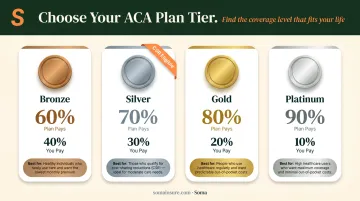
Plans come in four metal tiers. Choose based on expected healthcare usage:
| Tier | Plan pays | You pay | Best for |
|---|---|---|---|
| Bronze | 60% | 40% | Healthy providers, low usage |
| Silver | 70% | 30% | Moderate usage; only tier eligible for Cost-Sharing Reductions |
| Gold | 80% | 20% | Frequent medical care |
| Platinum | 90% | 10% | High utilization |
Cost-Sharing Reductions (CSRs) lower your deductible and out-of-pocket maximum — but only if your income is 100%–250% FPL and you choose a Silver plan. Use the KFF Health Insurance Marketplace Calculator to estimate your actual monthly cost based on income, age, and location.
Medicaid
Providers earning below 138% FPL may qualify for Medicaid at little to no cost. As of May 2026, 41 states including DC have adopted ACA Medicaid expansion. Key advantages over Marketplace plans:
- No enrollment window — applications accepted year-round
- Lower out-of-pocket costs — typically $0 to minimal premiums
- Immediate coverage — useful after a loss of income or during slow seasons
Association Enrollment Assistance
Some childcare associations help members navigate health insurance options. NAFCC has partnered with Stride to help members find individual health plans. Texas AEYC's Shared Services Alliance provides access to Thrive Workplace Benefits for enrollment support.
These are enrollment navigation resources — not group-rate association health plans. Confirm exactly what your association offers before assuming discounted pricing.
Health Insurance Options When You Have Employees
Providers with staff face a different equation. Businesses with fewer than 50 full-time equivalent employees aren't subject to the ACA employer mandate, but offering health benefits can help with hiring and retention in a competitive childcare labor market.
ACA SHOP Exchange
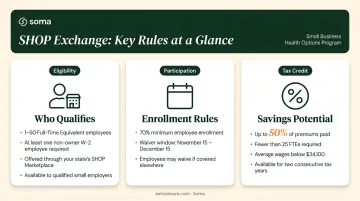
The Small Business Health Options Program covers employers with 1–50 FTEs who have at least one non-owner, non-family W-2 employee. Key details:
- All full-time employees (generally 30+ hours/week) must be offered coverage
- Most states require 70% of eligible employees to enroll — this minimum participation rule is waived each year from November 15 through December 15
- Small Business Health Care Tax Credit: Available to employers with fewer than 25 FTEs who pay at least 50% of employee-only premiums through SHOP. The credit covers up to 50% of premiums paid (35% for tax-exempt employers) for two consecutive tax years. For 2026, the full credit applies when average wages are below $34,100; eligibility phases out and ends at $68,200
Group Health Insurance Through a Private Broker
Working with a private broker off-exchange gives access to a wider range of plan designs and carrier networks than SHOP. The general eligibility requirement is at least one non-owner W-2 employee. One tradeoff: Premium Tax Credits are only available through on-exchange (SHOP) enrollment, not through off-exchange group plans. Compare both before deciding.
Qualified Small Employer HRA (QSEHRA)
A QSEHRA is an IRS-approved arrangement that allows small employers (fewer than 50 FTEs) to reimburse employees tax-free for individual health insurance premiums and qualified medical expenses. 2026 annual contribution limits:
| Coverage type | Annual maximum |
|---|---|
| Self-only | $6,450 |
| Family | $13,100 |
To receive tax-free reimbursements, employees must have minimum essential coverage. The QSEHRA is a meaningful step up from a simple cash stipend — an unrestricted stipend is treated as taxable wages, subject to income tax and payroll taxes. A properly structured QSEHRA is not.
For small daycare operations that can't swing a full group plan, a QSEHRA lets you support staff coverage in a structured, tax-efficient way — without taking on the administrative weight of traditional group benefits.
How Much Does Health Insurance Cost for Daycare Providers?
Costs vary significantly based on location, age, income, family size, and plan tier. Here are current benchmarks:
Individual coverage (2026):
- National benchmark Silver premium for a 40-year-old: $625/month before credits
- Range by state: $401/month (New Hampshire) to $1,299/month (Vermont)
- With subsidies: Eligible enrollees at 200% FPL could see credits covering the majority of that cost — the KFF calculator provides location-specific estimates
Small group coverage (2025):
- KFF reports a $9,211 average annual total premium for single coverage at firms with 10–199 workers — the closest published benchmark for small operations
For individual marketplace plans specifically, five factors determine your premium:
- Geographic location (state, urban vs. rural)
- Age of the insured
- Tobacco use
- Plan tier (Bronze through Platinum)
- Number of covered family members
Income affects subsidy eligibility but is not a direct premium rating factor.
One significant offset worth knowing: self-employed daycare providers can deduct 100% of health insurance premiums paid for themselves, their spouse, and dependents as an above-the-line federal income tax deduction, reducing taxable income dollar for dollar.
Tax Advantages and How to Find the Right Plan
The Self-Employed Health Insurance Deduction
Eligible providers — sole proprietors with Schedule C net profit, partners with self-employment earnings, and more-than-2% S-corp shareholders — can deduct health insurance premiums on Schedule 1, Line 17 of their federal return. This is an above-the-line adjustment to income, not a Schedule A itemized deduction, meaning you benefit regardless of whether you itemize.
Two important limits:
- The deduction cannot exceed the net profit from your daycare business
- No deduction is allowed for any month when you were eligible for employer-sponsored coverage through your own employer or your spouse's
Use Form 7206 to calculate the deduction if required.
Plan Selection Checklist
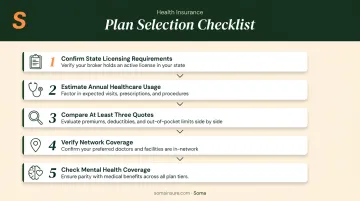
Before committing to a plan, work through these steps:
- Confirm state licensing requirements — some states require specific coverage documentation for licensed providers
- Estimate annual healthcare usage — if you rarely see doctors, a Bronze plan with lower premiums may cost less overall; if you have ongoing needs, Silver or Gold tiers typically deliver better value
- Compare at least three quotes across on-exchange and off-exchange options — tax credits are only available on-exchange
- Verify network coverage includes your preferred doctors and facilities
- Check mental health coverage — all Marketplace plans must cover mental health and substance use disorder services as an Essential Health Benefit, with parity protections equal to medical/surgical benefits
Health coverage is only one piece of the puzzle. The business side — general liability, abuse and molestation coverage, professional liability, workers' compensation, and commercial auto — requires separate commercial products entirely.
Soma specializes in this coverage for daycare providers, including in-home programs, licensed centers, Montessori schools, faith-based childcare, and multi-site franchises. Soma works with specialty carriers that write hard-to-insure childcare risk where standard markets often won't.
Frequently Asked Questions
What type of insurance do daycare providers need?
Daycare providers generally need two separate categories: personal health insurance covering medical expenses for themselves, family, and employees, and business insurance covering liability and operational risks (general liability, abuse and molestation coverage, professional liability, workers' compensation, and similar lines). Both are typically necessary but serve entirely different purposes.
How much does insurance cost for daycare providers?
Individual health insurance premiums vary widely by state, age, and income. The 2026 national benchmark Silver plan for a 40-year-old runs $625/month before tax credits — subsidies can significantly reduce that figure for providers earning 100%–400% of the federal poverty level (FPL). Business liability insurance is a separate cost determined by enrollment, facility type, and coverage lines selected.
Do health insurance plans for daycare providers cover bipolar disorder?
Yes. Under the ACA, Marketplace and most group health plans must cover mental health and substance use disorder services as an Essential Health Benefit. The Mental Health Parity and Addiction Equity Act (MHPAEA) also prohibits plans from applying stricter limits to mental health benefits than to comparable medical or surgical benefits.
Can self-employed daycare providers deduct health insurance premiums on their taxes?
Self-employed providers with net profit can generally deduct 100% of health insurance premiums for themselves and their family as an above-the-line federal income tax deduction. This deduction doesn't apply for any months the provider was eligible for employer-sponsored coverage through their own or a spouse's job.
What is open enrollment and when can daycare providers sign up for health insurance?
ACA Marketplace open enrollment runs from November 1 through January 15 each year. Providers who leave a job or experience qualifying life events can enroll during a Special Enrollment Period outside those dates. Medicaid enrollment is available year-round for those who meet income eligibility requirements.