For daycare owners, the practical question is what those changes mean for their own coverage. The steps are different depending on whether you have an active NEXT policy, have received a non-renewal notice, or are currently looking for a new daycare policy. This guide breaks down each situation and explains how to prepare if you need another insurance option.
TL;DR
- Next Insurance remains in business and now operates under the ERGO NEXT name.
- ERGO NEXT is no longer accepting new daycare insurance applications.
- Current daycare policies remain governed by their existing terms, while renewal decisions vary by policy.
- Daycare owners who need replacement coverage should start early and compare options based on eligibility, coverage, and underwriting requirements.
Short Answer: Is Next Insurance Going Out of Business?
No. Next Insurance continues to operate under the ERGO NEXT name following its acquisition. The change in company ownership and branding does not mean the insurer itself is shutting down.
The situation is different for daycare insurance. ERGO NEXT is winding down its daycare vertical and is no longer accepting new daycare insurance applications. Daycare owners should therefore treat the company's overall status and the availability of its daycare product as two separate issues.
What the ERGO NEXT Change Means for Daycare Owners
For daycare owners, the immediate impact is on access to coverage. Because ERGO NEXT is no longer accepting new daycare applications, businesses currently shopping for a policy will need to consider other insurers that still write childcare risks.
For existing policyholders, the end of new daycare business does not automatically terminate a policy that is already in force. What happens at renewal depends on the individual policy and the notice provided by the insurer. Owners should rely on their policy documents and renewal or non-renewal communications to understand their specific status.
This can become an operational issue because daycares may need current insurance for licensing, leases, contracts, or other proof-of-coverage requirements. If replacement coverage is required, the relevant expiration and compliance dates matter because a lapse could affect the daycare's ability to meet those obligations.
What If You Already Have a Daycare Policy?
What you need to do next depends on where your daycare currently stands with its insurance. An active policy does not require the same response as a non-renewal notice, while a business looking for a new policy has a different set of options.
Your Policy Is Still Active
If your current daycare policy is still active, continue operating according to its existing terms. There is no need to make changes simply because ERGO NEXT has stopped accepting new daycare applications.
For now:
Confirm your expiration date: Check the policy period shown on your declarations page so you know when the current term ends.
Review renewal documents: Read any renewal communication carefully when it arrives rather than assuming the policy will continue for another term.
Keep proof of insurance current: Make sure your certificate of insurance or other required documentation reflects your active coverage, particularly if it is kept on file with a licensing agency, landlord, or other organization.
Follow your existing policy terms: Unless you receive notice of a change, the coverage, limits, exclusions, and requirements in your current policy continue to govern the policy term.
The important point is to know when your current coverage ends and watch for communication about what happens after that date.
You've Received a Non-Renewal Notice
A non-renewal notice means the insurer does not intend to continue the policy after its current term. It is different from an immediate cancellation, so the notice should clearly identify when your existing coverage is scheduled to end.
Once you receive one:
Identify the effective date: Use the date stated in the notice as your deadline for having replacement insurance ready.
Start the replacement process early: Daycare insurance can involve additional underwriting questions, so waiting until the final days of the policy can limit the time available to evaluate options.
Check state requirements: Rules governing non-renewal notices differ by state. Review the notice and any applicable state requirements so you understand the timeline that applies to your policy.
Identify other insurance deadlines: A licensing agency, landlord, lender, contract, subsidy program, or other organization may require uninterrupted proof of insurance. Note those dates separately from the insurer's deadline.
At this stage, the priority is preventing an unintended gap between the end of the current policy and the start of the replacement policy.
You're Applying for a New Policy
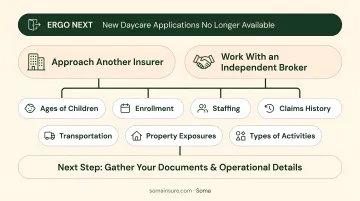
If you do not already have an ERGO NEXT daycare policy and are currently shopping for one, you will need to look elsewhere because new daycare applications are no longer available through ERGO NEXT.
You can:
Approach another insurer that currently writes daycare coverage, or
Work with an independent broker that can explore available insurance markets on your behalf.
Not every daycare will qualify for the same options. Insurers may consider factors such as the ages of children in your care, enrollment, staffing, claims history, transportation, property exposures, and the types of activities your program offers.
Having this information ready before you start comparing options can make the replacement process more efficient. The next step is gathering the documents and operational details an insurer or broker will need to evaluate your daycare.
How to Prepare Before Switching Daycare Insurance
Before requesting replacement quotes, organize the information an insurer or broker will need to evaluate your daycare. A complete submission can reduce back-and-forth during underwriting and make it easier to compare options on the same basis.
| What to prepare | What to gather |
|---|---|
| Current insurance documents | Your current policy, declarations page, renewal or non-renewal notice, claims history, and existing certificates of insurance. |
| Licensing information | Your current daycare license and any insurance requirements tied to the license or other agreements. |
| Children in your care | Current enrollment, licensed capacity, and the age groups you serve, including whether you provide infant or toddler care. |
| Staffing | Employee count, payroll information, and other staffing details requested during underwriting. |
| Property details | Building and business property values, including furniture, equipment, playground equipment, and other property that may need coverage. |
| Transportation | Daycare-owned vehicles, transportation of children, and whether employees use personal vehicles for daycare activities. |
| Program activities | Field trips, swimming, extended-hour care, overnight care, infant care, or other activities that may affect eligibility or coverage. |
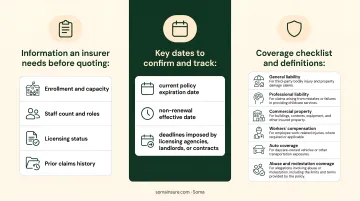
You should also have the relevant insurance dates in one place, including your current policy expiration date, any non-renewal effective date, and deadlines imposed by licensing agencies, landlords, or contracts. These dates establish the timeframe in which new coverage needs to be arranged.
Finally, list the coverages your daycare needs before you begin comparing quotes. Depending on your operation, that may include:
General liability: For third-party bodily injury and property damage claims.
Professional liability: For claims arising from mistakes or failures in providing childcare services.
Commercial property: For buildings, contents, equipment, and other insured property.
Workers' compensation: For employee work-related injuries, where required or applicable.
Auto coverage: For daycare-owned vehicles or other transportation exposures.
Abuse and molestation coverage: For allegations involving abuse or molestation, including the limits and terms provided by the policy.
Preparing this information first gives you a consistent baseline for the next step: comparing replacement policies based on what they actually cover, how they are underwritten, and whether they fit the way your daycare operates.
How to Compare Replacement Daycare Insurance
Daycare insurance is not underwritten like a generic small-business policy. Insurers may evaluate the ages of children served, enrollment, staffing, claims history, transportation, property exposure, program activities, and requested limits before deciding whether the business fits their underwriting guidelines. As a result, the cheapest quote is not necessarily the best replacement if the policy does not match how the daycare actually operates.
When comparing available options, look beyond the premium and review the policy itself:
| What to compare | What to look for |
|---|---|
| Included coverages | Confirm that the policy includes the protections your daycare actually needs rather than assuming every quote contains the same coverage. |
| Exclusions | Check for activities or exposures the policy does not cover, particularly if they are part of your normal operations. |
| Limits and sublimits | Review how much coverage is available for each exposure and whether any important protection is capped below the main policy limit. |
| Deductibles | Compare what the daycare would need to pay out of pocket before coverage responds. |
| Operational fit | Make sure the policy reflects the children you serve, transportation arrangements, property, staffing, and activities you actually provide. |
| Premium | Compare cost only after confirming that the policies offer reasonably comparable protection. |
Pay Particular Attention to Abuse and Molestation Coverage
Abuse and molestation coverage deserves specific attention because general liability does not automatically mean a daycare has adequate protection for these allegations. Check whether A&M coverage is included, the limit or sublimit that applies, and how the coverage is structured.
A quote with a lower premium may provide a much smaller A&M limit or exclude the exposure entirely. That difference can matter more than a modest price gap between policies.
Why Comparing Multiple Insurance Markets Can Help
Insurance companies do not all evaluate daycare businesses the same way. One insurer may restrict certain age groups, transportation arrangements, activities, or other characteristics that another insurer is willing to consider.
This means a daycare that falls outside one company's underwriting guidelines may still have options elsewhere. Comparing more than one available market can provide a clearer picture of both eligibility and the coverage terms available to the business.
Soma is an independent commercial insurance brokerage licensed in all 50 states. Rather than representing only one insurance company, Soma can use the daycare's information to approach available insurance markets that consider childcare businesses and help the owner compare the options returned.
The insurer ultimately determines eligibility, coverage terms, pricing, and approval, so all options remain subject to underwriting.
What Should Daycare Owners Do Next?
Start with your current insurance status. If your policy is active, keep your documents current and watch for renewal communication. If you have received a non-renewal notice or need a new policy, begin the replacement process before your coverage deadline.
Have your policy records, licensing details, claims history, staffing information, enrollment data, and operational details ready so insurers can evaluate your daycare accurately. When quotes are available, compare the coverage, exclusions, limits, and fit for your actual operations before focusing on price.
If you need help reviewing replacement options, Soma can help you compare daycare insurance markets and identify coverage that fits your operation, subject to underwriting.
FAQs
Is my existing NEXT or ERGO NEXT daycare policy still valid?
If your policy is still within its stated coverage period, follow the terms shown in your policy documents unless you receive a formal notice changing that status. Check the declarations page, expiration date, and any renewal or non-renewal communication rather than assuming the policy has either ended or will continue.
How early should I start looking for replacement daycare insurance?
Start before your current policy expires, especially if you have already received a non-renewal notice. Daycare applications can require detailed underwriting, and some insurers may not accept every type of childcare operation. Beginning early gives you more time to compare available options without creating unnecessary pressure around the expiration date.
What information will I need to get a daycare insurance quote?
Insurers may ask for your enrollment, ages served, employee count and payroll, licensing details, claims history, property information, transportation arrangements, and current insurance. They may also want details about activities such as infant care, field trips, swimming, extended hours, or overnight care.
What should I compare when replacing daycare insurance?
Compare more than the premium. Review the policy limits, sublimits, exclusions, deductibles, property protection, workers' compensation where applicable, transportation coverage, and whether abuse and molestation coverage is included. The goal is to find a policy that reflects how your daycare actually operates.
Can a broker help if one insurer is no longer accepting daycare applications?
Yes. An independent broker can approach multiple insurance markets instead of limiting the search to a single insurer. This can be useful because underwriting requirements differ between carriers. Available options, policy terms, pricing, and approval will still depend on the daycare's individual risk profile and the insurer's underwriting decision.