This guide breaks down exactly what coverage licensed family childcare homes need, why state licensing agencies require it, and how to make sense of rules that vary significantly from one state to the next.
Key Takeaways
- Standard homeowners insurance excludes commercial childcare activity — a separate business policy is required
- Ohio mandates $100,000 per occurrence / $300,000 aggregate in liability coverage; Texas requires $100,000 per occurrence of negligence (effective January 1, 2026)
- Core coverage types: general liability, professional liability, abuse and molestation coverage, and business property insurance
- Workers' compensation is required as soon as you hire any employee — exact thresholds vary by state
- Licensing thresholds differ by state — verify the exact trigger with your state's childcare licensing agency
What Is In-Home Daycare Insurance?
In-home daycare insurance refers to commercial coverage designed for childcare providers operating out of a private residence. The moment you accept payment to care for other people's children, your home functions as a business — and that distinction matters to every insurer that writes your homeowners policy.
That business distinction also means a single policy won't cut it. Most providers need several types working together:
- Liability insurance — covering bodily injury, property damage, and legal defense costs
- Professional liability — addressing allegations of negligent care
- Abuse and molestation coverage — protecting against claims that many general liability forms explicitly exclude
- Business property insurance — covering equipment and materials used in the daycare operation
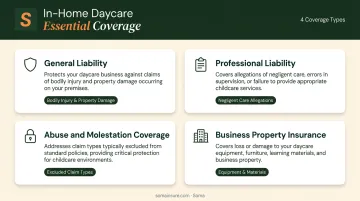
Without this combination, a single incident — a child injured on your property, an allegation of improper supervision — can result in a claim your homeowners carrier refuses to touch.
Why In-Home Daycare Insurance Is Required
The Legal Basis
Most states treat family childcare homes as licensed businesses once you charge for care, and that classification triggers insurance obligations enforced through the state's childcare licensing authority.
Two concrete examples from current law:
- Ohio (ORC 5104.041): Licensed Type A and Type B family childcare homes must maintain liability insurance at $100,000 per occurrence and $300,000 aggregate, or complete a statutory parent disclosure process as an alternative
- Texas (HB 2789, effective January 1, 2026): License and registration holders must carry $100,000 for each occurrence of negligence covering injury to a child on the premises or in the provider's care, enforced by the Texas Health and Human Services Commission, Child Care Regulation
These aren't uniform national standards — they're examples of how individual states structure their mandates. Your state's requirements may differ.
What's at Stake Without Coverage
A child fractures an arm on your property. A parent alleges inadequate supervision. Either scenario can generate medical costs and legal fees that most individual providers cannot cover. Without business-specific liability coverage, those costs fall on you personally.
Operating without compliant coverage — or without completing the state's permitted alternative — carries regulatory consequences beyond financial loss:
- License suspension or revocation, ending your ability to take on new enrollments
- Forced closure while you resolve the compliance gap
- Difficulty reinstating a lapsed license, which often requires re-inspection and additional documentation
Types of Coverage Required for In-Home Daycares
General Liability Insurance
This is the foundational coverage. It pays for:
- Bodily injury claims (a child hurt on your property)
- Third-party property damage
- Legal defense costs
State licensing minimums in Ohio and Texas reference liability insurance specifically, and general liability policies from carriers like Markel — which maintains a dedicated in-home daycare program — are designed to fulfill this function. Note that neither Ohio nor Texas statute labels the required form "commercial general liability," but general liability coverage is the standard vehicle providers use to meet the mandate.
Professional Liability (Errors & Omissions) Insurance
General liability covers physical injuries and property damage. It does not cover allegations of professional negligence — a parent claiming a child was improperly supervised, or that an injury resulted from a failure to follow documented safety procedures.
Professional liability (also called E&O coverage) fills that gap directly. For childcare providers making constant supervision decisions under documented care standards, this coverage is essential — not an upgrade.
Abuse and Molestation Coverage
This is the coverage type most often overlooked and most dangerous to omit. As Amwins documents, liability forms may contain absolute or limited exclusions for abuse and molestation claims — meaning a standard general liability policy may explicitly deny coverage for exactly the type of allegation that creates the largest legal exposure in a childcare setting.
Markel's in-home daycare program lists abuse and molestation coverage separately, which signals that it is not automatically bundled. Providers should verify whether their policy includes it or whether it must be added.
Business Property Insurance
Homeowners property coverage excludes business-use items. Playground equipment, educational materials, kitchen appliances used for snacks and meals, computers — none of these are protected under a standard residential policy when used as part of a compensated childcare operation.
Business property insurance covers these assets when damaged by covered perils: fire, theft, vandalism, and similar events.
Workers' Compensation Insurance
The moment you hire any employee — even a part-time assistant — workers' compensation requirements typically activate. It covers medical expenses and lost wages for an injured employee and shields you from direct employee lawsuits.
State thresholds vary significantly:
| State | Workers' Comp Trigger |
|---|---|
| California | Required with 1 employee |
| Florida | Generally required at 4+ employees (non-construction) |
| Texas | Generally optional for private employers |
| New York | Required for for-profit businesses; paid family members count as employees |
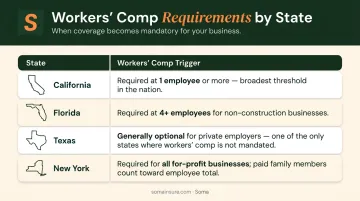
Check your state's workers' compensation rules independently of your childcare licensing requirements — they operate on separate tracks.
How State Licensing Requirements Shape Your Coverage
There is no national insurance standard for in-home daycares. Each state sets its own minimums through its childcare licensing authority, and the structure of those requirements varies considerably — from child-count thresholds to tiered registration categories.
The Disclosure Alternative
Both Ohio and Texas include provisions allowing providers to satisfy the insurance requirement through a formal disclosure mechanism rather than purchasing a policy — but under specific conditions.
In Ohio, providers who cannot obtain coverage may substitute a written statement signed by each child's parent confirming that no liability insurance is in force (using DCY form DCY 01933).
In Texas, HHSC guidance published January 13, 2026 recognizes circumstances where coverage cannot be obtained due to financial hardship or availability. When specific notice requirements are met, this limits administrative enforcement — but does not eliminate personal liability.
These alternatives are not preferred strategies. With no policy in place, the provider absorbs the full cost of any claim personally.
What Triggers Licensing (and Therefore Insurance Requirements)
Licensing obligations — and the insurance mandates attached to them — typically activate based on a combination of factors:
- Number of children in care at one time
- Whether children are related to the provider
- Hours of operation per week
State thresholds differ substantially:
| State | Licensing Trigger |
|---|---|
| California | Care for children from more than one unrelated family requires licensing review |
| Florida | Care for children from more than one unrelated family requires registration or licensing |
| New York | Programs serving 3+ children for more than 3 hours/day regularly must obtain a license |
| Ohio | Care for more than 6 children (no more than 3 under age 2) in a home triggers licensing |
| Texas | Uses tiered categories (listed, registered, licensed) rather than a single child-count trigger |
The federal National Database of Child Care Licensing Regulations lets providers search their state's current rules directly.
Renters and Additional Insured Requirements
Providers who rent — rather than own — their home face an added layer of complexity. Ohio's statute, for example, permits a landlord to request in writing to be named as an additional insured. The provider's policy must accommodate this without triggering cancellation, and the landlord covers any resulting premium increase.
Regardless of state, renters should take two steps before operating:
- Disclose to the landlord — commercial childcare activity may affect lease terms or trigger additional insured requests
- Disclose to the insurance carrier — undisclosed commercial activity can void a policy entirely
Key Factors That Affect Your Coverage Needs and Costs
Several variables determine both the coverage types you need and what you'll pay for them:
- Number of children enrolled — higher enrollment means higher risk exposure; some state mandates also scale with capacity
- Ages of children served — infant care is widely considered the hardest segment to insure and typically carries higher premiums regardless of setting
- State and locality — regulatory requirements and carrier market conditions vary; urban markets and states with stricter licensing regimes often carry different rate structures
- Whether you have employees — any hire introduces workers' compensation requirements and can affect your general liability premium
- Claims history and credentials — underwriting factors vary by carrier; providers should expect these to be reviewed during the application process
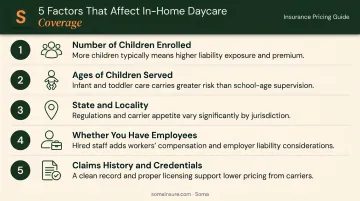
Some in-home daycare providers — particularly infant care operators, those with prior claims, or providers with a short operating history — are considered non-standard by many carriers and may find standard market quotes difficult to obtain.
Soma works with specialty carriers that write childcare risks in these situations. A single application covers the placement process, with premiums scaled to enrollment size, so providers can secure coverage without coordinating across multiple brokers or missing a licensing deadline.
Common Misconceptions About Home Daycare Insurance
"My homeowners policy covers this."
It doesn't. Standard homeowners policies exclude coverage for commercial business activities conducted on the premises. A claim related to a child in your paid care will be denied — and if the insurer discovers undisclosed business activity, your policy may be voided entirely.
"Insurance only matters if I have a lot of children."
Caring for even two or three unrelated children for compensation typically classifies your home as a business under state law, triggering both licensing and insurance obligations. What creates the obligation isn't the number of kids — it's receiving compensation for caring for unrelated children.
"Getting licensed means I'm covered."
A childcare license permits you to operate. It provides no insurance coverage. Licensing and insurance are entirely separate obligations that must each be maintained on their own.
Frequently Asked Questions
How much does insurance for an in-home daycare cost?
Costs vary based on your state, enrollment size, coverage types, and claims history. Bundling multiple coverage types (general liability, professional liability, business property) into a single placement is common and typically more cost-effective than placing each separately.
What type of insurance does an in-home daycare need?
The four core types are general liability, professional liability (E&O), abuse and molestation coverage, and business property insurance. Workers' compensation is required if you hire any employees, with state-specific thresholds determining exactly when it applies.
How many children can I watch in my home without a license?
Thresholds vary by state with no single number that applies everywhere. California and Florida count unrelated families; New York factors in hours per day; Texas uses tiered permit categories. Check your state's childcare licensing agency directly for the exact threshold.
Does homeowners insurance cover an in-home daycare?
No. Standard homeowners policies explicitly exclude business activities, and childcare for compensation qualifies as a business activity. Some insurers offer daycare endorsements, but these rarely provide sufficient coverage limits for licensed, full-time providers.
What happens if I operate a home daycare without insurance?
Operating without compliant coverage can result in license suspension or revocation. Any injury or damage claim then falls entirely on you — legal fees, medical bills, and any judgment, with no insurer to cover your losses.
Conclusion
In-home daycare insurance isn't optional for most licensed providers — it's a compliance obligation enforced by your state's childcare licensing authority, and the coverage it requires goes well beyond what any homeowners policy provides.
Knowing your state's requirements and pairing them with the right coverage types protects you against both a license action and a claim that could otherwise cost you everything. The harder part is finding a broker who actually places non-standard childcare risks — rather than sending you to a standard market that won't touch your operation.
Soma specializes in exactly that. One application covers the coverage lines your licensing authority requires, with no waiting weeks for a quote or chasing someone down for a response.