Introduction
Running a home daycare is running a business — with the liability to match. A child breaks an arm on your playground equipment. A parent alleges inadequate supervision. A kitchen fire destroys your educational materials and shuts you down temporarily. Any of these scenarios can trigger lawsuits or financial losses that your standard homeowners policy won't cover.
Most providers don't discover this gap until after an incident. According to NAEYC's 2024 liability insurance survey, 23% of family child care respondents did not report maintaining liability insurance — leaving them exposed to exactly this kind of financial risk.
This article covers the three types of home daycare insurance every provider needs, what each one covers, why they're all necessary, and how to choose the right coverage before an incident occurs.
Key Takeaways:
- Standard homeowners insurance excludes commercial daycare activities, leaving providers exposed
- Three distinct coverages form a complete protection package: general liability, business property, and professional liability
- Most states require at least general liability as a condition of childcare licensing
- Each coverage type addresses a different category of risk — none can substitute for another
- A childcare-familiar broker simplifies placement and closes common coverage gaps
What Is Home Daycare Insurance?
Home daycare insurance is a combination of commercial coverages designed to protect in-home childcare providers from risks a standard residential policy won't touch.
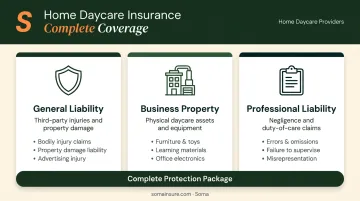
The three core components are:
- General liability — covers third-party injuries and property damage claims
- Business property — covers your physical daycare assets and equipment
- Professional liability — covers claims of negligence or failure to meet professional standards of care
Together, these three policies form a complete safety net for your business operations, home assets, and personal finances.
Most state licensing agencies also treat general liability as a minimum requirement. New York's Office of Children and Family Services, for example, maintains a dedicated liability insurance requirement page for child care programs — a standard that most states mirror.
Why Standard Homeowners Insurance Falls Short
Most homeowners policies contain a business-pursuits exclusion — paid childcare qualifies as a business pursuit. This means any claim arising from your daycare operations will typically be denied under a personal homeowners policy.
This isn't theoretical. In Allstate Indemnity Co. v. Riley (2020), a federal court upheld the denial of coverage for a child injured at an unlicensed South Carolina home daycare, applying exactly that exclusion. The court's reasoning followed the paid business activity, not the provider's license status. Even a small, informal arrangement carries that same risk.
What About Homeowners Endorsements?
Some insurers offer daycare endorsements or riders. Andover Companies, for example, offers a home daycare endorsement — but it applies only to licensed providers caring for no more than three children, with coverage capped at policy limits and no professional liability included.
These add-ons might work for a very limited operation, but they leave significant gaps:
- No professional liability coverage
- No dedicated business property protection
- Often unavailable once enrollment grows
- Low limits that may not cover a serious claim
Without proper coverage, providers face real financial exposure:
- Out-of-pocket medical bills from injured children
- Personal assets — including the home itself — at risk in a lawsuit
- Potential loss of their daycare license
The 3 Types of Home Daycare Insurance Every Provider Needs
These three coverages aren't alternatives — they address entirely different categories of risk. A complete home daycare insurance package should include all three.
General Liability Insurance
What it covers: General liability is the foundational coverage for home daycares. It protects you when a child, parent, or visitor is injured on your property, or when your daycare is held responsible for damage to someone else's property. Three core risk categories fall under this coverage:
- Physical injury (a child breaks an arm on playground equipment)
- Property damage (a child in your care breaks a neighbor's window)
- Personal injury (reputational harm claims from disputes with parents)
Unlike property insurance, general liability pays for the other party's medical bills, legal defense costs, and any settlements — not your own losses.
Who needs it: Every home daycare provider, regardless of size. Tennessee's 2025 rules, for instance, require $300,000 per occurrence and aggregate in general liability, plus separate abuse and molestation (A&M) limits. Many other states treat it as a condition of licensure.
Abuse and molestation coverage: Given the nature of childcare, A&M coverage is a critical add-on that providers should specifically request. Industry data consistently shows A&M coverage is excluded by default in many standard policies — providers need to request it explicitly, not assume it's included.
Key limitations to check:
- Does the policy cover off-premises activities like field trips?
- Is A&M coverage included, excluded, or available as an endorsement?
- What are the per-occurrence and aggregate limits?
General liability does not cover damage to your own property or professional negligence claims — those require the policies below.
Business Property Insurance
What it covers: Business property insurance protects the physical assets you use to run your daycare — playground equipment, educational materials, furniture, kitchen appliances, computers, and any home modifications made to accommodate your childcare program. Covered events typically include fire, theft, vandalism, and storm damage.
Many policies also include loss-of-income coverage, which matters if a covered event forces you to temporarily close your doors.
Why homeowners coverage isn't enough: Your homeowners policy may cover some personal property, but it won't cover commercially-used equipment or business-related modifications. The moment that swing set or curriculum library becomes part of your daycare business, it falls outside standard residential coverage.
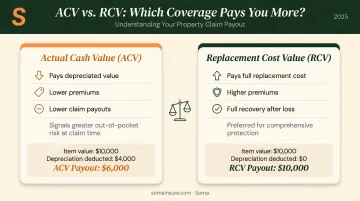
ACV vs. RCV — a critical distinction: Per NAIC guidance, these two valuation methods produce very different payouts:
| Valuation Method | How It Works | Best For |
|---|---|---|
| Actual Cash Value (ACV) | Pays depreciated value at time of loss | Lower premiums, lower payouts |
| Replacement Cost Value (RCV) | Pays full replacement cost, no depreciation | Higher premiums, full recovery |
For most daycare providers, RCV is worth the additional premium — you won't recover adequately from a fire payout that accounts for years of depreciation on your equipment.
Also check: Whether supplies or equipment used off-premises (such as on field trips) are covered under the policy.
Professional Liability (Errors & Omissions) Insurance
Professional liability — also called errors and omissions (E&O) insurance — protects you against claims of negligence, mistakes, or failure to meet professional standards of care. This applies when a parent alleges:
- Their child was improperly supervised
- A staff member made a harmful error
- You failed to fulfill your stated duty of care
The claim doesn't need to have merit to cost you money. Legal defense costs accumulate even when you've done nothing wrong — and professional liability covers those costs.
How it differs from general liability: General liability covers accidents and physical incidents. Professional liability addresses service-based allegations — the claim that you didn't do your job properly. A child can be physically unharmed and a provider can still face a significant professional liability claim over perceived negligence.
The claims-made timing issue: As the Insurance Information Institute notes, most professional liability policies operate on a claims-made basis. This means the policy must be active both when the incident occurred and when the claim is filed.
This creates a specific risk: if you change carriers or let coverage lapse, you may have no protection for incidents that occurred while you were covered under the previous policy. Before switching carriers, ask about:
- Retroactive date coverage
- Prior acts coverage
- Tail coverage or extended reporting periods
Professional liability is listed separately from general liability in dedicated childcare carrier programs — it's not something that's automatically included.
How Much Does Home Daycare Insurance Cost?
Reliable national averages for home daycare coverage are harder to find than you'd expect. NEXT Insurance has published a starting price of $18 per month for daycare coverage, though that figure is conditional on specific circumstances and shouldn't be treated as a universal benchmark.
The NAEYC 2024 survey tells a clearer story: 63% of family child care respondents reported increased insurance costs, and 57% experienced difficulty finding affordable liability coverage. The market is tightening — a childcare-familiar broker now matters more than ever.
Factors that affect your premium:
- Number of children in care and staff-to-child ratios
- Location (state regulations and geographic risk factors)
- Whether you provide infant care (typically the highest-risk segment)
- Whether you transport children
- Claims history
- Coverage limits and deductibles selected
Request comparable quotes from multiple carriers using the same enrollment figures, capacity, and coverage limits. A lower quote that excludes abuse and molestation, field trips, or pool coverage may leave far more risk exposed than a slightly higher one that covers those gaps.

How to Choose the Right Home Daycare Insurance Coverage
The right coverage combination depends on your specific operation. Two common mistakes to avoid:
- Assuming a homeowners endorsement is sufficient — it typically isn't, especially once you're caring for more than a few children or need professional liability coverage
- Choosing the cheapest option without verifying exclusions and coverage limits
What to Verify Before Binding Coverage
- Does the policy include or exclude off-premises activities?
- Is abuse and molestation coverage included, or is it an add-on?
- What are the specific limits — per occurrence and aggregate?
- Is professional liability claims-made or occurrence-based?
- Does business property coverage use ACV or RCV?
- What are your state's specific licensing requirements?
Carrier Selection
Prioritize insurers with experience writing childcare risk. Standard carriers frequently decline home daycare accounts — particularly those involving infant care. Check AM Best financial strength ratings (A- or better is a reasonable baseline) alongside state authorization, policy exclusions, and claims service reputation.
Sourcing multiple specialty carriers independently is time-consuming — and many won't quote home daycare accounts at all. Soma handles that legwork through a single application, placing coverage across partners like Markel, Nationwide, and Liberty Mutual without requiring providers to approach each insurer separately. The coverage stack includes general liability, abuse and molestation liability, professional liability, commercial property, workers' compensation, and commercial auto.
For providers facing licensing or renewal deadlines, Soma's placement process is built for speed — quotes move quickly so operations stay compliant on time.
Conclusion
Home daycare providers face genuine business risks that homeowners insurance doesn't cover. General liability, business property, and professional liability insurance work together to address three distinct categories of exposure, and no single policy covers all three.
Getting the right coverage isn't just about satisfying a state licensing requirement. It protects your livelihood, your home, and the trust families place in you every day. If you're unsure which policies apply to your situation, Soma works with daycare providers across multiple states to place the right coverage quickly — often with a single application.
Frequently Asked Questions
What types of insurance does a home daycare need?
Home daycares need at minimum three types of coverage: general liability (for injuries and property damage), business property (for equipment and home assets used in the daycare), and professional liability (for negligence claims). Providers with employees should also consider workers' compensation, and those who transport children should carry commercial auto.
Is homeowners insurance enough to cover a home daycare?
No. Most homeowners policies explicitly exclude commercial business activities, and paid childcare qualifies as a business activity. While some insurers offer daycare endorsements, these typically carry low limits and exclude professional liability, making dedicated business insurance necessary for full protection.
How much does home daycare insurance cost?
Costs vary based on location, number of children, staff ratios, coverage limits, and claims history. Premiums have been rising — NAEYC's 2024 survey found 63% of family child care providers reported increased costs. Requesting comparable quotes from multiple childcare-familiar carriers is the most reliable way to find competitive pricing.
Do I need insurance if I only care for a few children?
Yes. Caring for even two or three children triggers licensing requirements in many states, and most require liability coverage as a condition. A single accident can generate medical bills and legal fees far beyond what any provider could absorb out of pocket — Texas, for instance, mandates insurance or formal documentation for homes caring for as few as one to three unrelated children.
Is home daycare insurance required by law?
Requirements vary by state, but most state licensing agencies require home daycare providers to carry at minimum general liability insurance as a condition of obtaining or renewing their childcare license. Some states permit disclosure alternatives to insurance purchases. Check your state's child care licensing office for the specific requirements that apply to your license category and enrollment size.