That's exactly why the right insurance structure matters from day one. A Business Owner's Policy (BOP) is one of the most practical starting points for daycare operators: it bundles general liability, commercial property, and business interruption coverage into a single policy, typically at a lower combined cost than buying each separately.
This guide covers what a daycare BOP includes, what it leaves out, how it compares to buying separate policies, what it costs, and how to get one.
Key Takeaways
- A BOP bundles general liability, commercial property, and business interruption coverage in one policy
- Standard BOPs have critical gaps for daycares — abuse and molestation coverage is the most significant
- Most daycares need at least three coverages beyond a BOP — professional liability, abuse and molestation, and workers' compensation
- Insureon reports a $1,624 annual median BOP premium for human and social services businesses
- A specialty broker connects you with carriers experienced in childcare risk — and willing to write it
What Is a Business Owner's Policy (BOP) and Why Does It Matter for Daycares?
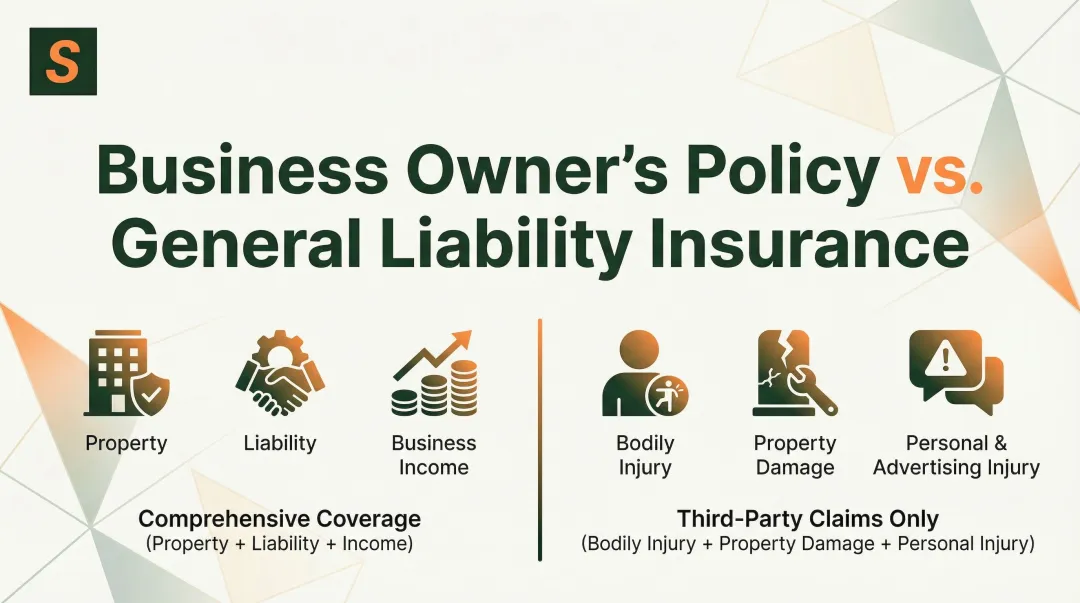
According to the Insurance Information Institute, a BOP is a prepackaged policy designed for small and medium businesses that combines three core coverages:
- Commercial property — covers your building and physical assets
- General liability — covers your legal responsibility if someone is harmed
- Business interruption — replaces lost revenue if a covered event forces you to close
Why Daycares Are a Strong Fit for BOPs
Daycares face simultaneous property and liability risks that few other small businesses do. You have a physical space filled with furniture, cribs, play equipment, and educational materials — all exposed to fire, theft, and weather. You also serve a vulnerable population, which creates real liability exposure every day.
Buying general liability and commercial property as separate policies from separate carriers is both more expensive and harder to manage. A BOP consolidates both into a single policy — one premium, one renewal date.
BOP vs. "Daycare Insurance" — Know What You're Buying
Not everything marketed as "daycare insurance" is a BOP. Some products are standalone general liability policies without any property component. Others are specialty packages that go well beyond a standard BOP.
Before you sign anything, confirm exactly which coverages are included — and which aren't. Common variations include:
- Standalone general liability only (no property coverage)
- Property-only policies with no liability component
- Specialty childcare packages that exceed standard BOP scope
What Does a Daycare BOP Typically Cover?
| Coverage | What It Protects in a Daycare Context |
|---|---|
| General Liability | Third-party bodily injury and property damage — child injuries, parent slip-and-falls, damage to neighboring property |
| Commercial Property | Your physical assets — furniture, cribs, high chairs, equipment, and business contents against fire, theft, vandalism |
| Business Interruption | Lost revenue and fixed expenses (rent, payroll, loans) if a covered event forces temporary closure |
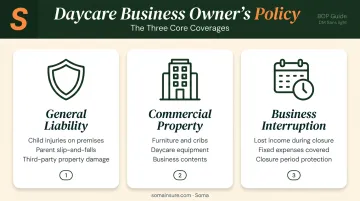
Each of these three components plays a distinct role in protecting your daycare. Here's what each one actually covers.
General Liability
This is the coverage most state licensing bodies and commercial landlords require daycares to carry. It covers claims that your business caused bodily injury or property damage to a third party — for example, a child who breaks an arm on the playground, or a parent who slips in the entryway during drop-off.
Most BOPs also include personal and advertising injury coverage, which addresses non-physical claims like libel, slander, or advertising infringement. This matters more than most daycare owners expect — a negative review dispute or a social media post gone wrong can trigger this coverage.
Commercial Property
This component covers the physical assets your daycare depends on daily — furniture, equipment, and business contents against covered perils like fire, theft, and vandalism. Common examples include cribs, activity tables, educational materials, and kitchen equipment. If you own your building, the structure itself can be covered as well.
Business Interruption
Business interruption is a standard BOP component, not an optional add-on. If a fire forces you to close for six weeks, this coverage replaces your lost net income and helps you continue paying fixed expenses — rent, payroll, taxes, loan payments — while you can't operate. Without it, a single covered disaster can create a cash-flow crisis that persists long after the physical repairs are done.
What a Daycare BOP Doesn't Cover — And the Add-Ons You'll Need
A BOP is a strong foundation. For most daycares, it's not sufficient on its own.
Abuse and Molestation Coverage
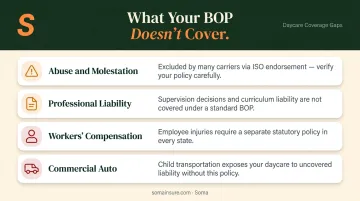
This is the most consequential gap. The standard ISO CGL form does not automatically exclude abuse or molestation, but many carriers attach an endorsement (ISO form CG 21 46) that explicitly excludes bodily injury, property damage, and personal injury arising from actual or threatened abuse or molestation. That exclusion extends to negligent hiring, supervision, and retention claims.
For a childcare business, that exclusion eliminates coverage for one of your highest-severity exposures. Markel identifies abuse and molestation liability as "critical coverage" in its commercial child care program. Confirm this coverage, whether as a BOP endorsement or a separate policy, before you bind anything.
Professional Liability (Errors & Omissions)
A BOP's general liability component does not cover claims that your professional decisions or supervision practices caused harm. If a parent sues because they believe your curriculum choices or staffing ratios led to developmental delays or emotional distress, a standard BOP won't respond. A separate professional liability policy, or a specific endorsement, is required.
Workers' Compensation
BOPs provide no coverage for employee work-related injuries. Workers' comp is a separate, legally required policy in most states. Requirements vary significantly — The Hartford's workers' compensation state directory is a reliable resource for confirming your state's specific thresholds and exemptions.
Commercial Auto
If your daycare transports children — field trips, school pickups — you need a commercial auto policy. A BOP does not include vehicle coverage. Personal auto policies generally won't defend your business for trips made primarily for business purposes. Relying on one for child transportation leaves accident claims fully uninsured.
BOP vs. Buying Separate Policies for Your Daycare
The Cost Case for a BOP
The III confirms that BOPs are generally more cost-effective than purchasing equivalent coverages separately. When GL and commercial property are bundled under one carrier, insurers offer a discounted combined premium. For a daycare with meaningful physical assets — furniture, equipment, a leased or owned facility — the math typically favors the BOP.
The administrative benefit matters too. Instead of juggling multiple policies across different carriers, you get a single renewal date and one point of contact for claims. For a daycare owner already managing staff ratios, licensing renewals, and daily operations, that consolidation reduces one more layer of overhead.
When Separate Policies Make More Sense
- Home-based daycares with minimal business assets may not benefit from the property component of a BOP
- Very large daycare centers may outgrow BOP eligibility limits and need a Commercial Package Policy (CPP), which can be tailored to more complex risk profiles
- Daycares with highly specialized exposures (infant care, transportation programs, multi-site operations) may find that a specialty program provides better coverage than a standard BOP regardless of cost
The III notes that companies with 100 or fewer employees and revenue around $5 million or less are typically BOP candidates. If your daycare exceeds those thresholds, a Commercial Package Policy is worth exploring — it offers more flexibility to match coverage to a larger or more complex operation.
Who Qualifies for a Daycare BOP and What Does It Cost?
Eligibility Basics
General BOP eligibility criteria include:
- Small-to-medium business size (typically under 100 employees)
- Annual revenue under approximately $5 million
- Defined physical business location
- Standard operational risk profile
Home-based daycares face variable eligibility depending on the carrier. Some insurers write BOPs for registered home-based operations with a clearly defined business space; others require standalone commercial policies.
One point worth knowing upfront: homeowners insurance does not cover daycare business liability. Many home-based providers only discover this after a claim.
What Drives Your Premium
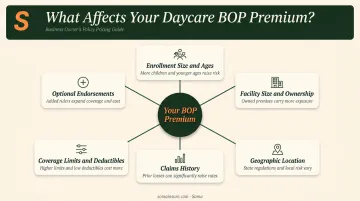
These factors most directly influence your daycare BOP cost:
- Number of enrolled children and their ages
- Facility size and whether you own or lease
- Geographic location and local weather/catastrophe exposure
- Claims history
- Coverage limits and deductibles selected
- Optional endorsements (especially abuse and molestation coverage)
What Does It Cost?
Insureon's data for human and social services businesses shows a $1,624 annual median BOP premium with typical $1M per occurrence / $2M aggregate liability limits. Their daycare-specific page cites an average of approximately $135 per month. These figures reflect a range of facility sizes and locations.
Higher deductibles lower your premium; lower deductibles mean more out-of-pocket at claim time. If your operation maintains steady cash reserves and has a clean claims history, a higher deductible is usually worth it.
State Licensing and Insurance Requirements
State minimums also affect your coverage decisions — and your cost. Several states tie daycare licensing to proof of liability insurance, which sets a floor on what you must carry:
- Texas: $100,000 per occurrence (effective January 1, 2026)
- Nebraska: $100,000 per occurrence
- Arizona: $300,000 general liability minimum
- California: $300,000 liability or bond, or a signed parental affidavit
The HHS National Database of Child Care Licensing Regulations is the most reliable starting point for your state's specific requirements.
How to Get a BOP for Your Daycare Business
What to Gather Before Applying
Have this information ready before requesting a quote:
- Business entity type and years in operation
- Number of enrolled children and their age range
- Number of employees and staff-to-child ratios
- Facility square footage and ownership status (owned vs. leased)
- Estimated replacement value of business contents
- Annual revenue
- Prior claims history (if any)
- Whether you transport children and what vehicles are used
Why a Specialty Broker Matters for Daycares
Many standard carriers restrict or decline daycare operations outright — particularly infant care programs, home-based daycares, and faith-based programs. Going directly to a single standard carrier often means a declination or a policy with significant exclusions.
A specialized commercial broker like Soma has access to specialty carriers that actually write hard-to-insure childcare risk — including infant care programs, which are the hardest childcare segment to place. Soma's daycare program uses enrollment- and ratio-based underwriting with a single application, so quotes come back fast enough to meet licensing and renewal deadlines.
Before You Bind Coverage
Read the full policy — not just the premium. Specifically:
- Confirm the abuse and molestation position — is it included, excluded, or available as an endorsement?
- Verify that GL limits meet your state's licensing minimums
- Check whether the policy is written on an occurrence or claims-made basis — this affects how future claims are handled
- Confirm that professional liability is addressed either through an endorsement or a separate policy
Frequently Asked Questions
What types of insurance does a daycare need?
Most daycares need general liability, commercial property (or a BOP combining both), professional liability, abuse and molestation coverage, and workers' compensation if they employ staff. Home-based daycares and operations that transport children have additional coverage needs. Specific requirements vary by state and facility type.
What does a business owners policy (BOP) for a daycare cover?
A daycare BOP bundles general liability (third-party injuries and property damage), commercial property (business equipment and contents), and business interruption insurance into one policy. Optional endorsements — abuse and molestation coverage in particular — can be added depending on the carrier and policy structure.
How much does business insurance for a daycare cost?
Cost varies based on enrollment size, ages served, facility type, location, coverage limits, and claims history. Insureon reports a median of approximately $1,624 per year for human and social services BOPs. A customized quote from a specialty broker will give you a figure based on your actual operation.
Is a BOP enough coverage for a daycare, or do I need additional policies?
A BOP covers the basics but leaves significant gaps for most daycares. Most daycares also need professional liability and abuse and molestation coverage at minimum, plus workers' compensation if they have employees. Daycares that transport children will also need commercial auto coverage.
Can a home-based daycare get a BOP?
Eligibility varies by carrier. Some insurers write BOPs for registered home-based daycares with a defined business space; others require standalone commercial policies. Homeowners insurance does not cover daycare business liability, so home-based providers need to secure coverage through a commercial insurer regardless of policy structure.
What is the difference between a BOP and general liability insurance for daycares?
General liability is one component of a BOP. A BOP bundles GL together with commercial property and business interruption coverage — making it broader and typically more cost-effective than GL alone for daycare owners who have physical business assets to protect.