Introduction
Picture this: a four-year-old slips on a wet kitchen floor during snack time. The parents rush to the ER, the bill comes to $8,000, and they file a claim against your homeowners policy — only to be told that your childcare operation isn't covered. That single afternoon could wipe out months of income, or worse, force you to shut down entirely.
Standard homeowners insurance is built for personal exposures. The moment you accept payment to care for someone else's child, you've crossed into commercial territory — and most personal policies won't follow you there. It's a gap that surprises a lot of providers, usually at the worst possible moment.
This guide covers what family daycare insurance actually is, which coverages matter most, what you can expect to pay, and how to make a smart buying decision.
Key Takeaways
- Family daycare insurance is commercial coverage — it is not an extension of homeowners insurance, which explicitly excludes paid childcare activities
- Core coverages include general liability, professional liability (E&O), abuse and molestation, business property, and workers' compensation
- Licensing rules vary by state — 13 states require liability insurance for home-based providers; 9 more require you to notify parents if you're uninsured
- Insurance premiums are generally 100% tax-deductible as a business expense under Schedule C
- A specialized broker can shop multiple carriers with a single application, saving time and improving coverage accuracy
What Is Family Daycare Insurance and Do You Need It?
Family daycare insurance is a commercial policy (or a bundle of policies) designed specifically for the liability and property risks of running a childcare program from a residential home. Your homeowners policy won't cover it.
The Gap in Your Homeowners Policy
According to the NAIC's consumer guide, a person paid to provide daycare at home must purchase additional business insurance — most standard homeowners policies cover only unpaid, incidental care. Markel, one of the specialty carriers that writes this risk, states directly that typical homeowners policies exclude liability for family daycare activities.
The Triple-I (Insurance Information Institute) also notes a $2,500 equipment sublimit for home-based businesses under most homeowners policies . An endorsement might raise that to $5,000 or $10,000, still far below the commercial value of a fully equipped childcare space. For liability claims tied to your childcare operation, you'd typically have nothing at all.
Who Needs It
If you're paid to care for other people's children in your home, you need it. That includes:
- Licensed family daycare homes (California allows up to 8 children; New York defines 3–6 as a family day care home)
- Providers operating below the licensing threshold but still accepting payment
- Group family homes with two or more caregivers
- Any compensated provider caring for children who aren't their own
The Licensing Angle
State rules vary materially. NAEYC's 2024 research found that 13 states require family home-based providers to carry liability insurance, while 9 additional states require providers to notify parents when they don't have coverage. California and New York both operate on an "insurance or affidavit" model , where a signed disclosure can substitute for coverage in some cases.
Even where coverage isn't legally required, the financial exposure is real. Legal defense costs alone — before any settlement — routinely reach $20,000 to $50,000 for childcare liability claims.
Types of Coverage Family Daycares Need
Family daycare insurance is rarely one document. It's a coordinated set of coverages that together address the full range of risks in a home-based childcare operation.
General Liability Insurance
This is the foundation. General liability covers:
- Bodily injury to children, visiting parents, or other third parties on your premises
- Property damage caused by your daycare operations
- Basic personal injury claims such as reputational harm
Practical examples: a child breaks an arm on your backyard playset, or a parent slips on your front steps during pickup. Without general liability, those claims come straight out of pocket.
Professional Liability (Errors & Omissions)
General liability handles physical accidents. Professional liability handles something different — claims that arise from how you delivered care. If parents allege their child was left unsupervised and injured as a result, that's a professional negligence claim, not just a slip-and-fall.
That distinction matters because one policy won't cover the other — a complete daycare insurance program needs both.
Abuse and Molestation Coverage
This is the coverage many providers don't think about until it's too late. Standard general liability policies frequently exclude claims related to allegations of child abuse or molestation — Amwins reproduces actual policy language excluding injury arising from "actual or threatened abuse or molestation."
What A&M coverage provides:
- Legal defense costs for allegations, even unfounded ones
- Settlement coverage if a claim proceeds
- Protection whether the allegation involves a caregiver, employee, or another child
Legal defense alone — regardless of outcome — can run into tens of thousands of dollars. Any provider running a licensed childcare program should treat this as a required line item, not an add-on.
Business Property Insurance
Standard homeowners property coverage doesn't account for the commercial value of childcare equipment, educational materials, outdoor play fixtures, or kitchen appliances used in your program. Business property insurance covers those assets separately at their actual commercial value — important if you've put real money into learning materials, outdoor structures, or a dedicated daycare kitchen.
Workers' Compensation Insurance
The moment you hire an assistant, workers' comp becomes a legal requirement in most states. It covers medical bills and lost wages if an employee is injured on the job. Note that employee-count thresholds vary: New York generally requires coverage with one or more employees, Florida's threshold for non-construction businesses is four employees, and Texas typically makes coverage elective. Check your state's specific rules.
Optional Coverages Worth Adding
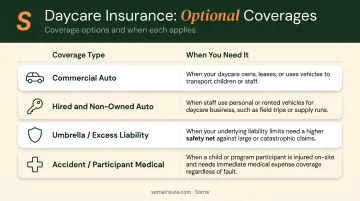
| Coverage | When You Need It |
|---|---|
| Commercial auto | If you transport children in any vehicle — personal auto policies typically exclude commercial use |
| Hired & non-owned auto | If you use vehicles you don't own for daycare-related transportation |
| Umbrella/excess liability | Extends limits across all underlying policies for catastrophic claims |
| Accident/participant medical | Covers medical expenses for children injured in your care, regardless of fault |
How Much Does Family Daycare Insurance Cost?
Pricing for family daycare insurance is variable — the published data is sparse, and starting prices don't reflect full coverage. NEXT Insurance advertises an $18/month starting price for in-home daycare coverage, but that's a floor, not a representative market range.
Understanding the factors that drive the number is more actionable.
Key Cost Drivers
Enrollment size is the most direct factor. More children in care means more exposure, which means higher premiums. A provider caring for two or three children will pay materially less than one at full capacity.
Location and state matter too. Urban areas with higher litigation rates carry higher premiums. States with stricter licensing requirements often set higher minimum coverage limits, which pushes baseline costs up — particularly in California and New York compared to lower-cost markets.
Claims history and credentials affect your rate in both directions:
- A clean claims record typically earns lower premiums
- Prior claims push costs up
- Formal childcare training or professional credentials (such as NAFCC accreditation) can qualify providers for better rates with some carriers
Higher deductibles reduce your premium but increase out-of-pocket costs when a claim hits. On limits, the difference in premium between minimum coverage and a $1M per occurrence / $2M aggregate structure is often smaller than providers expect — and the protection difference is substantial.

Tax Deductibility
The IRS 2025 Schedule C instructions allow self-employed providers to deduct business insurance premiums on line 15. IRS Publication 587 specifically addresses family daycare providers using a home for business. That deductibility reduces the net cost of coverage — confirm the treatment with a tax professional based on your specific business structure.
Key Policy Terms Every Family Daycare Provider Should Know
Before you sign anything, these terms will appear in every quote you receive.
Per occurrence vs. aggregate limits:
- Per occurrence — the maximum the insurer pays for any single claim
- Aggregate — the total maximum paid across all claims in a policy year
- A $1M/$2M structure means each incident is covered up to $1M, but total payouts in any year won't exceed $2M
Individual policy vs. master policy: Beyond the numbers, the structure of your policy matters. Some daycare associations offer master policies covering multiple providers under one umbrella. Individual policies are purchased directly. With a master policy, you typically have less control over coverage terms, claims handling, and cancellation rights — and your limits may be shared across all participating providers. Request the actual master contract and certificate before assuming coverage matches what an individual policy provides.
Exclusions — read this section first: Every policy lists specific situations it won't cover. Common exclusions in daycare policies include:
- Intentional acts
- Abuse and molestation (if A&M coverage is not added separately)
- Incidents occurring off-premises, such as field trips
- Certain equipment types (pools and trampolines are frequently excluded)
- Transportation of children under a personal auto policy
Read the exclusions section before anything else. A policy with a strong headline limit and a long exclusions list can leave you exposed in the exact scenarios that matter most.
How to Choose the Right Family Daycare Insurance Provider
Prioritize Childcare Specialists
A carrier or broker unfamiliar with home-based childcare will miss things — most commonly, the A&M endorsement or the distinction between general and professional liability. This niche requires someone who already knows how to structure coverage for it.
Working with a specialized brokerage like Soma, which places daycare coverage through specialty carriers experienced in hard-to-insure childcare risk, means your application reaches multiple markets simultaneously. One submission generates multiple quotes, faster — no chasing individual insurers across weeks of back-and-forth.
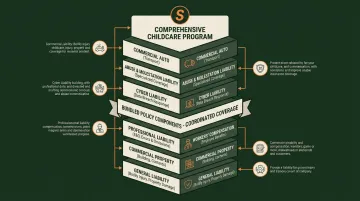
Soma's daycare program covers the full range of home-based operations: in-home family daycares, infant care programs (widely considered the hardest childcare segment to insure), faith-based childcare, and programs that transport children. The coverage stack — placed through a single application built around enrollment and ratio-based underwriting — includes:
- General liability and abuse & molestation (A&M)
- Professional liability and commercial property
- Workers' comp and commercial auto
- Umbrella and accident/participant medical
Compare at Least Three Quotes
When requesting quotes, ensure each one uses identical coverage limits and deductibles. Comparing a $300K policy to a $1M policy isn't a comparison — it's a setup for a coverage gap.
The cheapest quote is rarely the right choice. A lower premium with missing A&M coverage or lower aggregate limits creates real financial risk. Out-of-pocket exposure from a single coverage gap will almost always exceed what you saved on premium.
Ask the Right Questions
Before binding any policy, get written answers to:
- Are all enrolled children named insureds?
- Is abuse and molestation coverage included or excluded?
- Does coverage extend to off-premises activities and field trips?
- Does professional liability cover allegations of negligent supervision?
- What is the occurrence vs. claims-made structure?
- What are the cancellation terms?
Frequently Asked Questions
How much does family daycare insurance cost per month?
Most family daycare providers pay between $40 and $170 per month, depending on coverage types, enrollment size, location, and claims history. A two-child operation in a low-litigation state costs very differently from a six-child program in California. Multiple quotes are the only reliable way to find your number.
What types of insurance do family daycares need?
Most providers need four types of coverage: general liability, professional liability (E&O), abuse and molestation coverage, and business property insurance. Add workers' compensation if you employ any assistants, and commercial auto if you transport children — your personal auto policy won't cover that exposure.
Does homeowners insurance cover a family daycare?
No. Standard homeowners policies exclude commercial childcare activities. Even endorsements that add limited home-business coverage typically provide only a small property sublimit — not liability protection for your daycare operations. A separate commercial policy is required.
Is family daycare insurance required by law?
Requirements vary by state. NAEYC research found that 13 states require home-based providers to carry liability insurance as a licensing condition, while 9 more require disclosure to parents when coverage is absent. Check your state's child care licensing agency for the specific mandate and minimum limits that apply.
What is abuse and molestation coverage for daycares?
A&M coverage protects providers against the legal costs of defending allegations of child abuse or misconduct — including when the claim is unfounded. It must typically be purchased as a separate endorsement or policy because standard general liability policies explicitly exclude these claims.
Can I deduct family daycare insurance premiums on my taxes?
Yes. The IRS 2025 Schedule C instructions allow self-employed providers to deduct business insurance premiums as an operating expense. IRS Publication 587 specifically addresses family daycare providers. Confirm the deductibility of your specific coverage with a tax professional based on your business structure and state rules.