Both questions are valid — but the answers are completely separate. Standard health insurance does not pay for daycare. Daycare tuition is a childcare service, not a medical expense, and IRS Publication 502 explicitly excludes it from medical cost deductions. What does exist are tax programs and benefit accounts for parents, and a distinct set of business insurance requirements for providers.
This article covers both.
Key Takeaways
- Health insurance never covers daycare tuition — different tools exist for parents and providers
- Parents can reduce costs through Dependent Care FSAs, federal tax credits, and state subsidy programs
- Daycare operators need general liability, professional liability, abuse and molestation, property, and workers' compensation coverage
- Annual premiums for daycare general liability typically range from $675 to $1,092+, varying by operation type and size
- Childcare brokers matter — standard policies routinely exclude abuse and molestation, professional liability, and other exposures daycare operators actually face
How Parents Can Offset Daycare Costs Through Benefits and Tax Programs
Health insurance won't pay your daycare bill — but several tax-advantaged programs can meaningfully reduce what you spend out of pocket.
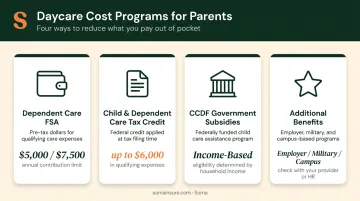
Dependent Care FSA
A Dependent Care FSA (DC-FSA) lets you set aside pre-tax dollars through your employer to pay for qualifying childcare expenses, including daycare for children under age 13.
Key details per IRS Publication 503:
- 2024 and 2025 limit: $5,000 per household ($2,500 if married filing separately)
- 2026 limit: $7,500 per household ($3,750 if married filing separately)
- Funds are generally subject to a use-or-lose rule, though employers may offer a grace period of up to 2.5 months after the plan year
Child and Dependent Care Tax Credit
Working parents can claim daycare expenses on federal taxes using IRS Form 2441. The credit applies to:
- Up to $3,000 in expenses for one qualifying child
- Up to $6,000 for two or more children
The credit percentage ranges from 35% to 20% of those expenses depending on your adjusted gross income — higher earners receive a smaller credit percentage.
Important: If you use a DC-FSA, the expenses you exclude through that account reduce what's available for the tax credit. You can't double-count the same dollars.
Government Subsidy Programs
The Child Care and Development Fund (CCDF), authorized under the Child Care and Development Block Grant (CCDBG), is the primary federal source of childcare subsidies for eligible low-income working families. States administer these funds and set their own income thresholds, copayments, and eligibility rules — so what's available in Texas looks different than in California or New York. Income limits are often higher than families expect, so it's worth checking your state's program directly before ruling yourself out.
Additional Programs Worth Knowing
- Employer benefits: Beyond FSAs, some employers offer childcare stipends, partnerships with local centers, or on-site care. Check your benefits package or ask HR directly.
- Military families: The Military Child Care in Your Neighborhood (MCCYN) program subsidizes community-based civilian childcare for eligible service members, with on-base programs using a sliding fee scale based on total family income.
- College student parents: The CCAMPIS program funds campus-based childcare services for low-income student parents at participating institutions.
What Insurance Does a Daycare Business Need?
Running a daycare — whether out of your home or a commercial facility — carries liability exposures that personal insurance was never built to handle. A child injury, an abuse allegation, or an employee accident can each generate claims worth hundreds of thousands of dollars. Standard homeowners and personal policies typically exclude commercial business activity entirely.
Here are the coverage lines every daycare operator should carry.
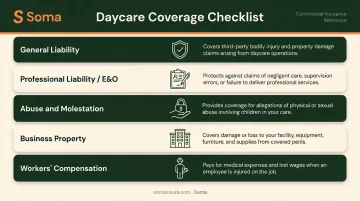
General Liability Insurance
This is the foundation. General liability covers:
- Bodily injury to third parties (a child slips on wet flooring, for example)
- Third-party property damage
- Legal defense costs for covered claims
Most state licensing agencies require proof of general liability as a condition of licensure — though minimum limits vary by state. New York requires proof at both initial licensing and renewal. Texas generally requires $300,000 per occurrence with annual verification. California permits a signed parental affidavit as an alternative to coverage in some cases.
Professional Liability (Errors & Omissions) Insurance
General liability covers accidents. Professional liability covers claims that your daycare failed to provide adequate care — for example, a parent alleging negligence after a child was injured during an unsupervised activity.
These are distinct coverage lines. Gaps between them are exactly where claims fall through — and where uninsured losses begin.
Abuse and Molestation Coverage
Most daycare operators underestimate this one. Standard general liability policies frequently exclude abuse and molestation claims outright through ISO CG 21 46-type exclusions, which can bar not only direct abuse claims but also negligent hiring and supervision claims.
Explicit abuse and molestation coverage must be confirmed — either as a separate policy or by endorsement. Don't assume a general liability policy responds to these allegations.
Business Property Insurance
Daycare equipment, playground structures, educational materials, and facility improvements are business assets. A standard homeowners policy typically caps business property coverage at $2,500 on premises, per the Insurance Information Institute — nowhere near sufficient for most daycare operations.
Commercial property insurance covers these assets properly against fire, theft, vandalism, and weather damage.
Workers' Compensation Insurance
Once you hire any staff, workers' compensation becomes a legal requirement in most states — though the threshold varies:
| State | Requirement Threshold |
|---|---|
| California | One or more employees |
| New York | Virtually all employers |
| Florida | Four or more employees |
| Texas | Elective for most private employers |
Confirm your state's requirements before assuming coverage is or isn't required.
How Much Does Daycare Insurance Cost?
Published pricing data for daycare insurance is limited and varies considerably by operation type, location, and coverage package. Here's what the available market data shows:
Published benchmarks (general liability):
- NEXT Insurance data (October 2022, home and commercial combined): 67% of daycare customers paid $56–$78/month, with occurrence limits of $500,000–$1M — roughly $675–$944 annually
- Insureon data (human/social services category, 2025): GL averaging $91/month (
$1,092/year); professional liability averaging $99/month ($1,188/year); business owner's policy averaging $135/month (~$1,620/year)
These figures reflect combined or broader category data — home-based providers typically land at the lower end of these ranges, while larger commercial centers pay more.
Several variables push that number up or down for your specific operation:
Factors that move your premium:
- Number of children enrolled and their ages (infant care is the hardest and costliest to insure)
- Home-based vs. commercial facility
- Number of employees and total payroll
- State and local licensing requirements
- Claims history
- Coverage limits and deductibles chosen
A higher deductible lowers your monthly premium but increases out-of-pocket costs at claim time. A $5,000 deductible may work for a larger center with cash reserves, but it can strain a small in-home operation. States with stricter licensing requirements add another layer: they often mandate higher minimum coverage limits, which raises your baseline cost regardless of operation size.
How to Choose the Right Daycare Insurance Provider
Generic commercial policies frequently miss the risks that matter most in childcare: abuse and molestation coverage, off-property incidents, and professional liability for supervision failures. Working with a broker who understands childcare as a distinct risk class, rather than treating it as a generic small business, makes a real difference in whether your policy actually responds when something goes wrong.
Soma places this type of coverage for in-home daycares, licensed commercial centers, preschools, Montessori programs, faith-based programs, before/after-school care, multi-site franchises, and infant care programs. Coverage goes through specialty carriers who write hard-to-insure childcare risk, with a single-application process built around licensing and renewal deadlines.
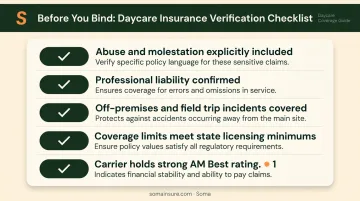
When evaluating any daycare insurance provider, verify:
- Abuse and molestation coverage is explicitly included in the policy, not simply absent from the exclusions list
- Professional liability is either a separate policy or clearly written into your general liability coverage
- Off-premises and field trip incidents are covered (many policies restrict coverage to the named premises only)
- Coverage limits meet your state's licensing minimums — confirm this before binding
- The carrier holds a strong AM Best financial strength rating, which reflects its ability to pay claims when it matters
Compare at least three quotes with matching limits and deductibles: an apples-to-apples comparison, not just the lowest headline number. Coverage gaps discovered after a claim or during a license renewal inspection are far more expensive to fix than the premium difference would have been.
Frequently Asked Questions
What insurance covers daycare?
For daycare operators, core coverages include general liability, professional liability, abuse and molestation, business property, and workers' compensation. For parents, the tools that help pay daycare tuition are Dependent Care FSAs, the Child and Dependent Care Tax Credit, and state subsidy programs — not health insurance.
How much is insurance for a daycare per month?
Published data shows most daycare operators pay roughly $56–$91/month for general liability alone, translating to approximately $675–$1,092 annually. Home-based providers typically pay less than commercial centers. Professional liability and property coverage add to that baseline.
Does homeowners insurance cover a home daycare?
Standard homeowners policies exclude commercial business liabilities and cap business property coverage at around $2,500. Endorsements exist but rarely cover professional liability or abuse and molestation, so most home daycare operators need a dedicated commercial policy for complete protection.
Can I use an FSA to pay for daycare?
Yes — but only a Dependent Care FSA, not a health FSA. The 2025 contribution limit is $5,000 per household ($2,500 if married filing separately), rising to $7,500 in 2026. Funds must be used for qualifying care for children under 13, and most plans apply a use-or-lose rule at year end.
Is daycare insurance required by law?
Most states require licensed daycare operations to carry at least general liability insurance to maintain their license. Requirements vary by state — New York, Texas, and California each have different verification rules. Check with your state licensing agency for the specifics that apply to your program.