Introduction
If your daycare insurance renewal came in higher than expected, you're not alone. An August 2024 NAEYC survey of 1,173 early childhood educators found 80% of insured programs experienced a liability insurance cost increase in the prior year, with 13% of center-based programs reporting increases of $10,000 or more.
Daycare centers sit in one of the higher-risk categories in commercial insurance. You're responsible for other people's children, and that creates significant liability exposure — across injury claims, abuse allegations, transportation incidents, and more.
What makes budgeting harder is that costs vary dramatically by facility type. A home-based provider caring for four children and a licensed commercial center serving 80 children aren't just different in scale: they face different coverage requirements, underwriting criteria, and premium structures entirely.
This guide breaks down approximate cost ranges by facility size and coverage type, explains the key factors that drive pricing up or down, and helps you build a realistic insurance budget for your specific operation.
Key Takeaways
- Annual insurance costs for a bundled daycare package range from roughly $1,200 for small home-based providers to $20,000+ for large commercial centers
- The biggest cost drivers are facility type, enrollment size, age groups served, transportation services, and claims history
- Commercial centers typically need 4–6 coverage lines; GL-only policies leave centers exposed to uncovered claims
- Abuse and molestation coverage is excluded from most standard GL policies — it must be added separately
- Wrong enrollment counts or missing transportation riders can void coverage when you need it most
How Much Does Daycare Center Insurance Cost?
Daycare insurance doesn't have a single price point. Costs vary by coverage type, facility size, state, and operational risk profile. Getting a clear picture upfront prevents underbudgeting, wrong coverage configurations, and gaps you won't discover until after a claim.
Typical Cost Ranges by Facility Size
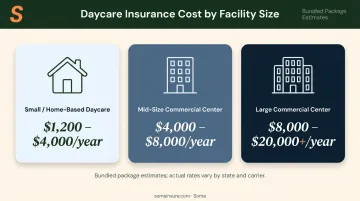
The ranges below represent approximate annual benchmarks for a bundled insurance package — not a single policy. Treat these as directional estimates rather than guaranteed market rates, since actual premiums depend heavily on state, enrollment, claims history, and the specific carrier.
| Facility Type | Estimated Annual Bundle |
|---|---|
| Small / home-based daycare | ~$1,200 – $4,000 |
| Mid-size commercial center | ~$4,000 – $8,000 |
| Large commercial center | ~$8,000 – $20,000+ |
A typical bundled package includes general liability, commercial property, and professional liability. The following typically require separate policies or add-ons:
- Workers' compensation
- Abuse and molestation coverage
- Commercial auto (if transporting children)
- Cyber insurance
- Commercial umbrella
Cost Ranges by Individual Coverage Type
Approximate annual ranges per coverage line for daycare operations:
| Coverage Line | Approximate Annual Range |
|---|---|
| General Liability | $500 – $2,200 |
| Professional Liability | $1,900 – $2,600 |
| Commercial Property | $330 – $440 |
| Workers' Compensation | $216 – $887 per employee |
| Commercial Auto | $2,087 – $5,692 |
| Cyber Insurance | $1,121 – $1,630 |
These figures vary considerably by state. High-litigation markets like California and New York consistently produce higher premiums across general liability and professional liability lines. Workers' comp rates are jurisdiction-specific and based on payroll, using NCCI class code 8869 for childcare operations.
Types of Daycare Insurance Coverage
Before comparing quotes, understand what each policy covers — and what it explicitly doesn't. Most commercial daycare centers need more than just general liability, and the gaps between policies are where high-severity claims tend to land.
General Liability
The foundation of every daycare insurance program. GL covers:
- Third-party bodily injury (a child injured on your premises)
- Property damage caused by your operations
- Reputational harm claims
Most states require GL as a condition of licensing. What it does not cover: abuse and molestation claims, professional negligence allegations, or employee injuries. Those require separate policies.
Professional Liability (Errors & Omissions)
Covers claims tied to supervision decisions, inadequate care, or failure to meet professional care standards , exposures that GL policies explicitly exclude. This coverage is especially important for centers serving infants or toddlers, where supervision intensity is highest and injury severity potential is greatest.
Abuse and Molestation Coverage
Standard GL policies exclude abuse-related claims entirely. ISO form CG 40 28 09 22 removes this coverage broadly, including negligent supervision, investigation, and retention decisions — not just direct acts. Defending and settling these claims is among the most expensive exposures in childcare.
Two common placement structures exist:
- Endorsement attached to a GL or specialty policy (carriers like Great American use separate limits within a specialty human services product)
- Standalone policy (Tokio Marine HCC offers a dedicated sexual misconduct and molestation product for daycare operations, with limits up to $1M per victim / $2M aggregate)
Always review the actual policy forms for this exclusion before binding any coverage — regardless of your facility's size or history.
Workers' Compensation and Commercial Property
These two coverages address your people and your physical space. Workers' comp is legally required in most states once you employ staff. Childcare work carries real physical injury risk: Texas DOI data shows 4,670 childcare employees sustained work-related injuries requiring time away in 2020, from repeated lifting, bending, and floor-level work.
Commercial property covers the building (if owned), furniture, playground equipment, and educational supplies against fire, theft, or damage.
Additional Coverages Worth Knowing
- Commercial Auto — Required if your center transports children; hired and non-owned auto covers field trips using non-owned vehicles
- Cyber Insurance — Relevant for centers using digital enrollment systems, payment processing, or electronic health records
- Business Income / Extra Expense — Covers lost revenue if your facility must temporarily close
- Commercial Umbrella — Adds excess limits above primary policies, important for centers with higher enrollment or infant programs
Key Factors That Affect Daycare Center Insurance Costs
Pricing is determined by operational, regulatory, and risk-profile factors — not just facility size alone.
Type of Facility and Services Offered
A home-based provider, a single-location commercial center, and a multi-site franchise face different base rates from the start. Layered on top:
- Transportation programs trigger commercial auto requirements and raise overall liability exposure
- Overnight care significantly expands the risk profile
- Specialized programs for children with disabilities carry broader professional liability exposure
Age Groups Served
Centers serving infants and toddlers consistently pay higher premiums than those serving school-age children. Younger children require more intensive supervision and present greater injury severity potential — two factors underwriters price directly into premiums.
State regulations confirm the intensity difference. California requires a 1:3 teacher-to-infant ratio; New York mandates 1:4 for children under 18 months. Insurers treat these ratios as a baseline measure of operational risk.
Number of Children, Staff Size, and Ratios
More enrolled children means more potential claims. Workers' comp premiums are calculated based on payroll, so staffing size directly affects that line. Whether your center meets or exceeds state-mandated supervision ratios also shapes how underwriters assess professional liability risk — centers that document compliance fare better at underwriting than those that don't.
Location and Litigation Environment
State litigation environments vary substantially. High-density urban markets with more plaintiff-friendly courts produce structurally higher GL and professional liability premiums. States with strict licensing requirements also tend to mandate higher minimum coverage limits — Texas, for example, requires $300,000 per occurrence for negligence injuring a child in care.
Claims History and Risk Management Practices
Prior claims — especially abuse allegations or major injury claims — will raise premiums significantly or make coverage harder to obtain. The inverse is equally true. Centers that demonstrate strong risk management typically qualify for better rates. Carriers commonly look for:
- Clean claims history with no abuse allegations or major injury claims
- Documented supervision protocols and staff training records
- Background check records for all staff and volunteers
- State licensing inspection reports showing consistent compliance
Complete vs. Basic Coverage: What's the Real Cost Difference?
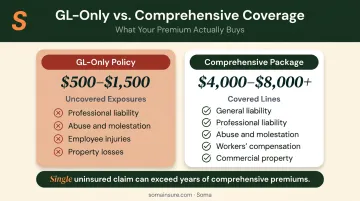
A GL-only policy for a small center might cost $500–$1,500 per year. It looks affordable. But it leaves the owner personally exposed to:
- Professional liability claims (negligent supervision, inadequate care)
- Abuse and molestation allegations
- Employee injuries
- Property losses
A comprehensive package — GL, professional liability, abuse and molestation, workers' comp, and property — typically runs $4,000–$8,000+ for a mid-size center. The premium gap looks significant until you compare it against the cost of a single uninsured claim — where that difference disappears quickly.
Abuse and molestation claims and professional liability lawsuits are among the most expensive to defend even when unfounded. Defense costs alone can exceed several years of comprehensive premiums — making the higher-cost bundle the sounder financial decision for any commercial daycare operator.
How to Lower Your Daycare Insurance Costs
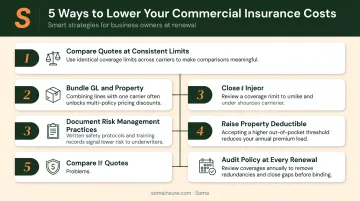
Several practical steps can reduce your daycare insurance premiums without stripping the coverage that actually matters.
- Compare quotes at consistent coverage limits. The childcare insurance market sees wide pricing variation for professional liability and abuse and molestation coverage. Comparing quotes with mismatched limits produces misleading results. Working with a specialty brokerage like Soma — with access to hundreds of carriers — means one application reaches the right markets rather than approaching each carrier individually.
- Bundle GL and property through one carrier. A package policy typically costs less than buying those lines separately and closes administrative gaps between coverages.
- Document your risk management practices. Written supervision protocols, staff training logs, and background check records don't just reduce incidents. They directly influence how underwriters price your professional liability and abuse and molestation exposure.
- Raise your property deductible if your claims history is clean. Increasing the deductible can lower that premium without meaningfully raising your financial exposure.
- Audit your policy at every renewal. A transportation program added mid-year, an enrollment increase, or a shift toward infant care all change your risk profile. Policies that don't reflect current operations can leave you underinsured or overcharged.
What Most Daycare Owners Miss When Budgeting for Insurance
Three patterns show up consistently among daycare operators with coverage gaps:
Skipping professional liability and abuse and molestation coverage. These two lines are most likely to produce catastrophic out-of-pocket costs — and they're most frequently excluded from base GL policies without being clearly flagged at purchase.
Letting the policy go stale after operational changes. Adding a van program, enrolling more infants, or opening a second location shifts the risk profile across multiple lines at once. Many centers are overcharged or underinsured simply because their coverage still reflects an operation from two years ago.
Treating state licensing minimums as sufficient coverage. Those floors — typically $100,000–$500,000 in GL limits — exist as a licensing threshold, not a coverage adequacy standard. Legal costs from a single defended claim frequently exceed them.
Conclusion
Daycare insurance costs vary significantly based on facility type, enrollment, age groups served, services offered, and state — with total annual costs for a complete protection package commonly ranging from $1,200 for small home-based providers to $20,000 or more for large commercial centers.
The right budget accounts for all relevant coverage lines, not just the most visible ones. Understanding what each policy covers, what it excludes, and how your operational profile shapes your risk exposure determines whether your coverage actually holds up when a claim is filed. If you're unsure where your current program stands, speaking with a broker who specializes in child care can help you identify gaps before they become costly.
Frequently Asked Questions
How much does insurance for daycare centers cost?
Annual costs for a bundled daycare insurance package typically range from $1,200 for small home-based providers to $20,000 or more for large commercial centers. Costs vary by state, enrollment, coverage lines included, and the specific carrier. See the pricing section above for a full breakdown by facility size and coverage type.
What type of insurance do daycares need?
Core policies include general liability, professional liability, abuse and molestation coverage, commercial property, and workers' compensation. Depending on services offered, you may also need commercial auto (if transporting children), hired and non-owned auto, and a commercial umbrella policy.
Does daycare insurance cost more for commercial centers than home-based providers?
Yes — by a wide margin. Commercial centers pay more due to larger enrollment, more employees, higher required coverage limits, and broader services. A home-based provider may pay $500–$2,000 per year, while a mid-size to large commercial center typically pays $4,000–$20,000+.
Is daycare insurance required by law?
Requirements vary by state. A 2025 Bipartisan Policy Center review found 23 states require center-based programs to carry liability insurance. Even in states without a mandate, many landlords, lenders, and subsidy programs require proof of coverage to operate.
Does general liability insurance cover abuse and molestation claims at a daycare?
No. Standard GL policies exclude abuse and molestation claims via endorsement. ISO form CG 40 28 09 22 removes this exposure broadly — including claims tied to negligent supervision and retention. This coverage must be added separately and is essential for any childcare operation.
Can I lower my daycare insurance premiums without reducing coverage?
Yes. Key strategies include:
Yes. Key strategies include:
- Bundle policies with a single carrier for multi-policy discounts
- Document risk management practices: supervision protocols, background checks, training logs
- Maintain a clean claims history to qualify for preferred pricing
- Compare quotes across multiple specialty carriers at each renewal
- Review coverage limits annually to remove outdated or redundant exposures