Introduction
Daycare insurance requirements vary dramatically from state to state — and what satisfies a licensing inspector in Illinois can leave you out of compliance in Texas, or completely unprotected in Georgia. For childcare operators, this isn't a bureaucratic footnote. Most states tie insurance compliance directly to your license, meaning a coverage gap can shut your program down.
This guide is written for home-based childcare providers, commercial daycare center owners, and operators expanding across multiple states. You'll find a clear breakdown of required coverage types, a state-by-state reference table with verified minimums, what coverage typically costs, and how to get compliant quickly.
A Maryland Insurance Administration hearing found that more than 80% of childcare providers reported rising liability costs, and 62% said coverage was harder to obtain. In a tightening market, knowing exactly what your state requires — and where to find compliant coverage — directly affects whether your program stays open.
Key Takeaways
- Most states require general liability insurance as a condition of licensure — operating without it risks license denial or revocation
- Minimum coverage limits vary sharply by state and provider type (home-based vs. commercial center)
- Abuse and molestation liability is not included in standard general liability policies and must be placed separately
- General liability alone typically costs $91/month (median); bundled policies offer better per-risk value
- A specialist broker with childcare carrier access is essential; most generalist brokers can't place the full coverage stack
Why State-Mandated Insurance Requirements Matter for Daycare Operators
Most state licensing agencies treat insurance compliance as a precondition for licensure — not an afterthought. If your coverage lapses or falls below required minimums, you may face license denial, suspension, or simply be unable to renew. That means you cannot legally care for children.
Even in states with no statutory dollar minimum, the absence of a mandate doesn't eliminate the risk. Any one of these claims can generate out-of-pocket costs that exceed what most small operators can absorb:
- Bodily injury claims involving a child on your premises
- Lawsuits alleging inadequate supervision
- Allegations of abuse or neglect
Where to start: The HHS Office of Child Care licensing directory routes providers to their specific state licensing body — it's the verified federal entry point for finding your state's insurance requirements and licensing contacts.
Types of Insurance Daycare Providers Typically Need
Not every coverage type is mandatory in every state, but each addresses a real exposure that exists regardless of what the law requires.
General Liability
The foundational policy for any daycare. It covers:
- Bodily injury to a child on your premises
- Third-party property damage
- Legal defense costs for covered claims
General liability is the most commonly mandated coverage type in state licensing rules and should be the first policy any operator secures.
Professional Liability (Errors & Omissions)
Covers claims of negligence, failure to supervise adequately, or failure to deliver promised educational services. This coverage matters most for programs where parents can argue a specific standard of care wasn't met, including:
- Structured curricula or academic enrichment programs
- Montessori-style instruction
- Before/after-school programs with stated educational outcomes
Abuse and Molestation Liability
This is a separate coverage that does not come standard in a general liability policy. CGL policies frequently contain explicit abuse and molestation exclusions, meaning a claim of this nature could be denied entirely under a standard policy.
It's also among the hardest coverage types to place. Standard markets regularly decline childcare risks in this category, which makes working with a specialist broker a practical necessity rather than an option.
Workers' Compensation
Required for daycare employers in most states. It covers work-related injuries, lost wages, and medical care for staff. State thresholds and exemptions vary; Texas, notably, does not require most private employers to subscribe. Check your state's specific rules before assuming workers' comp is or isn't mandatory.
Commercial Auto
Required if your program transports children. Personal auto policies may not cover business-use activities, which creates gaps on field trips, school pickups, or any vehicle use tied to the program. If staff use personal vehicles for daycare-related transport, hired and non-owned auto (HNOA) coverage closes that gap.
Daycare Insurance Requirements by State: What the Law Mandates
State licensing agencies — typically housed under a Department of Health and Human Services or a child welfare equivalent — set minimum liability thresholds as a condition of licensure. Those thresholds vary significantly, and the distinction between home-based and commercial providers often changes the minimum entirely.
The table below reflects verified requirements from each state's licensing authority. Where no dollar minimum was found in official materials, that is noted explicitly.
| State | Provider Type | Verified Minimum | Notes |
|---|---|---|---|
| Texas | Listed family homes | $100,000/occurrence | Effective Jan. 1, 2026; listed homes unable to obtain coverage may use parent/HHSC notification process |
| California | Family day care homes | $100,000/occurrence; $300,000 aggregate | Alternatively: $300,000 bond, or signed parent affidavits per HSC § 1597.531 |
| Illinois | Licensed centers | $300,000/occurrence | Group homes: $100,000/occurrence; center vehicles requiring school-bus-driver permit: $1M combined single limit |
| Illinois | Group day care homes | $100,000/occurrence | Tiered separately from commercial centers |
| Ohio | Type A & licensed Type B family homes | $100,000/occurrence; $300,000 aggregate | Alternative: signed parent/guardian disclosure stating home lacks coverage |
| Pennsylvania | Centers, group homes, family homes | Comprehensive GL required | No dollar minimum stated in cited regulations; policy must be retained at facility |
| New York | Child day care centers | GL certificate required at licensing and renewal | No dollar minimum found in official center rules; family provider page recommends coverage |
| Georgia | Child care learning centers | No binding minimum found | DECAL recommends $1M/occurrence and $2M aggregate; exempt programs without coverage must notify parents |
| Florida | Facilities transporting children | No verified statewide GL minimum | Vehicle liability: $5,000 × rated seating capacity or $100,000, whichever is greater |
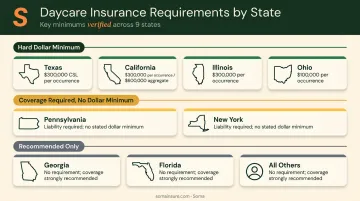
What the table makes clear is that states fall into three distinct categories — and knowing which one applies to you determines your compliance path.
Mandatory vs. Recommended: A Critical Distinction
Some states set a hard dollar minimum — miss it and you lose your license. Others require coverage but don't specify an amount (Pennsylvania, New York centers). Still others make coverage recommended rather than required (Georgia, Florida for general liability).
That last category is worth pausing on. Georgia daycares operating without insurance face the same liability exposure as any other childcare program if a child is injured — the absence of a state mandate doesn't reduce the financial risk.
The Tiered Approach: Centers vs. Home Providers
Two clear examples of states that impose higher requirements on commercial centers:
- Illinois requires $300,000/occurrence for licensed centers, $100,000/occurrence for group day care homes, and a separate $1M vehicle requirement for center transportation
- New York requires licensed daycare centers to submit GL documentation at licensing and renewal, while family providers receive guidance rather than a binding minimum
Home Daycare vs. Commercial Daycare: How Requirements Differ
Home-based providers and commercial centers operate on different licensing tracks in most states, which usually means different insurance thresholds.
Capacity Thresholds Matter
Many states tie insurance requirements directly to enrollment size:
- Small home daycares caring for very few unrelated children may face fewer mandates
- Larger family homes and group childcare homes often trigger commercial-level requirements
- Texas's listed family home category, for example, applies its own insurance rule even at small enrollment numbers
Why Homeowners Insurance Doesn't Work
Because a listed family home is a business, homeowners insurance will not cover daycare-related losses — the Texas Department of Insurance makes this explicit for home-based providers operating under that category.
A home-business endorsement offers only a marginal upgrade. The Insurance Information Institute notes it may raise property coverage from $2,500 to $5,000 — but it still does not:
- Meet state licensing thresholds for liability
- Cover professional liability claims
- Address abuse and molestation exposure
Some states approach this differently. California's affidavit model, for instance, offers an alternative to purchasing insurance outright, but it still requires formal documentation and signed parental acknowledgment. It satisfies a licensing requirement — it does not eliminate the underlying risk.
How Much Does Daycare Insurance Cost?
According to Insureon's daycare insurance data, median monthly premiums run:
| Coverage Type | Median Monthly Cost |
|---|---|
| General liability | $91/month |
| Professional liability (E&O) | $99/month |
| Business owner's policy (GL + commercial property) | $135/month |
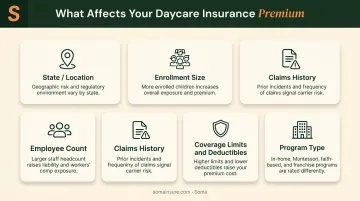
These are medians, not statutory rates. Your actual premium depends on several variables:
- State and location — urban markets and high-litigation states typically run higher
- Enrollment size — more children means more exposure
- Employee count — workers' comp costs scale with payroll
- Claims history — prior incidents increase premiums meaningfully
- Coverage limits and deductibles — higher limits cost more; higher deductibles reduce premiums
- Program type — infant care, transportation programs, and abuse & molestation coverage each add complexity and cost
One cost that doesn't fit neatly into benchmark data: abuse and molestation coverage. Pricing varies widely based on carrier appetite, program type, and enrollment profile.
Bundling can offset some of these costs. A business owner's policy that combines general liability and commercial property typically delivers better per-risk value than buying each line separately. Working with a broker who accesses multiple carriers lets you compare the full market instead of being locked into one insurer's pricing.
How to Get the Right Daycare Insurance Coverage for Your State
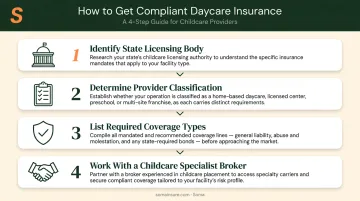
Step-by-Step Process
- Identify your state's licensing body — use the HHS childcare licensing directory to find your specific agency and its insurance requirements
- Determine your provider classification — home-based or commercial center, and your enrollment capacity; these determine which requirements apply
- List every coverage type your operation needs — consider employees (workers' comp), vehicles (commercial auto), curricula (professional liability), and abuse & molestation coverage
- Work with a broker who specializes in childcare — not a general business insurance broker; a specialist who knows which carriers write abuse and molestation coverage and how state-specific policy forms differ
Why Specialist Access Matters
Generic brokers often lack access to the specialty markets that write childcare risks — particularly abuse and molestation coverage, which standard carriers frequently decline. Soma works with carriers including Chubb, Markel, Liberty Mutual, and Nationwide to place coverage across childcare operations of every structure:
- In-home family daycares
- Licensed commercial centers
- Montessori and faith-based programs
- Multi-site franchises
- Infant care programs (the hardest childcare segment to insure)
One application covers all major lines: general liability, abuse and molestation liability, professional liability, workers' comp, and commercial auto — placed with carriers that actively write childcare risks.
Watch for These Common Policy Gaps
Before binding any policy, confirm your coverage addresses:
- Off-premises incidents — field trips and outings are frequently excluded
- Volunteer coverage — unpaid helpers may not be covered under workers' comp or GL
- Cyber and data liability — enrollment records, payment data, and family information create real exposure that standard GL does not cover
- Transportation — confirm commercial auto and HNOA coverage if any vehicle use occurs
Frequently Asked Questions
What type of insurance do daycares need?
Most daycare operators need five core coverages:
- General liability (required in most states)
- Professional liability
- Abuse and molestation coverage
- Workers' compensation (if you have employees)
- Commercial auto (if you transport children)
These are separate policies — no single policy covers all five exposures.
How much is insurance for a daycare per month?
General liability alone runs a median of $91/month; professional liability runs about $99/month. A business owner's policy bundling GL and property averages $135/month. Final costs vary based on state, enrollment, employees, and coverage limits.
Is daycare insurance required in every state?
Most states require at least general liability as a licensing condition, but minimums and required coverage types differ by state. A few states set no statutory dollar minimum — but operators in those states still face significant personal liability exposure without coverage.
Does homeowners insurance cover a home daycare?
Standard homeowners policies exclude commercial activities. A daycare endorsement may provide limited property coverage but typically won't meet state licensing thresholds. It also won't cover professional liability or abuse and molestation claims.
What happens if my daycare doesn't have the required insurance?
Operating without required coverage can result in license denial, suspension, or revocation. In California, providers must obtain signed parent affidavits as an alternative to insurance. Failing to follow any compliant path exposes operators to regulatory penalties and personal liability.
What is the minimum liability coverage required for a daycare?
Minimums vary widely: Texas requires $100,000/occurrence (effective Jan. 1, 2026), California mandates $100,000/$300,000, and Illinois requires $300,000/occurrence for licensed centers. Some states set no dollar minimum. Always verify current requirements directly with your state's childcare licensing authority.