Introduction
Daycare insurance is both a legal requirement in most states and one of the more complicated insurance purchases a childcare operator will make. A 2024 NAEYC survey of 1,173 insurance decision-makers found that 80% reported higher liability insurance costs over the prior year, with 32% receiving non-renewal notices and 36% seeing their coverage limits reduced or restricted.
Those pressures translate directly to what you pay. Costs vary depending on how you operate. A small home daycare might pay a few hundred dollars annually for basic general liability. A mid-size commercial center with employees, a transportation program, and infant care can pay many times that across all required coverage lines.
This guide breaks down realistic pricing by operation type, the coverage types every daycare needs, the factors that drive premium variation, and the mistakes that leave providers underinsured.
Key Takeaways
- General liability alone runs roughly $675–$1,847/year depending on operation type, based on published 2025–2026 benchmarks.
- Daycare insurance is never one policy — professional liability, abuse & molestation, workers' comp, and commercial auto all add to GL costs.
- Infants, transportation programs, and large enrollments cost more to insure — insurers price each risk factor separately.
- 80% of childcare providers saw premium increases in 2024; renewal rates should not be assumed to hold.
- Bundling coverage lines and comparing quotes across specialty carriers are the most reliable ways to control costs.
How Much Does Daycare Insurance Cost?
There is no single "daycare insurance" price. Most providers underestimate their total insurance spend because they budget for one policy — typically general liability — without accounting for the other coverage lines their operation actually requires.
Home Daycare (In-Home Childcare)
For home-based providers, general liability is the starting point. NEXT Insurance data shows that 67% of its daycare customers paid between $56–$78/month ($675–$944/year) for general liability, though this figure covers both home and commercial operations rather than home-only providers.
What GL covers at this level:
- Third-party bodily injury (a child or visitor injured on your property)
- Property damage to others' belongings
- Reputational harm claims
What it typically excludes:
- Professional liability (negligence in the care itself)
- Abuse and molestation claims
One point home-based providers often miss: homeowners insurance does not cover in-home daycare operations. Texas's Department of Insurance states directly that homeowners policies do not cover losses related to a listed family-home daycare because it constitutes a business activity. Some insurers offer endorsements, but these carry limited coverage and often fall short for full-time operations.
Plan on a separate commercial policy — not an endorsement — to cover your actual exposure.
Commercial Daycare Centers
Home-based operations carry manageable costs. Commercial centers are a different story — higher foot traffic, larger enrollments, and stricter state licensing requirements push premiums up significantly.
Published 2025–2026 benchmarks for commercial daycare GL:
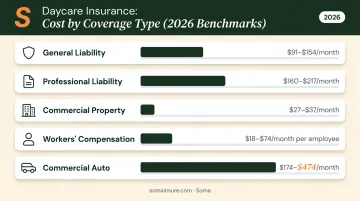
- Insureon's human and social services median: $91/month ($1,097/year)
- MoneyGeek's modeled daycare average: $154/month ($1,847/year)
GL is only the starting line. A commercial center typically needs several additional policies, all stacking on top of it:
| Coverage Type | 2026 Monthly Range | Source |
|---|---|---|
| Professional liability | $160–$217/month | MoneyGeek 2026 |
| Commercial property | $27–$37/month | MoneyGeek 2026 |
| Workers' compensation | $18–$74/month per employee | MoneyGeek 2026 |
| Commercial auto | $174–$474/month | MoneyGeek 2026 |
These are modeled benchmarks, not guaranteed quotes. Actual premiums vary by state, enrollment, claims history, and the carriers available for your risk profile.
What Types of Insurance Does a Daycare Need?
Daycare coverage is a stack of policies, not a single product. The right combination depends on your operation's size, services, and staffing.
General Liability
This is the foundational policy for every daycare — home-based or commercial. It covers third-party bodily injury, property damage, and personal and advertising injury claims arising from operations. According to NAEYC, approximately 30 states require licensed childcare centers to carry liability insurance, with 21 of those extending the requirement to certain licensed family childcare homes.
Professional Liability (Errors & Omissions)
This covers claims of negligence in the care you provide — failure to follow a child's allergy protocol, improper supervision, or inadequate staff training. Unlike general liability (which covers physical accidents), professional liability addresses service failures — and most standard GL policies exclude it entirely.
Abuse and Molestation Coverage
This is the coverage gap that surprises providers most. Standard GL policies exclude abuse and molestation claims, yet these are among the most expensive claims in childcare to defend — regardless of whether an allegation is substantiated.
The market has also tightened. An insurance agent quoted by the Hechinger Report noted that policies once offering up to $1 million in abuse claim coverage now frequently cap at $100,000–$300,000 in some markets — a trend worth understanding before you buy.
Abuse and molestation coverage may be structured as:
- A GL endorsement (limited — confirm the actual sublimit)
- A standalone policy
- A bundled specialty program
Never assume it's included — verify the sublimit explicitly with your broker before binding.
Property, Workers' Comp, and Commercial Auto
- Commercial property protects your building (if owned), equipment, supplies, and furnishings against fire, theft, and weather damage.
- Workers' compensation requirements vary by state. California requires coverage from the first employee. Georgia's threshold is generally three employees. Texas does not require most private employers to participate at all. Check your state's specific rules.
- Commercial auto is required if your center transports children. Personal auto policies do not cover business driving. If staff use their own vehicles for daycare business, a separate hired and non-owned auto policy covers that exposure.
Key Factors That Affect Daycare Insurance Costs
Operational and geographic factors drive far more premium variation than business size alone.
Facility Type and State
Home daycares pay less than commercial centers — lower foot traffic, simpler risk profiles, fewer staff. But state location matters just as much.
MoneyGeek's 2026 GL data shows the range clearly:
- West Virginia: ~$94/month
- California: ~$281/month
That gap reflects litigation environments, local court costs, and state regulatory requirements — not just the size of the operation.
Age Groups Served and Enrollment Size
Centers caring for infants and toddlers pay more than those serving school-age children. The supervision intensity and injury severity risk are higher, and insurers price accordingly.
Enrollment size directly scales liability exposure across most policy lines — more children means higher premiums. Underwriting applications collect maximum enrollment by age group specifically because insurers price these factors separately.
Services Offered
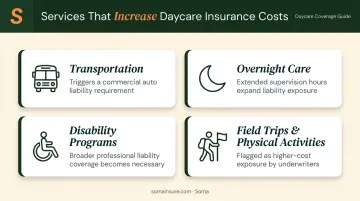
Each added service layer creates a distinct liability exposure:
- Transportation triggers the need for commercial auto, one of the more expensive coverage types
- Overnight care introduces extended supervision liability
- Programs serving children with disabilities may require broader professional liability terms
- Field trips and physical activities are flagged as higher-cost exposures by major underwriters
Claims History and Staff Practices
A history of filed claims — even unresolved ones — can make coverage harder to find and more expensive at renewal. Carriers will ask about prior claims during the application process.
On the other side, thorough documentation gives underwriters evidence of a well-managed operation — and can support better terms at renewal:
- Supervision protocols on file
- Staff training records
- Completed background checks
- Incident reporting procedures
Rising Market Conditions
The childcare insurance market has been hardening. Fewer carriers are writing daycare policies, abuse and molestation coverage has become more restricted, and providers have reported premium increases of 30%–300% in recent years — these are individual provider experiences reported to journalists, not a measured national average, but they reflect what many operators are encountering.
NAEYC's 2024 survey found 32% of respondents had been denied coverage and 32% had received a non-renewal notice since May 2023. Budget for renewal increases. Do not plan on last year's rate holding.
How to Budget for Daycare Insurance
The right insurance budget is not the lowest number — it is one that covers the actual exposures of your operation at realistic market prices.
Start with the full coverage stack, not just GL. A commercial center budgeting only for general liability will consistently underestimate its actual insurance spend. Professional liability, abuse and molestation, workers' comp, and commercial auto all add meaningful cost on top of the GL base.
A few practical budgeting approaches:
- Get quotes on all coverage lines simultaneously. Knowing the combined annual cost across all required policies — not just GL — is the only way to plan accurately.
- Ask about bundling. Some small daycare programs qualify for a Business Owner's Policy (BOP) that combines general liability and commercial property. Insureon's applicable human/social-services median for a BOP is around $135/month, which can represent savings compared to placing each line separately.
- Compare across multiple carriers. Quote variation for daycare insurance is wide, particularly for professional liability and abuse and molestation coverage. Approaching individual carriers one at a time is slow and often incomplete.
Comparing multiple carriers at once is easier with a specialist who already has access to them. Soma places daycare coverage — including abuse and molestation liability, professional liability, workers' comp, and commercial auto — through specialty carriers that write child care risk that standard markets often decline.
A single application drives quotes across carriers including Markel, Chubb, Liberty Mutual, Nationwide, and Kinsale, with underwriting based on enrollment ratios rather than lengthy back-and-forth. That matters when licensing and renewal deadlines don't allow for multi-week delays.
What Most Daycare Owners Get Wrong About Insurance Costs
Relying on homeowners insurance
Many in-home providers assume their homeowners policy covers daycare activities. Most don't. Some insurers offer endorsements, but these typically carry low limits and leave significant gaps — particularly for full-time operations. A separate commercial policy is necessary, not optional.
Skipping abuse and molestation coverage
Because it is not automatically included in general liability, some providers unknowingly operate without it. Even unsubstantiated allegations trigger immediate legal costs — and a policy that doesn't explicitly list this coverage won't respond when those costs hit.
This coverage has become harder to find and more restricted in recent years. Confirming it is explicitly included — not assumed — at every renewal is a non-negotiable step for any daycare operator.
Budgeting for GL and ignoring the rest
That same blind spot extends to the overall cost picture. Providers who budget only for general liability are regularly surprised by the combined cost of professional liability, workers' comp, property, and auto coverage.
Understanding the total annual spend across all required policies is the only way to build an accurate financial plan. Gaps discovered at claim time are the most expensive kind.
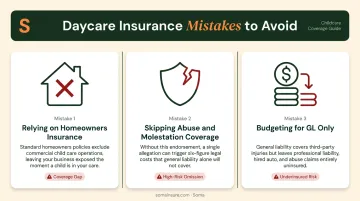
Three mistakes worth avoiding before renewal:
- Assuming homeowners coverage extends to full-time care operations
- Treating abuse and molestation coverage as included unless confirmed in writing
- Planning the insurance budget around GL alone, without accounting for all required lines
Frequently Asked Questions
How much is insurance for a daycare per month?
General liability alone runs approximately $56–$154/month based on published 2025–2026 benchmarks, ranging from smaller operations to commercial centers. Total monthly costs across all required coverage lines: professional liability, workers' comp, property, and auto — run considerably higher for centers with employees, transportation programs, or infant care.
What type of insurance do daycares need?
The core stack includes general liability (foundational), professional liability, abuse and molestation coverage, commercial property, workers' compensation (if you have employees), and commercial auto (if you transport children). Each addresses a distinct exposure that the others do not cover.
Does my homeowners insurance cover my home daycare?
Standard homeowners policies explicitly exclude business activities, including paid in-home childcare. Some insurers offer endorsements, but these carry limited coverage and frequently leave significant gaps. A separate commercial policy is required for full-time home daycare operations.
Is daycare insurance legally required?
General liability is required for licensed childcare centers in approximately 30 states, with 21 of those extending requirements to certain licensed family childcare homes. Workers' compensation requirements vary by state. Even where not mandated, operating without coverage exposes the business to potentially catastrophic personal liability.
Does the number of children I care for affect my premium?
Yes. Enrollment size directly affects premium calculations across most policy lines, and the age groups you serve matter as well. Insurer underwriting applications specifically collect maximum enrollment by age group — infant and toddler care is priced at higher rates than school-age programs.
Why has my daycare insurance premium gone up significantly at renewal?
The childcare insurance market has been hardening industry-wide: fewer carriers are writing these policies, claims costs have risen, and abuse and molestation coverage has become more restricted. NAEYC's 2024 survey found 32% of providers received a non-renewal notice in a single year — even well-run centers with clean claims histories are not exempt.