Introduction
Running a daycare means accepting responsibility for something no parent takes lightly — their child's safety. That concentration of liability exposure is exactly what standard commercial policies are not built to handle.
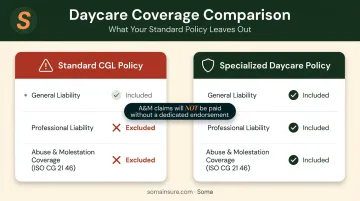
General liability forms routinely exclude abuse and molestation claims. Coverage gaps show up across multiple areas:
- Professional liability for supervision failures (missing from most BOPs)
- Field trip and child transportation incidents
- Staff conduct and background screening failures
- Abuse and molestation claims excluded by standard GL forms
The consequences of the wrong coverage aren't abstract. NAEYC's 2024 survey of 1,173 early childhood educators found that 62% reported more difficulty finding affordable coverage than the previous year, 32% had been denied coverage outright, and 32% had received a nonrenewal notice. The childcare insurance market is tightening — and the carriers willing to write quality coverage are not all equal.
This guide compares the best daycare insurance carriers based on coverage depth, AM Best financial strength ratings, childcare underwriting specialization, and claims handling — giving you a clear basis for comparison before you commit to a carrier.
Key Takeaways
- Daycare insurance requires coverages standard policies exclude — especially abuse and molestation liability and professional liability.
- 30 states mandate liability insurance as a condition of childcare licensing, but state minimums vary significantly.
- The top carriers for daycares include Chubb, Markel, Liberty Mutual, Nationwide, and Kinsale — each serving different operation types and risk profiles.
- Coverage exclusions and claims handling matter more than premium when selecting a carrier.
- Working with a specialty childcare broker reduces coverage gaps and gets quotes faster than approaching carriers directly.
Why Daycare Businesses Need Specialized Insurance
Standard commercial insurance is built around predictable risks. Daycare operations are not. When children are in care, the legal duty of supervision creates liability exposure on every square foot of the facility — the playground, the van, the nap room, and the field trip destination.
Several risk categories that are routine in childcare are excluded or severely underinsured by generic commercial policies:
- Abuse and molestation claims — excluded by default under most standard CGL forms (ISO exclusion CG 21 46)
- Professional liability — covering supervision failures or developmental care errors
- Hired and non-owned auto — for centers transporting children by bus or van
- Participant accident medical — covering injuries to children in care
- Crime and employee dishonesty — internal theft by staff members
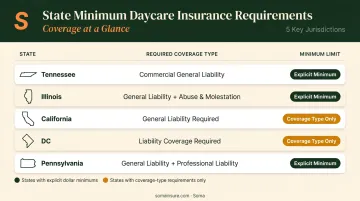
State licensing requirements add another layer. Thirty states require licensed childcare centers to carry liability insurance as a condition of licensure, with 21 of those extending requirements to some licensed family childcare homes. Specific minimums vary by jurisdiction:
| State | Verified Minimum Requirement |
|---|---|
| Tennessee | $500,000 GL per occurrence/aggregate (centers); $100,000 A&M per occurrence |
| Illinois | $300,000 single-limit GL per occurrence |
| California | $300,000 annually for family childcare homes |
| DC | CGL + sexual abuse and molestation required (no stated dollar minimum) |
| Pennsylvania | Comprehensive GL required; no specific dollar minimum stated |
Meeting state minimums keeps a license active — it does not protect against a serious claim involving staff conduct or professional negligence. Carrier selection determines whether that claim gets paid or disputed. The sections below compare carriers actively writing daycare coverage in the U.S.
Best Daycare Insurance Carriers Compared
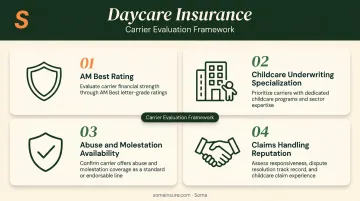
Carriers were evaluated across four criteria:
- AM Best financial strength rating — a measure of the carrier's ability to pay claims
- Dedicated childcare or social services underwriting program — specialty focus vs. general commercial appetite
- Abuse and molestation coverage availability — a non-negotiable for most daycare operations
- Claims handling reputation in the childcare sector — responsiveness when it matters most
Chubb
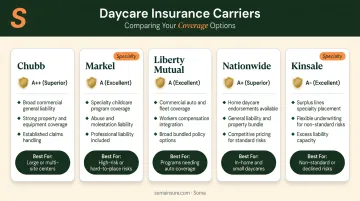
Chubb is a global commercial insurer with documented experience in human services and social services liability. Its human services program covers behavioral health agencies and related organizations, with policy limits potentially reaching $10 million — making it one of the few carriers positioned for larger daycare operations and multi-location childcare chains.
| Attribute | Detail |
|---|---|
| AM Best Rating | A++ (Superior), Stable — affirmed January 2026 |
| Coverage Highlights | General liability, professional liability, abuse and molestation, commercial property, umbrella |
| Best For | Mid-to-large daycare centers or multi-location childcare businesses needing high coverage limits |
| Key Differentiator | Strongest available AM Best rating; dedicated risk management resources for human services clients |
Markel
Markel is one of the most consistently cited specialty carriers in the childcare niche. It maintains separate, purpose-built underwriting programs for in-home providers (caring for 1–18 children) and commercial centers — covering licensed daycare centers, preschools, Montessori programs, nursery schools, and before/after-school programs.
Abuse and molestation coverage is included in its commercial childcare program and described internally as a "critical coverage."
| Attribute | Detail |
|---|---|
| AM Best Rating | A (Excellent), Stable — effective November 2025 |
| Coverage Highlights | Childcare liability package, abuse and molestation, professional liability, business personal property, accident medical, commercial auto, workers' comp |
| Best For | Small to mid-size daycare centers and home-based childcare providers seeking a specialty-focused carrier |
| Key Differentiator | One of few carriers with childcare-specific underwriting programs covering both in-home and center-based operations |
Liberty Mutual
Liberty Mutual is a large national commercial carrier with broad appetite across small business sectors. Its Business Owner's Policy (BOP) provides a bundled starting point for daycare operators who want property and liability coverage under a single policy with a nationally recognized brand.
| Attribute | Detail |
|---|---|
| AM Best Rating | A (Excellent), Stable — affirmed September 2025 |
| Coverage Highlights | BOP (general liability + commercial property), workers' compensation, commercial auto, umbrella |
| Best For | Daycare owners looking for bundled commercial coverage with a large carrier's claims network behind it |
| Key Differentiator | Flexible BOP structure with nationwide claims support — strong option for risk-averse owners prioritizing brand stability |
Note: Liberty Mutual's public documentation does not expressly confirm a daycare-specific BOP with an abuse and molestation endorsement. Verify A&M availability for your specific operation before binding.
Nationwide
Nationwide has a documented presence in the childcare and nonprofit space through its OthersFirst human services program, which expressly includes nonprofit and for-profit daycare centers — including programs serving children with special needs. Available coverages include abuse and molestation, professional liability, and business income.
Nationwide also ranked first in J.D. Power's 2023 U.S. Small Commercial Insurance Study with a score of 883 out of 1,000 — a strong signal for small daycare operators who need reliable service and fast claims response when something goes wrong.
| Attribute | Detail |
|---|---|
| AM Best Rating | A (Excellent), Stable — affirmed November 2025 |
| Coverage Highlights | General liability, professional liability, commercial property, business income, A&M, workers' comp, umbrella, auto |
| Best For | Independent daycare owners and small childcare businesses seeking straightforward, accessible coverage |
| Key Differentiator | Top-ranked small commercial insurer for customer satisfaction; digital-first policy management tools |
Kinsale
Kinsale is an Excess and Surplus (E&S) lines carrier — the go-to option when standard markets decline a daycare due to prior claims history, higher enrollment, unusual operational risks, or infant care specialization. E&S carriers like Kinsale operate outside standard market guidelines, which gives them flexibility to cover risks most carriers won't touch. Its documented daycare underwriting program covers general liability, professional liability, and abuse and molestation with primary limits up to $2 million.
| Attribute | Detail |
|---|---|
| AM Best Rating | A (Excellent), Stable — effective August 2025 |
| Coverage Highlights | General liability, abuse and molestation, professional liability (E&S placements) |
| Best For | Daycares declined by standard carriers, or those with complex risk profiles requiring E&S placement |
| Key Differentiator | E&S underwriting flexibility for hard-to-place childcare risks, including infant care — with faster-than-typical quote turnaround |
Key Coverage Types Every Daycare Policy Should Include
Not all daycare policies are equal. These are the coverage types that should appear in any policy package — and what each one actually does.
General Liability
Covers bodily injury and property damage claims from third parties — children, parents, or visitors — on your premises. This includes playground injuries, slip-and-fall incidents, and damage caused by children to others' property. General liability is the foundation of any commercial policy, but it leaves several exposures uncovered — which is why the coverages below matter.
Abuse and Molestation (A&M) Coverage
This is the most critical endorsement in childcare insurance and the most commonly missing. Standard general liability forms exclude abuse and molestation claims by default under ISO exclusion CG 21 46 — meaning a claim involving staff conduct toward a child in care would not be covered without a dedicated A&M form.
Some jurisdictions require it explicitly: Tennessee mandates $100,000 per occurrence in A&M coverage for licensed centers; Washington DC requires proof of sexual abuse and molestation coverage as part of the licensing process. Even where it isn't legally required, no daycare should operate without it.
Professional Liability (Errors and Omissions)
Covers claims arising from the professional delivery of childcare services — inadequate supervision, developmental care errors, negligent enrollment decisions, or failure to follow mandated reporting obligations. This is distinct from general liability and requires its own coverage form.
Workers' Compensation and Commercial Property
Both coverages are standard requirements for operating daycares, but they serve different purposes:
- Workers' comp — legally required in most states; covers medical expenses and lost wages for staff injured on the job
- Commercial property — protects facility contents, equipment, furnishings, and tenant improvements for centers that have invested in their physical space
How We Chose the Best Daycare Insurance Carriers
The carriers listed in this guide were not selected based on premium competitiveness alone. The evaluation applied four filters:
- AM Best financial strength rating — A- or better preferred, reflecting the carrier's ability to pay claims
- Childcare or social services underwriting specialization — carriers with dedicated programs, not generic commercial lines
- Abuse and molestation availability — A&M must be available within the program, not excluded by default
- Claims handling reputation — particularly relevant for childcare-specific claims that involve sensitive conduct allegations
The most common mistake daycare owners make is choosing the lowest-quoted premium without checking whether A&M coverage is included, what the policy exclusions are, or whether the carrier has experience adjudicating childcare claims. A lower premium on a policy that excludes abuse and molestation is not a bargain — it's an uncovered exposure.
Soma works with multiple daycare-focused carriers (including those listed in this guide), allowing childcare operators to receive competitive quotes across specialty markets through a single application. The process uses enrollment- and ratio-based underwriting, built specifically to meet licensing and renewal deadlines without the weeks of back-and-forth that generalist brokers require.
For operations that have been declined, non-renewed, or are entering the market for the first time, access to multiple specialty carriers in one submission can be the difference between getting coverage and going bare.
Conclusion
The right daycare insurance carrier combines financial stability, childcare-specific underwriting experience, and essential coverages — most critically, abuse and molestation protection. Choosing based on the lowest premium without verifying coverage inclusions is how providers end up with policies that don't pay out when it counts.
Before binding any policy, run through these three steps:
- Review exclusions carefully to confirm what the policy won't cover
- Verify A&M coverage is explicitly included, not just general liability
- Reassess annually as enrollment grows, staff changes, or operations expand
Whether you operate a single-room home daycare, a Montessori preschool, a faith-based childcare program, or a multi-site franchise, Soma places coverage with specialty carriers who write hard-to-insure child care risk, including infant care that standard markets routinely decline. One application. No weeks of waiting. Get a quote and find out which carriers will write your specific operation.
Frequently Asked Questions
What is the meaning of daycare in insurance?
In the insurance context, "daycare" refers to a business providing supervised care for children during daytime hours. Daycare insurance is a specialized commercial policy package — not a standard BOP — designed to cover the liability, professional, and property risks specific to childcare facilities, including abuse and molestation exposure and professional negligence claims.
What are the four types of insurance coverage for daycares?
The four broad commercial insurance categories are general liability, commercial property, professional liability, and workers' compensation. For daycares, all four apply: GL covers premises injuries, property covers the facility, professional liability covers supervision errors, and workers' comp covers staff injuries on the job.
How much does daycare insurance typically cost?
Premium varies by enrollment size, ages served, location, coverage limits, prior claims history, and whether A&M coverage is included. NAEYC's 2024 survey found that among programs reporting premium increases, 30% saw increases up to $1,999, while 13% of center-based programs reported increases of $10,000 or more in a single year.
Is abuse and molestation coverage required for daycares?
A&M is not universally required by law, but several states mandate it — Tennessee requires minimum A&M limits as part of childcare licensing, and Washington DC includes it in required proof of insurance. Even where not legally required, A&M is non-negotiable: standard GL policies exclude it by default.
Do home-based daycares need the same insurance as commercial daycare centers?
No — but they still need separate childcare coverage. Homeowners insurance does not cover paid childcare liability, as confirmed by NAIC guidance. Home-based daycare providers need a dedicated childcare liability policy, though the structure and limits typically differ from those of a licensed commercial center.