
Introduction
Running a dog daycare means shared spaces, unpredictable animals, and daily physical liability exposure — dog bites, escapes, injuries, and property damage are real, recurring events, not edge cases. The U.S. pet daycare market was valued at $1.73 billion in 2024 and is projected to grow at 8.78% annually through 2030, which means more facilities, more dogs in care, and more claims.
Insurance for this business isn't optional. The question is cost and coverage.
Dog daycare insurance costs range from under $600 per year for a solo home-based operator to $5,000 or more annually for a full-service facility with employees, overnight boarding, and transport. That spread reflects real differences in risk exposure — not just facility size.
This guide breaks down current pricing benchmarks by coverage tier, the key factors that drive your premium, and the coverage gaps that catch operators off guard when a claim hits.
Key Takeaways
- Dog daycare insurance costs range from roughly $600–$900/year for solo operators to $3,000–$5,000+/year for full-service facilities
- Most facilities need four core coverages: general liability, animal bailee/care-custody-control (CCC), commercial property (typically via a BOP), and workers' comp if you have employees
- Standard general liability does not cover injured dogs in your care — animal bailee/CCC coverage fills that gap
- Adding overnight boarding, transport, or grooming increases premiums meaningfully
- The cheapest policy isn't always the best — gaps in exclusions leave operators exposed when a claim actually hits
How Much Does Dog Daycare Insurance Cost?
Dog daycare insurance doesn't have a fixed price. Premiums shift based on facility size, employee count, services offered, location, and which coverages you select. Solo operators with a handful of dogs pay a fraction of what a multi-employee boarding facility pays — more staff, more animals, and more services mean more exposure.
According to Insureon's 2025 customer data, pet boarding and dog daycare customers paid an average of $639/year for general liability and $1,104/year for a Business Owner's Policy (BOP). Pet Care Insurance (PCI) advertises dog daycare coverage starting at $332.20/year — a carrier floor, not a typical mid-market price.
Here's how costs break down across three operational tiers:
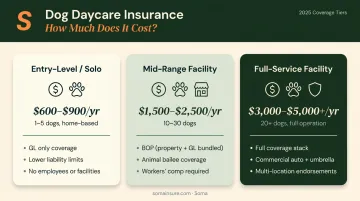
| Operator Tier | Estimated Annual Cost | What Drives It |
|---|---|---|
| Entry-level / solo (1–5 dogs, home-based) | $600–$900 | GL only, minimal staff, low capacity |
| Mid-range facility (staff, 10–30 dogs) | $1,500–$2,500 | BOP + animal bailee + workers' comp |
| Large / full-service (boarding, transport, 20+ dogs) | $3,000–$5,000+ | Full package including commercial auto, professional liability |
Entry-Level Coverage ($600–$900/Year)
Home-based operators and part-time setups with few dogs and no employees typically land in this range. Coverage at this tier includes:
- General liability ($1M per occurrence / $2M aggregate)
- Minimal or no animal bailee coverage
- Sometimes basic professional liability
One limitation to watch: base animal bailee limits from specialty carriers can be as low as $2,500 per occurrence / $5,000 per policy term. A single dog-on-dog incident can exceed that — which is why many growing operations quickly outgrow entry-level policies.
Mid-Range Coverage ($1,500–$2,500/Year)
Established daycare facilities with a physical location, staff, and capacity under 30 dogs typically fall into this tier. Coverage includes:
- Business Owner's Policy (BOP: general liability + commercial property)
- Animal bailee/CCC coverage with higher limits
- Workers' compensation for 1–5 employees
High-End Coverage ($3,000–$5,000+/Year)
Multi-service facilities with overnight boarding, grooming, transport, and 20+ dogs in daily care need a full coverage stack. That typically means:
- Full BOP
- Animal bailee coverage with meaningful per-occurrence limits
- Workers' comp for larger teams
- Commercial auto for transport ($2,500–$5,000/year on its own)
- Professional liability/E&O
- Optional cyber liability
Key Factors That Affect Dog Daycare Insurance Cost
Your premium is shaped by a combination of operational and coverage-specific factors. Understanding each one helps you budget accurately and avoid surprises at renewal.
Facility Size and Dog Capacity
The number of dogs you can handle simultaneously is one of the most direct premium drivers. More dogs means more liability exposure, a higher probability of incidents, and larger potential claim payouts. Insurers ask about dog capacity upfront for this reason.
Overnight boarding operations consistently carry higher premiums than daycare-only facilities. The extended supervision window (overnight, when staffing is reduced) increases the risk of undiscovered medical emergencies, escapes, or dog-on-dog incidents.
Services Offered
Each service you add introduces a distinct risk layer:
- Grooming adds equipment liability, handling risk, and potential for injury claims
- Overnight boarding extends the period of responsibility and increases animal bailee exposure
- Transport requires commercial auto coverage — typically $2,500–$5,000/year as a standalone policy
Group play environments specifically affect how animal bailee/CCC coverage applies. Insurers treat group-play facilities differently from individual-run operations because the incident probability and liability structure differ significantly.
Location and State Regulations
Where you operate affects your premium in two ways:
- Regional veterinary costs: A vet bill for a dog injured in New York City is significantly higher than one in rural Georgia, and insurers price accordingly.
- Property values: Urban locations with higher property values push commercial property premiums up.
State and local licensing requirements also shape your minimum coverage needs. New York City's Small Animal Boarding Establishment Permit, for example, requires proof of workers' compensation and disability insurance as a condition of licensure. Requirements differ by jurisdiction, so confirm local rules before selecting your coverage limits.
Claims History and Business Experience
A clean claims history works in your favor at renewal. Prior claims, especially bite or injury claims, signal higher risk to underwriters and can meaningfully increase your renewal premium.
Newer businesses are typically rated as higher risk due to limited track record. Professional certifications, such as those from PACCC (Professional Animal Care Certification Council), can demonstrate operational credibility, though no specific premium discount tied to certification has been publicly documented by carriers.
Dog Daycare Insurance Cost Breakdown by Coverage Type
Your total insurance cost isn't a single policy — it's the sum of several distinct coverages. Here's what each costs and what it protects.
General Liability Insurance
- Annual cost benchmark: ~$639/year for boarding/daycare facilities (Insureon 2025 customer average)
- Limits: Typically $1M per occurrence / $2M aggregate
- Covers: Third-party bodily injury or property damage — a client slipping in your lobby, a dog biting a visitor
This is the baseline policy. Nearly every dog daycare needs it. What it does not cover is equally important.
Animal Bailee / Care, Custody, and Control (CCC) Coverage
This is the most critical and most misunderstood coverage for dog daycare operators.
Standard general liability policies explicitly exclude damage to property in the insured's care, custody, or control. Animals qualify as property under that exclusion. An injured dog in your facility generates zero GL coverage without a separate animal bailee endorsement.
That gap has real financial consequences. Pet Care Insurance reports that animal bailee coverage responded to 59.97% of pet professional claims that GL could not cover — claims that would have come straight out of pocket without it. Documented examples include:
- $7,117 — puppy play-group fight injuries
- $14,429 — severe virus among boarded dogs
- $15,000 — lost dog
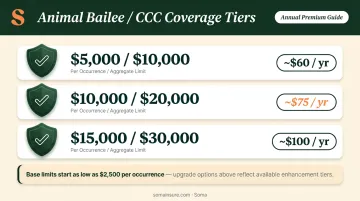
Base bailee limits from some carriers start as low as $2,500 per occurrence. Upgrades typically run:
- $5,000/$10,000 limit: ~$60/year
- $10,000/$20,000 limit: ~$75/year
- $15,000/$30,000 limit: ~$100/year
For higher-capacity facilities, these base limits can be exhausted by a single incident.
Business Owner's Policy (BOP)
- Annual cost benchmark: ~$1,104/year for boarding/daycare (Insureon 2025 average)
- Covers: General liability + commercial property, often including business income replacement
A BOP bundles GL and commercial property into one policy, which is typically more cost-effective than buying each separately. The business income component can replace lost revenue if a covered event forces a temporary shutdown — a meaningful safeguard if your entire operation runs from one facility.
Protecting the business itself is one side of the equation. Protecting the people who run it is another.
Workers' Compensation Insurance
- Annual cost benchmark: ~$1,488/year for boarding/daycare (Insureon 2025 average)
- Required in: Most U.S. states once you have employees (Texas is the notable exception, where most private employers may opt out as nonsubscribers)
Dog daycare work carries real physical risk — bites, falls, lifting injuries. Even in states where workers' comp isn't legally mandated, operating without it exposes the business to direct employee lawsuits for work-related injuries.
Professional Liability / E&O and Commercial Auto
- Professional liability/E&O: ~$1,056/year (Insureon 2025 pet-care average) — covers claims of negligent supervision or professional service failures
- Commercial auto: $2,500–$5,000/year — required if company vehicles transport dogs
Professional liability becomes relevant when clients dispute how their dog was handled — a grooming injury, an escape, or a dog-fight during supervised play. Commercial auto applies the moment a company vehicle picks up or drops off a dog. If staff use their own cars for transport instead, hired/non-owned auto coverage fills that gap at a lower cost.
What Most Dog Daycare Owners Get Wrong About Insurance Costs
Assuming General Liability Covers Dogs in Their Care
It doesn't. The ISO standard commercial general liability form excludes property damage to personal property in the insured's care, custody, or control. Dogs fall under that exclusion. An operator who believes their GL policy protects them when a dog is injured in their facility will discover the gap only after a claim is denied.
Animal bailee/CCC coverage is not a supplemental nice-to-have — it's a core coverage for any facility with dogs in group care.
Not Updating Coverage as the Business Grows
Many operators buy a policy when they open with 5–10 dogs and never adjust it as capacity, staff, and services expand. Coverage limits that were appropriate at launch can be woefully inadequate two years later. A claim that exceeds outdated limits creates out-of-pocket exposure that no business wants to absorb.

Review your policy annually. Trigger a coverage review any time you:
- Increase dog capacity
- Hire additional staff
- Add services like boarding, grooming, or transport
Buying the Cheapest Policy Without Reading the Exclusions
Meeting a basic licensing requirement and actually protecting your business are two different things. The difference only becomes apparent when a claim is filed.
A generic small business policy may exclude animal-related liability entirely. Working with a specialist broker — like Soma, which places coverage across dozens of carrier partners — lets operators compare coverage structures, not just premium prices, so those exclusions get caught before a claim does.
Frequently Asked Questions
What insurance do you need for a doggy daycare?
The core coverage stack includes general liability, animal bailee/CCC coverage, commercial property (typically bundled in a BOP), and workers' compensation if you have employees. Commercial auto applies if you transport dogs in company vehicles. Some jurisdictions, including New York City, require proof of specific coverage as a condition of licensure.
How much does $100,000 of dog liability insurance cost?
Most specialty pet care carriers cap published animal bailee tiers around $15,000–$30,000, so a $100,000 limit typically requires a broker conversation. Note that animal liability — covering injuries a pet causes to third parties — is a separate product from bailee coverage and priced differently.
How much does general liability insurance cost for a dog daycare?
Based on Insureon's 2025 customer data, dog daycare and boarding facilities paid an average of $639/year for a standard $1M/$2M general liability policy. Rates vary by location, dog capacity, and claims history — solo home-based operators may pay less, while larger urban facilities typically pay more.
Does dog daycare insurance cover dog-on-dog bite incidents?
Standard general liability does not cover dog-on-dog injuries. These fall under the care, custody, and control exclusion. Animal bailee/CCC coverage is what responds to dog-on-dog incidents — the policy general liability explicitly excludes. Any facility running group play needs it.
Is workers' compensation required for dog daycare employees?
Workers' comp is required in most U.S. states once you have employees — Texas is the main exception, where opt-out is allowed but leaves employers exposed to direct lawsuits. Given the physical demands of dog daycare work, coverage is advisable even where it isn't legally required.
Can I bundle multiple coverages to reduce my dog daycare insurance cost?
Yes. A BOP bundles general liability and commercial property into a single policy and is generally more cost-effective than purchasing each separately. Working with a broker who has access to multiple carriers allows you to compare bundled options specifically structured for pet care operations — rather than a generic small business package that may not cover pet care risks.