The right choice depends on more than price. Daycare insurance can differ in areas such as abuse and molestation coverage, property protection, eligibility for activities like infant care or transportation, certificate support, and how you apply for and manage coverage. Some providers work best for specific types of childcare operations, while others offer broader market access.
This guide compares seven Next Insurance daycare alternatives to help you identify which options may fit your business. Before comparing providers, it helps to know which differences actually matter for a daycare.
TL;DR
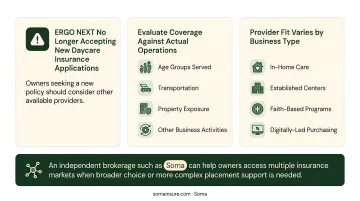
- ERGO NEXT is no longer accepting new daycare insurance applications, so owners seeking a new policy need to consider other available providers.
- Coverage should be evaluated against the daycare's actual operations, including the age groups served, transportation, property exposure, and other business activities.
- Provider fit varies by business type, with some options geared toward in-home care, established centers, faith-based programs, or digitally led purchasing.
- An independent brokerage such as Soma can help owners access multiple insurance markets when broader choice or more complex placement support is needed.
What to Compare in a Next Insurance Daycare Alternative
While comparing daycare insurance alternatives, it is useful to look beyond price and review a few factors that affect how well a policy fits your operation.
1. Abuse and Molestation Coverage
Check whether abuse and molestation coverage is included in the policy or added through an endorsement. Pay attention to the available limit or sublimit rather than assuming general liability provides sufficient protection. You should also confirm whether the coverage is written on an occurrence or claims-made basis and whether legal defense costs reduce the amount available to pay a covered claim.
2. Property Coverage
Property limits should reflect what it would actually cost to replace the items your daycare relies on. This can include furniture, cribs and cots, appliances, classroom equipment, playground equipment, and improvements made to the premises. A limit that works for a small in-home provider may not be appropriate for a larger childcare center with substantially more business property.
3. Fit With Your Daycare's Operations
Insurance should match the activities your program performs in practice. When reviewing an option, check how it treats infant care, transportation, field trips, extended operating hours, and any other regular activities that affect your risk profile. The right fit will depend on your daycare's size, age groups served, services, and operating model.
4. Service and Certificate Support
Daycare owners may need certificates of insurance for landlords, licensing agencies, subsidy programs, accreditation organizations, or other parties that require proof of coverage. Review how certificate requests and policy servicing are handled once coverage is in place. Depending on the provider, support may come through an agent, broker, representative, or digital servicing platform.
5. Direct Carrier vs. Brokerage Access
The buying structure can also affect the options available to you. A direct carrier offers policies available through that insurer and applies its own underwriting requirements. An independent brokerage can approach multiple insurance markets based on the daycare's needs and risk profile, although eligibility and final terms still depend on each carrier's underwriting.
For owners who want broader market access or help with a more complex placement, Soma's daycare insurance brokerage can help identify available options and compare coverage across appropriate markets.
With those factors in mind, the seven options below stand out for different types of daycare owners.
7 Best Next Insurance Daycare Alternatives
No single insurance provider is the right fit for every daycare. Some options specialize in childcare, others are suited to broader commercial or organizational risks, and brokerages can provide access to more than one insurance market. The seven options below stand out for different daycare structures, coverage needs, and buying preferences.
1. Soma: Best for Broad Market Access and Hard-to-Place Daycares
Soma is an independent commercial insurance brokerage licensed in all 50 states. Unlike a direct carrier, it is not limited to one insurance company. Soma can approach appropriate insurance markets based on a daycare's operations, coverage needs, and underwriting profile.
Soma is a strong fit for owners who want broader market access, help with a difficult placement, or guidance comparing daycare-specific coverage.
Its brokerage model can be useful for:
Complex daycare operations: Including infant care, transportation, extended hours, multiple locations, or other factors that may require more specialized placement.
Daycare-specific coverage needs: Soma can help compare options for general liability, abuse and molestation liability, professional liability, property, workers' compensation, auto exposures, and other relevant coverages.
Broader market access: If one insurer's underwriting requirements do not fit the business, Soma can approach other appropriate markets that consider childcare risks.
Policy comparison: Owners can review differences in limits, exclusions, endorsements, deductibles, and coverage structure before choosing an option.
Certificate support: Once coverage is bound, Soma can assist with certificate of insurance requests for landlords, licensing agencies, and other organizations.
Eligibility, pricing, coverage terms, and binding decisions remain subject to carrier underwriting.
2. Markel: Best for Established Childcare Specialty Coverage
Markel offers specialty insurance programs for childcare businesses, including eligible in-home providers and licensed commercial childcare centers.
Depending on the program, available coverage may include:
- General liability
- Professional liability
- Abuse and molestation liability
- Commercial property
- Accident medical
- Commercial auto
- Umbrella liability
- Workers' compensation
Its childcare focus makes it relevant for owners who prefer a carrier with programs designed specifically around childcare operations rather than a general small-business policy.
Markel also serves different childcare structures, so owners should review which program applies to their operation. The coverage available to an in-home provider may differ from that offered to a larger commercial center.
Quotes and policy servicing are generally handled through insurance agents, giving owners professional assistance during the application and servicing process.
3. The Hartford: Best for Established Centers Seeking Broad Commercial Coverage
The Hartford offers a broad range of commercial insurance products that may suit established daycare centers with employees, business property, and several commercial exposures.
A daycare may need a combination of coverages such as:
- General liability
- Commercial property
- Business income
- Workers' compensation
- Other policies or endorsements based on its operations
This broader commercial approach may be useful for established childcare businesses that need more than a single liability policy.
Daycare owners should still review the actual quote carefully. Confirm which childcare-specific endorsements are included, the applicable liability limits, exclusions, and whether abuse and molestation protection is part of the proposed coverage.
The final policy should reflect the daycare's actual activities rather than relying on the assumption that every exposure is automatically covered under a broader commercial package.
4. Great American: Best for Child-Serving Organizations Focused on Abuse-Prevention Resources
Great American serves a broader human-services market that includes organizations working with children.
One area that distinguishes its offering is the attention given to abuse and molestation risk and related prevention resources. Depending on the applicable program, coverage may address abuse and molestation exposure alongside other commercial insurance needs.
Available coverage for eligible organizations may include areas such as:
- General liability
- Professional liability
- Property
- Commercial auto
- Crime
- Umbrella or excess liability
Risk-management resources may also address staff screening, training, reporting, and abuse-prevention practices.
Because these programs extend beyond traditional daycare businesses, owners should confirm that their specific childcare operation is eligible and review the actual coverage form, applicable limits, exclusions, and defense-cost provisions included in the quote.
5. Church Mutual: Best for Faith-Based Daycare Programs
Church Mutual may be particularly relevant when a daycare operates as part of a church, ministry, religious school, or other faith-based organization.
These programs can have insurance needs that extend beyond the childcare operation itself, including buildings, employees, organizational activities, and liability exposures.
Relevant coverage may include:
- Property
- General liability
- Professional liability
- Workers' compensation
- Other organizational coverages based on the operation
For a church- or ministry-attached daycare, this broader organizational approach can allow the childcare program to be considered alongside the risks of the larger institution.
Owners should confirm how the daycare operation is covered within the proposed insurance program. Abuse, sexual misconduct, or molestation protection should also be reviewed directly in the quote and policy documents, including the applicable limits and exclusions.
6. Philadelphia Insurance Companies (PHLY): Best for Center-Based and Organizational Childcare
Philadelphia Insurance Companies, commonly known as PHLY, offers a childcare insurance package for eligible childcare centers, preschools, daycares, and after-school programs.
This makes it particularly relevant to center-based and organizational childcare operations seeking a program structured around the exposures of a childcare facility.
Depending on the policy and eligibility, owners may need to review areas such as:
- General liability
- Abuse and molestation protection
- Professional liability
- Property
- Business income
- Other organizational coverages
PHLY may fit nonprofit and for-profit childcare organizations, subject to its underwriting requirements.
Quotes and servicing are generally supported by agents or brokers, allowing owners to get assistance with applications, placement, and ongoing policy needs. As with any option, the daycare should confirm the final limits, exclusions, endorsements, and operational eligibility shown in the proposed policy.
7. CoverWallet: Best for Owners Who Prefer a Digitally Led Brokerage Process
CoverWallet offers a digitally led business insurance experience that combines an online application process with access to insurance advisors.
This structure may appeal to daycare owners who prefer to begin the insurance-buying process online while still having professional support available when needed.
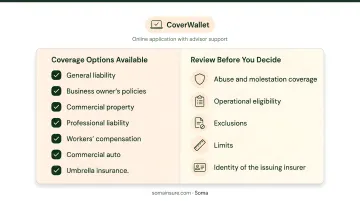
Depending on the insurer and the daycare's underwriting profile, available commercial coverage may include:
- General liability
- Business owner's policies
- Commercial property
- Professional liability
- Workers' compensation
- Commercial auto
- Umbrella insurance
Because CoverWallet operates as a brokerage and placement platform rather than issuing every policy itself, the actual terms depend on the insurer providing the quote.
Daycare owners should therefore review the proposed policy for childcare-specific considerations such as abuse and molestation coverage, operational eligibility, exclusions, limits, and the identity of the issuing insurer before making a decision.
The table below puts the main differences between these options in one place.
Next Insurance Daycare Alternatives Compared
The right option depends on the type of daycare you operate, the coverage you need, and how you prefer to buy and manage insurance. This table summarizes the main differences between the seven alternatives.
| Provider | Structure | Daycare fit | A&M position | Buying / support model |
|---|---|---|---|---|
| Soma | Independent commercial brokerage | Broad fit, including more complex or hard-to-place daycare risks | Can seek dedicated A&M options where available | Broker-assisted application and market placement |
| Markel | Specialty insurance carrier | In-home providers and licensed childcare centers | Childcare programs may include dedicated A&M coverage | Agent-assisted quoting and servicing |
| The Hartford | Commercial insurance carrier | Established centers with broader commercial insurance needs | Confirm inclusion, limits, and endorsements in the final quote | Representative or partner-supported process |
| Great American | Specialty commercial insurer | Child-serving and human-services organizations | A&M coverage and prevention resources may be available | Representative or broker-assisted |
| Church Mutual | Religious and institutional insurance specialist | Church-, ministry-, and faith-based childcare programs | Confirm sexual misconduct or molestation protection in policy terms | Representative-assisted |
| PHLY | Specialty commercial insurer | Center-based, preschool, after-school, and organizational childcare | May be available within the childcare program | Agent- or broker-assisted |
| CoverWallet | Digital brokerage and placement platform | Owners who prefer a digitally led buying process | Depends on the carrier and quoted policy | Online application with advisor support |
Coverage, eligibility, endorsements, and availability can change. Final terms depend on the actual quote, policy documents, and carrier underwriting.
Once you have selected an option, the next step is making the change without leaving your daycare uninsured between policies.
How to Switch Daycare Insurance Without a Coverage Gap
Once you have chosen a replacement option, the priority is making sure the new policy starts before the old one ends. A coverage gap can create problems with licensing, leases, contracts, or other requirements tied to proof of insurance.
1. Gather Your Current Policy Documents and Loss Runs
Start with your declarations page, current policy forms, endorsements, certificates of insurance, and any recent renewal or non-renewal communication. You may also need loss runs, which summarize your prior claims history and are commonly requested during underwriting.
Having these documents ready can reduce delays once the application process begins.
2. Complete the New Application Accurately
Provide complete and current information about your daycare. This may include enrollment, ages served, employee count and payroll, licensing status, property values, transportation, prior claims, and other operational details requested by the insurer.
Incomplete or inconsistent information can slow down underwriting or affect the terms offered.
3. Confirm That Replacement Coverage Is Formally Bound
A quote is not the same as active insurance. Before ending your existing policy, confirm in writing that the replacement coverage has been formally bound and review the effective date shown on the binding confirmation or policy documents.
This is the point at which the new insurer has confirmed that coverage will take effect according to the stated terms.
4. Align the Effective Dates
Compare the expiration date and time of your existing policy with the effective date and time of the replacement policy. The dates should line up so there is no uninsured period between them.
If the new policy begins before the old one expires, confirm how any overlap should be handled before making changes to the existing coverage.
5. Update Certificates and End the Old Policy if Needed
Once the replacement policy is active, request updated certificates of insurance for any landlord, licensing agency, subsidy program, lender, or other organization that requires proof of coverage.
After that, complete any required cancellation steps for the old policy and keep written confirmation for your records.
The right replacement is the one that fits both your daycare's operations and the way you prefer to buy and manage coverage.
Choosing a Replacement for Next Insurance Daycare Coverage
No single insurance provider fits every daycare, so the best replacement should be chosen on more than price alone. Look for an option that matches your operation, required coverage, and the level of support you want during quoting and servicing.
Soma is a strong option for daycare owners who need access to multiple insurance markets, help with a more difficult placement, or guidance comparing daycare-specific policy terms. As an independent commercial insurance brokerage licensed in all 50 states, Soma can approach appropriate markets based on the daycare's risk profile, subject to underwriting.
Request a daycare insurance quote from Soma before your licensing, lease, opening, or current-policy deadline.
FAQs
Can I switch daycare insurance before my current policy ends?
Yes. You can move to a new daycare insurance policy before the existing one expires, but the replacement coverage should be formally bound before the old policy is cancelled. Confirm the new effective date in writing so there is no unintended gap between policies.
What information will I need to get a daycare insurance quote?
Insurers typically need enough information to understand the size and operations of your childcare business. Be prepared to provide:
- Current enrollment and licensed capacity
- Ages of the children served
- Number of employees and payroll
- Licensing information
- Claims or loss history
- Property and equipment values
- Transportation details, if applicable
- Current policy documents and coverage information
Additional details may be requested depending on the daycare's activities and underwriting profile.
What does replacement daycare insurance cost?
There is no single price that applies to every daycare. Premiums can vary based on factors such as enrollment, ages served, staffing and payroll, location, property values, transportation, prior claims, requested limits, deductibles, and the types of coverage included.
A small in-home provider may therefore receive a very different quote from a larger childcare center with employees, vehicles, and substantial business property. Final premiums are determined through underwriting, so online averages should not be treated as expected quote prices.
Is a broker or direct carrier better for a daycare?
Neither structure is automatically better for every childcare business. A direct carrier can be a practical option when the daycare fits that insurer's eligibility requirements, and the available policy provides the coverage the owner needs.
An independent brokerage may be more useful when the daycare needs access to multiple insurance markets, has received a non-renewal, requires specialized limits, or has operational characteristics that make placement more complex. The right approach depends on the daycare's risk profile and preferred level of assistance.
What should I check if my daycare transports children?
If your daycare owns vans, buses, or other vehicles, review whether commercial auto insurance is required for those vehicles and drivers. If employees use personal vehicles for daycare-related errands or transportation, hired and non-owned auto coverage may also be relevant. You should also confirm that child transportation is permitted under the liability program and is not restricted or excluded by the policy terms.