According to Hiscox's 2025 underinsurance report, 77% of small businesses are underinsured, and 83% of owners couldn't correctly describe professional liability. That's not a minor knowledge gap — it's a coverage gap that can cost you everything when a claim hits.
This guide breaks down exactly what general liability (GL) and professional liability (PL) each cover, where they diverge, and how to figure out which one — or both — your business actually needs.
Key Takeaways
- GL covers physical, third-party risks: bodily injury, property damage, and advertising injury
- PL (also called E&O) covers financial harm clients suffer from your professional errors or omissions
- GL claims are triggered by accidents; PL claims are triggered by service failures
- Most service businesses need both — the two policies cover entirely different exposures
- Policy structure differs too: GL is occurrence-based, PL is claims-made
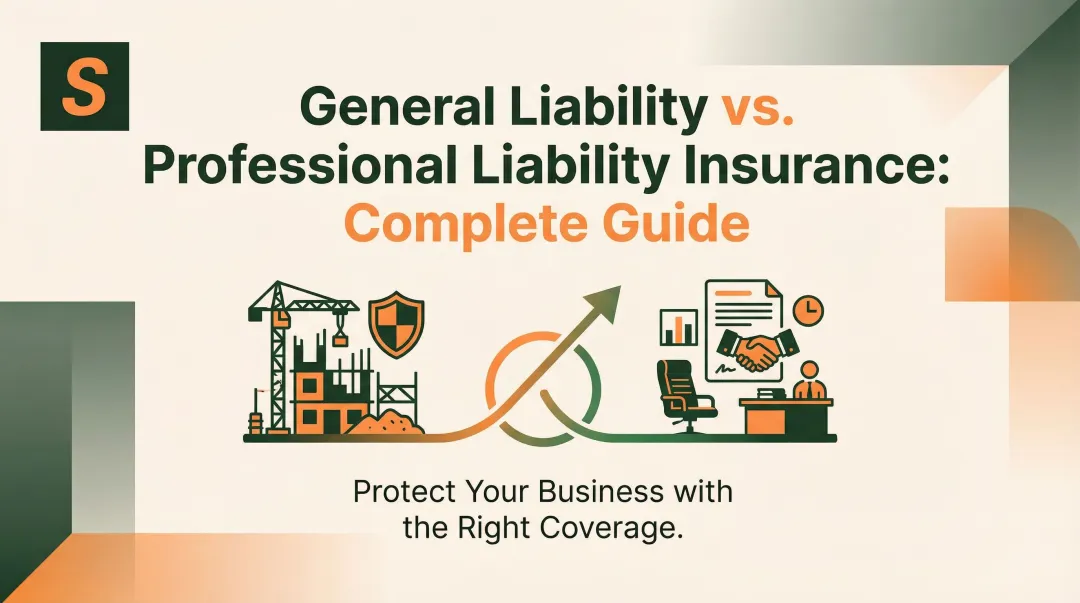
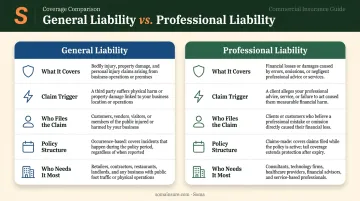
General Liability vs. Professional Liability: Quick Comparison
| Dimension | General Liability (GL) | Professional Liability (PL) |
|---|---|---|
| What it covers | Bodily injury, property damage, personal/advertising injury | Client financial loss from errors, omissions, or negligence in professional services |
| What triggers a claim | An accident — someone trips, property gets damaged | A client alleges your advice or work caused them measurable harm |
| Who files the claim | General public, visitors, third parties | Clients or customers who feel professionally wronged |
| Policy structure | Occurrence-based | Claims-made (coverage must be active when claim is filed) |
| Who needs it most | Any business with a physical location or public-facing operations | Any business providing advice, expertise, or professional services |
What Is General Liability Insurance?
General liability is typically the first policy a small business buys — and for good reason. It protects against third-party claims arising from physical incidents during normal business operations.
What GL Covers
Four core areas fall under a standard GL policy:
- Bodily injury — a customer slips on your premises and requires medical treatment
- Property damage — your employee accidentally damages a client's property on a job site
- Personal and advertising injury — libel, slander, or copyright infringement in your marketing
- Products-completed operations — physical harm that occurs after a job is finished or a product is sold
GL is structured as an occurrence-based policy, meaning it covers incidents that happen during the policy period — even if the claim is filed years later.
What GL Does NOT Cover
This is where many business owners overlook gaps:
- Professional errors or bad advice
- Your own business property (requires commercial property insurance)
- Employee injuries (requires workers' compensation)
- Company vehicle accidents (requires commercial auto)
Those gaps matter more than most owners expect. Hartford's analysis of over one million small-business policies found more than 40% of small businesses will have a claim within 10 years, with slip-and-fall incidents averaging $20,000 per claim.
GL is often packaged into a Business Owner's Policy (BOP) alongside commercial property insurance, making it a cost-efficient starting point for most businesses.
Who Needs General Liability Insurance?
GL is essential for:
- Construction contractors — on-site operations and completed work exposure
- Retail businesses — customer-facing premises with constant foot traffic
- Restaurants and hospitality — guest injury, premises liability, food service incidents
- Any business with a physical location open to the public
- Businesses that rent commercial space — most landlords require proof of GL before a lease is signed
Many clients and general contractors also require a valid GL certificate before signing a contract. Without one, you may not win the work at all.
What Is Professional Liability Insurance?
Professional liability insurance — also called errors and omissions (E&O) insurance — protects businesses from client claims alleging that professional services caused financial harm. Coverage applies even when no actual mistake was made — because the cost of defending a lawsuit alone can be devastating.
What PL Covers
Four core scenarios trigger PL coverage:
- A consultant's flawed analysis steers a client into a costly business decision
- A financial advisor recommends the wrong investment strategy
- An IT firm delivers a project late, triggering client revenue losses
- A marketing agency's creative work inadvertently infringes on existing intellectual property (IP)
What PL Does NOT Cover
PL is equally firm about what it excludes:
- Bodily injury or property damage (that's GL)
- Your own business property
- Employee injuries
- Vehicle accidents
The Claims-Made Trap
Most PL policies run on a claims-made basis — meaning coverage only applies if both the incident and the claim occur while the policy is active. This creates a real risk: let your policy lapse, receive a claim a year later, and you may have no coverage.
This is why tail coverage (an extended reporting period) matters when switching carriers or winding down operations.
PL Naming Varies by Industry
The same core coverage goes by different names:
- Lawyers → Professional liability
- Healthcare providers → Malpractice insurance
- Tech and consulting firms → Errors and omissions (E&O)
Same function. Different forms tailored to industry-specific risks.
Who Needs Professional Liability Insurance?
The name on the policy changes, but the need doesn't. PL is essential for:
- IT and SaaS firms — software failures, failed implementations, data errors
- Consultants and advisors — any profession where clients rely on your judgment
- Healthcare providers — clinical errors and treatment decisions
- Accountants and CPAs — tax errors, audit failures, financial misstatements
- Architects and engineers — design flaws, specification errors
- Financial advisors and RIAs — investment advice, fiduciary decisions
- Marketing agencies — campaign errors, IP issues in creative work
State law can make PL mandatory — Oregon attorneys must carry coverage through the state's Professional Liability Fund, and Colorado and Kansas set defined malpractice requirements for healthcare providers. Beyond legal mandates, many client contracts in tech and finance require proof of PL before any engagement starts.
Key Differences Between GL and PL
The single most important distinction: GL covers physical harm to people or property; PL covers financial harm to clients from how your services were delivered.
Trigger Difference
- GL is triggered by an unexpected accident — someone trips, a wall gets damaged, a product injures a customer
- PL is triggered by a dissatisfied client who alleges your professional judgment, advice, or work caused measurable financial loss
These are completely different legal situations with different legal dynamics.
Policy Structure Difference
This one catches people off guard. The two policies follow different coverage timelines:
- GL (occurrence-based): A claim for an incident that happened during an active policy period is still covered, even if the policy has since lapsed
- PL (claims-made): If the policy lapses and a claim arrives later, you may have no coverage — regardless of when the work was performed
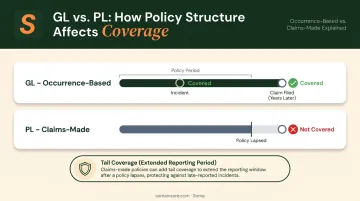
Example: A consultant completes a project, decides not to renew the PL policy, then receives a lawsuit 14 months later alleging the advice caused client losses. Without an extended reporting period (tail coverage), that claim falls entirely outside coverage.
Coverage Gaps Both Policies Share
Neither GL nor PL covers:
- Employee injuries → workers' compensation
- Owned business assets → commercial property insurance
- Company vehicle accidents → commercial auto insurance
Each of these gaps represents a separate exposure — which is why most businesses end up needing several policies working in parallel, not just one.
Which Type of Liability Insurance Does Your Business Need?
Three Paths to the Right Answer
The right coverage depends on where your exposure actually lives:
- GL only — your primary risk is physical: a public-facing location, work on client property, or products you manufacture and sell
- PL only — your primary risk is service-based: advice, consulting, or expertise that clients rely on financially
- Both — you do both, which describes most businesses in tech, healthcare, construction, finance, and hospitality
Industry-Specific Examples
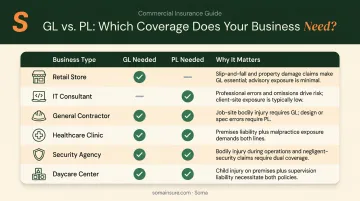
| Business Type | GL Needed? | PL Needed? | Why |
|---|---|---|---|
| Retail store | ✅ Yes | Usually no | Customer injuries, premises liability — no professional advice exposure |
| IT consultant | ✅ Yes | ✅ Yes | Client site visits (GL) + software failures or bad code (PL) |
| General contractor | ✅ Yes | ✅ Yes | On-site injuries (GL) + design/planning decisions (PL) |
| Healthcare clinic | ✅ Yes | ✅ Yes | Premises incidents (GL) + clinical errors and malpractice (PL) |
| Security agency | ✅ Yes | ✅ Yes | Physical operations (GL) + failure-to-prevent claims and E&O (PL) |
| Daycare center | ✅ Yes | ✅ Yes | On-site child injuries (GL) + professional care negligence (PL) + abuse & molestation liability |
For businesses in complex or hard-to-insure categories — security agencies, daycare providers, healthcare, construction — standard markets frequently decline to write coverage or offer incomplete programs.
Soma places both GL and PL across all of these industries, working with hundreds of carrier partners (including Chubb, Hiscox, Kinsale, Liberty Mutual, and Markel) through a single application. If you've been told your business is too complicated to insure, that's exactly the problem Soma is built to solve.
Before finalizing coverage, make sure you've covered these steps:
- Review client contracts for any insurance requirements they specify
- Check state licensing mandates in every state where you operate
- Factor in your claims history, which affects both eligibility and pricing
A specialized broker can run through all of this in a single conversation — and get you quoted the same day.
Frequently Asked Questions
Is commercial general liability insurance the same as professional liability insurance?
No. GL covers physical incidents — bodily injury, property damage, and advertising injury from your business operations. PL covers financial harm clients suffer due to your professional errors or negligence. They respond to entirely different types of claims.
Do I need both commercial general liability and professional liability insurance?
Many businesses do — especially service providers who also meet clients in person or work on-site. Each policy excludes exactly what the other covers. A consultant with only PL has no protection if a client slips in their office; one with only GL has no protection if sued for bad advice.
What does professional liability insurance not cover?
PL does not cover bodily injury, property damage, employee injuries, vehicle accidents, or damage to your own business assets. Those exposures require separate policies: GL, workers' compensation, and commercial auto, respectively.
Which industries are required to carry professional liability insurance?
Requirements vary by state and profession. Oregon private-practice attorneys have carried mandatory PL through the state PLF since 1978; Colorado and Kansas impose requirements on defined healthcare providers. Many tech and finance client contracts also require PL before an engagement begins. Check your state licensing board and client contracts for specifics.
Can I bundle general liability and professional liability insurance?
You can sometimes package them together through a broker, but they are typically separate policies with separate limits and terms. Working with a single broker simplifies claims handling and renewal coordination.