The problem is that "daycare liability insurance" doesn't have a single price. Premiums are individually underwritten based on your operation type, enrollment size, staff count, state, and the specific coverages you're buying. Get the calculation wrong and you're either underinsured — exposed to lawsuits that could shut you down — or overpaying for coverage that doesn't match what you actually operate.
This article breaks down typical cost ranges by operation size, explains what each coverage type costs and why, identifies the factors that move premiums up or down, and shows how to approach getting the right program at the best price.
Key Takeaways
- Home-based daycare GL typically runs $500–$3,000 per year; a small commercial center's full package often lands between $2,000–$12,000 annually
- The biggest cost drivers are operation type, number and age of children, staff size, state, and which coverages you buy
- Standard homeowners insurance does not cover a home daycare — a separate commercial policy is required
- Abuse and molestation coverage is excluded from most standard GL policies and must be purchased as a separate add-on
How Much Does Daycare Liability Insurance Cost?
There's no flat rate. Carriers underwrite each daycare policy individually based on that operation's specific risk profile. Published benchmarks give you a starting point — but your actual premium will depend on your size, staff, location, and coverage stack.
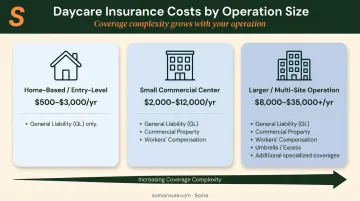
The three tiers below reflect how costs scale with operational complexity:
Entry-Level / Home-Based Daycare
Typical annual cost: $500–$3,000
Brokerage benchmark data from Hotaling Insurance places home daycares serving 6–12 children in this range for their total annual insurance cost. For GL specifically, NEXT Insurance's 2022 customer data showed 67% of daycare policyholders paying $675–$944 annually — a directional figure that reflects GL-only cost, not a full coverage package.
Best for:
- Licensed family home providers
- Small in-home programs
- Solo operators with no employees
Mid-Range / Small Commercial Center
Typical annual cost: $2,000–$12,000
A standalone commercial daycare center needs GL plus commercial property and, once staff are hired, workers' compensation. Combining these core policies typically lands in this range for a small-to-mid-sized operation.
Best for:
- Small commercial centers with leased space
- Preschool and pre-K programs
- Church-based or faith-affiliated childcare
Larger Operation with Full Coverage Package
Typical annual cost: $8,000–$35,000+
Multi-staff centers with transportation, specialized programs, or multiple locations need a comprehensive stack: GL, professional liability, workers' comp, commercial property, abuse and molestation coverage, commercial auto, and umbrella. Hotaling's benchmarks place multi-location operations serving 100–300 children in the $8,000–$35,000 range, with enterprise-scale operations exceeding $100,000.
Best for:
- Multi-staff centers and franchise locations
- Programs transporting children via owned or hired vehicles
- Operations under state mandates requiring higher coverage limits
Here's how those ranges compare at a glance:
| Operation Type | Typical Annual Cost | Key Policies Included |
|---|---|---|
| Home-based / entry-level | $500–$3,000 | GL only |
| Small commercial center | $2,000–$12,000 | GL, property, workers' comp |
| Larger / multi-site operation | $8,000–$35,000+ | GL, professional liability, workers' comp, property, abuse & molestation, commercial auto, umbrella |
Types of Coverage Daycares Need and What Each Costs
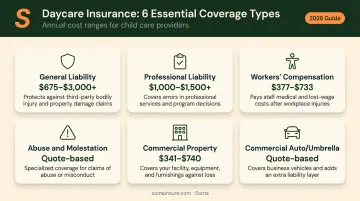
"Daycare liability insurance" is shorthand. A complete childcare insurance program involves several distinct policies, each covering a different category of risk.
General Liability Insurance
Typical annual cost: $675–$3,000+ depending on operation size
GL covers third-party bodily injury, property damage, and reputational harm — a child slips and falls, a visitor's property is damaged on-site. Most states require proof of GL to obtain or renew a daycare operating license, though mandatory minimums vary significantly by state. Markel's in-home daycare program offers limits up to $1 million per occurrence / $3 million aggregate; NEXT lists options from $500,000 to $1 million.
Professional Liability (Errors & Omissions)
Typical annual cost: $1,000–$1,500+ (Insureon reports approximately $1,188 annually as a broader human services average — treat this as a directional benchmark)
Professional liability covers claims of negligence, inadequate supervision, or failure to meet a professional standard of care — risks that fall entirely outside a standard GL policy. A family can sue for a supervision failure even without any physical injury occurring. Common triggers include:
- A child left unattended
- Staff-to-child ratios not maintained
- A pickup handled incorrectly
All of these claims route to professional liability, not GL.
Workers' Compensation
Typical annual cost: $377–$733 (per NEXT's 2022 customer distribution — note this is a policy-level figure, not a per-employee rate)
Workers' comp is required in most states the moment a daycare hires its first employee. California, New York, New Jersey, Illinois, and Massachusetts all require coverage with the first hire. Florida's threshold for non-construction employers is four employees. Actual premiums are payroll-driven and state-specific, so these benchmarks are starting points — not quotes.
Abuse and Molestation Coverage
Cost: Varies; must be quoted separately
Beyond supervision failures, the most dangerous gap in standard daycare coverage is abuse and molestation. Abuse and molestation exclusions are standard in many general liability forms — meaning a GL policy alone leaves your operation exposed to one of its most severe risks.
This coverage pays legal defense costs and settlements when an employee faces an abuse or misconduct allegation. It can be structured as an endorsement to a GL policy or as a standalone policy, depending on the carrier. Great American, Markel, and Tokio Marine HCC all write this coverage for childcare operations.
Commercial Property and Additional Policies
| Coverage | Typical Annual Cost | Purpose |
|---|---|---|
| Commercial Property | $341–$740 (NEXT 2022 data) | Protects building, equipment, supplies from fire, theft, perils |
| Commercial Auto | Quote-based | Required if you transport children in owned vehicles |
| Hired & Non-Owned Auto | Quote-based | Covers vehicles not owned by the daycare |
| Commercial Umbrella | Quote-based | Excess liability protection above primary policy limits |
Key Factors That Affect Daycare Liability Insurance Premiums
Underwriters evaluate a specific set of variables when pricing a daycare policy — and where you land in any published range depends almost entirely on the factors below.
Type and Scale of Operation
A licensed home daycare, a small commercial center, and a multi-staff facility represent genuinely different risk profiles. Enrollment size, square footage, number of locations, and activities offered all scale the premium directly. More children enrolled means greater potential severity of a single claim.
Age of Children Served
Centers serving infants and toddlers typically pay higher premiums than those serving school-age children. Younger children require more intensive supervision, carry higher injury severity potential, and demand higher staff-to-child ratios — all of which insurers price into GL and professional liability rates. Insureon directly states that providers caring for infants pay higher premiums, though no industry source has published a fixed infant surcharge percentage.
Staff Size and Employment Practices
Payroll directly drives workers' comp premiums. Beyond that, staffing practices shape how underwriters assess professional liability exposure. Key documentation underwriters look for includes:
- Three prior years of loss runs
- Current abuse-prevention procedures
- Background check policies and supervision protocols
- Proof of compliance with state-mandated staff-to-child ratios
PHLY's childcare application explicitly requests all of the above. Failure to maintain compliant ratios can increase premiums or create coverage gaps at the time of a claim.
Location and State Regulations
GL premiums vary by state based on litigation environment and local jury verdict trends. California, Florida, New York, and Texas account for an outsized share of high-severity verdicts nationally. State minimum coverage requirements also push baseline premiums — California requires family home providers to carry at least $300,000 in liability coverage or obtain signed parent waivers; Texas changed its minimum to $100,000 per occurrence effective January 1, 2026.
Claims History and Services Offered
A clean claims history can reduce premiums over time. Prior claims — particularly those involving child injury — can limit carrier options and sharply increase costs. Additional services also expand your exposure profile:
- Transportation — adds commercial auto and passenger liability risk
- Overnight care — extends supervision hours and increases severity potential
- Care for children with disabilities — introduces specialized professional liability exposure
Each of these is typically priced as a separate line item on your policy, not bundled into the base premium.

In-Home vs. Commercial Daycare: Cost Comparison
| Factor | Home-Based Daycare | Commercial Daycare Center |
|---|---|---|
| GL Insurance | ~$675–$3,000/yr | ~$1,500–$5,000+/yr |
| Property Insurance | Lighter need (home already insured separately) | ~$341–$740+/yr for business property |
| Workers' Comp | Often not required (sole operator) | Required once first employee is hired in most states |
| Abuse & Molestation | Required regardless of size | Required regardless of size |
| Total Package | ~$500–$3,000/yr | ~$2,000–$12,000+/yr |
Home-based providers often have lighter property coverage needs since they operate in a residence with a separate homeowners policy. That policy won't cover them for business activities, though. The NAIC's consumer guidance confirms that anyone paid to provide daycare at home must purchase separate commercial liability coverage, because standard homeowners policies explicitly exclude business use.
Commercial centers face broader exposure across the board. More staff triggers mandatory workers' comp requirements, leased facilities add property and premises liability, and larger enrollment raises the potential severity of any single claim.
How to Lower Your Daycare Insurance Costs
Three tactics consistently reduce daycare insurance premiums without sacrificing coverage:
1. Compare quotes using identical coverage limits Quotes built on mismatched per-occurrence and aggregate limits aren't comparable. You're just seeing different products at different prices. Shop with consistent limits to identify a genuinely lower price.
Specialty childcare carriers often price these risks more competitively than general small business insurers, which is why broker access to that market matters. Soma specializes in childcare and daycare insurance placement, using a single-application process across carriers including Markel, Nationwide, and Liberty Mutual to generate quotes without the weeks-long delays common in standard broker channels.
2. Bundle policies and cut coverage you no longer need Combining GL and commercial property into a Business Owner's Policy (BOP) can reduce total premium. The Insurance Information Institute notes that prepackaged BOPs are often more cost-effective than buying each policy separately. Also review your coverage at every renewal — carrying commercial auto after selling your transport vehicle is a common source of unnecessary cost.
3. Document your risk management practices Maintaining written supervision protocols, conducting staff background checks, logging all incidents, and following state-mandated ratios gives underwriters measurable evidence of a well-managed operation. Markel and PHLY both publish these as underwriting expectations.
A clean operational file consistently works in your favor at renewal, particularly for professional liability and GL pricing.
Frequently Asked Questions
How much is liability insurance for a daycare?
General liability for a home-based daycare typically runs $675–$3,000 annually; a commercial center's GL often falls between $1,500–$5,000+. Your final premium depends on enrollment size, state, claims history, and the coverage limits you choose.
What type of insurance do daycares need?
GL is the foundational policy most states require for licensing. A complete program also includes professional liability, workers' compensation (once you have employees), commercial property, and abuse and molestation coverage, with each policy addressing a distinct category of risk.
Is daycare liability insurance required by law?
Most states require proof of GL to obtain or renew a childcare operating license, though mandates vary by state and provider type. Workers' compensation kicks in separately once you hire employees, with the exact threshold set by each state.
Does homeowners insurance cover a home daycare?
No. Standard homeowners policies explicitly exclude commercial business activities, including operating a paid home daycare. Even endorsements offering limited in-home childcare coverage often carry insufficient limits for full-time providers running licensed operations.
What does daycare liability insurance typically not cover?
Standard GL policies exclude several key risk categories:
- Abuse and molestation claims — requires a separate endorsement or standalone policy
- Transportation incidents — covered under commercial auto, not GL
- Professional negligence such as supervision failures — covered under professional liability
How can I lower my daycare insurance premiums?
Compare quotes from multiple carriers using identical coverage limits, bundle GL and property where possible, and document your risk management practices. Underwriters weigh supervision protocols, staff background check records, incident logs, and staff-to-child ratios when pricing your renewal.