If you were considering Next Insurance for your daycare, your options have changed. Next Insurance, now ERGO NEXT, is no longer accepting new daycare applications, which means owners seeking new or replacement coverage need another route. Soma is one option worth comparing, particularly if you want to maintain the core protection your daycare needs while exploring a different way to secure it.
The switch is not simply about replacing one company name with another. Soma can address many of the same practical insurance needs, but its approach creates different options for how coverage is found, evaluated, and supported. This guide looks at where the two routes are similar, where they differ, and what those differences may mean if you are choosing new coverage or considering a change from an existing Next Insurance policy.
TL;DR
- New daycare applicants who would have considered Next Insurance now need to use a different route for coverage.
- The replacement process still involves familiar steps, including underwriting, policy documents, certificates, and confirming that coverage fits the daycare's operations.
- Soma's independent-brokerage model can approach multiple appropriate insurance markets instead of relying on one provider's available path.
- Existing policyholders should review current terms, effective dates, service needs, and replacement coverage before making any change.
- Those differences become clearer when the two models are compared around the same daycare-owner questions.
Next Insurance vs Soma Daycare Insurance: Side-by-Side Comparison
Next Insurance, now ERGO NEXT, and Soma serve daycare owners through different insurance models. ERGO NEXT operates as a digital insurance provider, while Soma is an independent commercial insurance brokerage. In either case, an insurance carrier ultimately underwrites the risk and issues the policy when coverage is approved and bound.
The process also shares some familiar steps. Daycare owners still need to provide information about their operations, review the resulting policy documents, arrange certificates where required, and evaluate price, limits, exclusions, and effective dates. The main distinction is how insurance options are accessed and compared before placement.
| Question | Next Insurance / ERGO NEXT | Soma |
|---|---|---|
| What role does it play? | Digital insurance provider | Independent commercial insurance brokerage licensed in all 50 states |
| How does the process start? | Digital-first insurance process | Broker-assisted intake and market placement |
| How are insurance options reached? | Through products and eligibility available through its insurance platform | Soma can approach multiple appropriate insurance markets based on the daycare's risk |
| Who issues the policy? | The applicable insurance carrier | The carrier selected through the placement process |
| How much human comparison support is built in? | Primarily digital and self-service, with support functions | A broker helps compare available terms, exclusions, limits, and documentation |
| How can complex daycare operations be handled? | Eligibility depends on the provider's current underwriting appetite and rules | Soma can seek markets based on the actual operation, including more complex exposures, subject to underwriting |
| What is the current practical fit for daycare? | Existing policyholders should rely on their current policy documents and insurer notices | New applicants, replacement shoppers, non-renewals, and more complex daycare risks can use Soma to explore appropriate markets |
The biggest difference is not simply online versus human. It is whether the daycare follows the insurance path available through one provider's platform or works with a broker that can approach multiple suitable markets.
Which Route Fits Your Daycare Situation?
The practical choice also depends on where your daycare is in the insurance process.
| Your situation | What matters | Practical direction |
|---|---|---|
| You already have an active ERGO NEXT daycare policy | A change in new-business appetite does not by itself establish that an active policy has ended | Review the policy period, renewal or non-renewal notices, and written insurer communication before making any change |
| You received a non-renewal notice | Replacement timing becomes the immediate issue | Start the replacement process early enough to compare options, and do not cancel current coverage before replacement coverage is formally bound |
| Your daycare has infant care, transportation, extended hours, multiple locations, prior claims, or specialized coverage needs | The operation may require additional underwriting review and a market that accepts the specific exposure | A brokerage route may be useful because multiple appropriate markets can be considered, subject to underwriting |
Once the structural difference is clear, the more useful question is what Soma's brokerage model can add when a daycare needs another route.
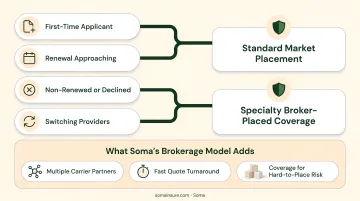
Gains With Soma's Independent Brokerage Model
Soma's added value comes from how an independent brokerage works. Instead of being tied to one insurance company, Soma can take a daycare's underwriting information to appropriate markets and help the owner evaluate the options that come back. That broader access can matter when the daycare does not fit a single carrier's standard eligibility rules.
More Than One Appropriate Market Can Be Considered
A decline or non-renewal from one insurer does not necessarily end the search. Soma can approach other suitable markets based on the daycare's underwriting profile, including its size, operations, claims history, and requested coverage. This gives owners another path when one insurer's eligibility criteria do not fit their business, although any offer still depends on the carrier reviewing and accepting the risk.
Complex Daycare Operations Can Be Presented More Specifically
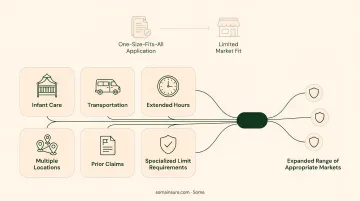
Some daycares require more underwriting review than a straightforward program. Infant care, transportation, extended hours, multiple locations, prior claims, or specialized limit requirements can all affect how a carrier evaluates the business.
Through Soma, those operating details can be presented to markets with different underwriting appetites rather than treated as a one-size-fits-all application. That does not mean every complex daycare will qualify, but it can expand the range of appropriate markets considered.
Coverage Can Be Built Around the Actual Operation
Rather than starting with a preset package, daycare insurance coverage can be reviewed against the daycare's actual property values, employees, transportation exposure, professional responsibilities, and liability needs.
For example, abuse and molestation coverage should be checked for the applicable form, limit, exclusions, and other policy terms rather than assumed to be included at an adequate level. Depending on the placement, different coverage lines may also involve different carrier solutions.
A Broker Can Help Compare the Details
Soma can help owners review differences between available quotes, including limits, exclusions, endorsements, documentation requirements, and effective dates. After coverage is bound, the brokerage can also assist with certificate requests, renewal communication, and ongoing policy servicing.
The issuing carrier remains responsible for underwriting decisions and the handling of covered claims.
Those added options matter only if the replacement also preserves the documents, service functions, and timing your daycare already relies on.
If You're Switching From Next Insurance, Keep What Already Works
Existing ERGO NEXT policyholders may already rely on digital access to policy documents, payment settings, certificates of insurance, and online claims reporting. ERGO NEXT's official account resources confirm that policyholders can manage documents and certain policy information through the customer portal, create certificates online, and begin a claim through their account.
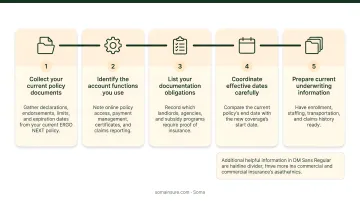
If you are considering replacement coverage, the goal is not just to find another policy. It is also to preserve the service functions and documentation your daycare depends on.
Collect your current policy documents: Gather the declarations, endorsements, current limits, expiration date, and any renewal or non-renewal communication.
Identify the account functions you use: Note whether you rely on online policy access, payment management, certificate generation, claims reporting, or other self-service tools.
List your documentation obligations: Record which landlords, licensing agencies, subsidy programs, accreditation bodies, or other parties require proof of insurance.
Coordinate effective dates carefully: Compare the end date of existing coverage with the proposed replacement date. Do not intentionally cancel the current policy before replacement coverage is formally bound.
Prepare current underwriting information: Have enrollment and capacity, ages served, staffing and payroll, transportation details, property values, prior coverage, claims history, and requested limits ready for the new application.
Whether an existing ERGO NEXT policyholder needs to switch depends on the actual policy term, renewal status, and notices received; those documents should guide the decision rather than the new-business position alone.
With continuity handled, the final comparison is the policy itself: what is covered, how much protection is available, and under what conditions.
What to Compare in a Replacement Daycare Policy
A replacement policy should be evaluated on more than premium alone. The important question is whether the coverage, limits, exclusions, and policy terms actually match how the daycare operates. A lower-priced quote may not be the better option if important exposures are restricted or insured at inadequate limits.
| Comparison point | What to verify |
|---|---|
| Abuse and molestation coverage | Confirm whether coverage is included, the applicable limit or sublimit, the coverage form, exclusions, and how defense costs are treated. |
| Professional liability | Check whether claims involving supervision, care, medication, or other professional responsibilities are addressed. |
| Property | Make sure limits reflect the value of the building, if applicable, as well as furniture, equipment, playground property, and other business property. |
| Workers' compensation | Confirm that coverage fits the daycare's staffing structure and any requirements that apply in its state. |
| Transportation | Determine whether commercial auto and/or hired and non-owned auto coverage is needed when the daycare owns vehicles or employees drive for business purposes. |
| Operational exclusions | Review whether infant care, field trips, swimming, extended hours, overnight care, or other activities affect eligibility or coverage. |
| Limits, deductibles, and effective dates | Compare the actual quoted limits, deductibles, policy dates, and other terms rather than focusing only on the headline premium. |
| Licensing and certificate needs | Confirm any insurance documentation required by the daycare's state, landlord, contracts, subsidy programs, licensing authority, or other organizations. |
State insurance and licensing requirements vary by jurisdiction and by type of childcare operation, so any specific minimum or proof-of-coverage requirement should be verified for the daycare's location and license type.
The strongest replacement option is therefore not necessarily the cheapest one. It is the policy that addresses the daycare's actual operations, provides appropriate limits, and meets the documentation and timing requirements the business depends on.
When coverage terms, service needs, and effective dates are considered together, the better route is the one that fits the daycare's actual operation rather than simply the most familiar brand name.
Is Soma a Good Next Insurance Alternative for Daycare?
If you already have an active ERGO NEXT daycare policy, base any switching decision on the policy documents, effective dates, and renewal or non-renewal communication you have actually received.
If you need new or replacement coverage, Soma can take your daycare's underwriting information to multiple appropriate insurance markets and help you evaluate the available options.
Start your daycare insurance quote with Soma early enough to compare available options before your renewal, opening, lease, licensing, or other operating deadline.
Frequently Asked Questions
Will I need a new daycare insurance application if I already have a Next Insurance policy?
Yes. A replacement carrier will usually need current underwriting information before it can evaluate the daycare. Your existing policy documents can help provide background, but you should still be prepared to provide updated details such as enrollment and capacity, ages served, staffing and payroll, transportation, property values, claims history, prior coverage, and requested limits.
Does a prior non-renewal prevent Soma from seeking daycare coverage?
Not necessarily. A prior non-renewal does not automatically prevent Soma from approaching appropriate insurance markets. However, each carrier has its own underwriting appetite and eligibility requirements. The reason for the non-renewal, the daycare's current operations, claims history, requested coverage, and other underwriting factors can all affect whether coverage is offered and on what terms.
Can Soma place every daycare coverage with the same insurance carrier?
It depends on the daycare's needs and the markets available for each coverage line. In some cases, several coverages may be placed with one carrier. In others, different policies may be used to address separate exposures. The priority is to make sure the overall insurance program is coordinated, with clear effective dates and no unintended gaps, rather than assuming every coverage must come from the same insurer.
Is using an insurance broker automatically more expensive than buying directly?
No. Buying through a broker is not automatically more expensive, just as buying directly is not automatically cheaper. The better comparison is the total quoted cost and what the policy actually provides. Review any disclosed fees, premiums, deductibles, coverage limits, exclusions, available market options, and the level of service included. A lower price may not offer better value if the policy leaves important daycare exposures inadequately addressed.