Introduction
Daycare operations face a risk profile that standard business policies weren't built for. A single injury claim, an abuse allegation, or a professional negligence lawsuit can generate legal costs that dwarf annual revenue — and unlike most small businesses, childcare providers face all three exposures simultaneously.
The numbers reflect this pressure. A 2024 survey of 1,173 early childhood educators found that 80% reported year-over-year premium increases, and 62% found affordable coverage harder to secure than the year prior. One center reported a 64% premium jump in a single year.
What you pay depends on whether you operate from home or a commercial facility, how many children you enroll, which coverage types you carry, and where your business is located. The sections below cover verified cost ranges by operation type, the coverage lines that matter most, and the factors that move your premium up or down.
Key Takeaways
- Home daycares typically pay $400–$2,500/year depending on bundled coverage; commercial centers commonly pay $3,000–$15,000+ for a full package
- Premiums depend on facility type, enrollment size, age groups served, transportation services, and claims history
- General liability is the foundation most states require for licensing; abuse & molestation coverage, workers' comp, and commercial auto each carry additional cost
- Getting quotes from multiple specialized carriers — not just one insurer — can produce significantly lower premiums for the same coverage
How Much Does Daycare Insurance Cost?
Daycare insurance doesn't have a single fixed price. The total annual premium reflects your business type, coverage structure, and location — and misunderstanding this leads either to overpaying for the wrong policy or, more commonly, being underinsured when a claim arrives.
NEXT Insurance's 2022 daycare customer data provides the most daycare-specific pricing evidence available:
| Coverage Line | Annual Cost Range | % of Customers |
|---|---|---|
| General Liability | ~$675–$944/year | 67% of daycare customers |
| Workers' Compensation | ~$377–$733/year | 34% of daycare customers |
| Commercial Property | ~$341–$740/year | 43% of daycare customers |
These figures span all daycare customer types — not separate home vs. center benchmarks. What you'll actually pay depends on your operation, which the three tiers below break down.
Home Daycare (Basic Coverage)
Solo operators with fewer than 6 children — particularly those in states with minimum licensing requirements — usually start here.
Home-based providers seeking general liability only generally pay $400–$1,500/year. This tier covers third-party bodily injury and property damage but excludes:
- Abuse and molestation claims
- Professional liability
- Business property coverage
- Workers' compensation
It's an entry point, not a complete program. Each exclusion above represents a real claim scenario that a standalone GL policy won't cover.
Home Daycare or Small Commercial Center (Comprehensive Coverage)
Established home daycares and small commercial centers with 1–5 staff and mixed-age enrollment are the primary fit for this tier.
Bundling general liability, professional liability, business property, and abuse & molestation coverage runs $1,000–$2,500/year for home-based operations. This is where most home daycares land once they account for their full risk exposure — the abuse and molestation endorsement alone changes the risk picture.
Large Commercial Daycare Center (Full Coverage Package)
Centers serving 20+ children, operating with a full staff, or required by state licensing to carry higher limits need a full commercial program.
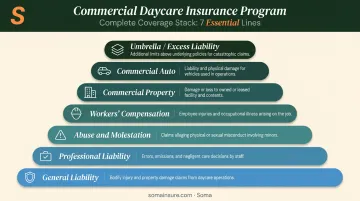
Commercial centers with employees, leased or owned facilities, and extended services typically pay $3,000–$15,000+/year for a complete program. A full stack for this tier generally includes:
- General liability
- Professional liability
- Abuse and molestation
- Workers' compensation
- Commercial property
- Commercial auto (if transporting children)
- Umbrella/excess liability
Types of Daycare Insurance and Their Costs
Childcare operations face layered risk — bodily injury, professional negligence, property damage, employee injury, and abuse allegations. Each requires a different policy, and most daycare operators need more than one.
General Liability Insurance
The foundational policy most states require for licensing. GL covers third-party bodily injury (a child injured on the playground) and property damage caused by the operation.
- Cost range: ~$675–$944/year based on NEXT's daycare customer data
- Standard limits: $1M per occurrence is common; Markel's in-home daycare product offers up to $1M/$3M aggregate
- State requirements vary: California requires at least $100,000 per occurrence/$300,000 aggregate for family child care homes; Texas sets $100,000 per negligent occurrence for covered childcare operations
Professional Liability Insurance
Covers claims of negligence, inadequate supervision, or failure to meet professional childcare standards — scenarios that fall outside general liability entirely. If a parent claims their child's developmental needs went unmet due to inadequate care, GL won't respond.
- Cost benchmark: ~$1,191/year (Insureon's human and social services median, 2025)
- Most relevant for: Centers with structured educational programming, Montessori programs, infant care, or specialized disability services
Abuse and Molestation Coverage
Standard GL policies increasingly exclude abuse allegations through endorsements like ISO form CG 21 46, which can bar not just injury claims but also related negligent hiring and supervision allegations. This is one of the most financially devastating exposures in childcare, and it requires an affirmative coverage grant.
- Structure: Sometimes added as an endorsement; often requires a separate policy or explicit inclusion. Never assume GL covers it without verifying the policy language.
- No verified daycare-specific premium exists in published data; cost varies significantly by carrier appetite and operation type
- Markel's in-home daycare program expressly includes abuse and molestation coverage as a named feature, which is the clearest way to confirm coverage is in place
Workers' Compensation and Commercial Property
Workers' compensation protects employees injured on the job. It's priced per $100 of payroll and uses NCCI class code 8869 for child care services, with state-specific rates applying.
- Cost range: ~$377–$733/year (NEXT 2022 data)
- Threshold varies by state: California requires coverage with one employee; Florida generally requires it at four employees; Texas private employers may opt out. Verify your state's specific rules before assuming you're exempt.
Commercial property covers facility equipment, educational materials, and supplies from fire, theft, and similar perils.
- Cost range: ~$341–$740/year (NEXT 2022 data)
- Critical note: Standard homeowners policies typically exclude business property used for daycare operations. That gap typically surfaces only after a claim is filed.
Additional Coverages: Commercial Auto, Cyber, and Umbrella
| Coverage | When You Need It | Cost Benchmark |
|---|---|---|
| Commercial Auto | Any time children are transported | ~$2,942/year (Insureon human services median) |
| Cyber Liability | Digital enrollment records, health data storage | ~$1,552/year (Insureon human services median) |
| Commercial Umbrella | Higher limits above primary policies; high-risk states | Varies; confirm with carrier |
Bundling multiple policies with one carrier often qualifies for a multi-policy discount — worth asking about when getting quotes for two or more of the coverages above.
Key Factors That Affect Daycare Insurance Cost
Insurers evaluate a daycare's complete risk profile, not just its size. Operational decisions directly influence what you pay across every coverage line.
Facility Type and Enrollment Size
Home-based daycares pay substantially less than commercial centers: smaller scale, fewer children, fewer employees, and lower total liability exposure. As enrollment grows and operations move into leased or owned commercial space, premiums rise across GL, property, and workers' comp simultaneously. The cost increase isn't linear; adding employees and a physical facility triggers multiple coverage lines at once.
Age Groups Served and Services Offered
Infant and toddler care carries higher premiums than school-age programs because the supervision intensity is greater and injury severity potential is higher. Carriers explicitly collect enrollment data by age group during underwriting.
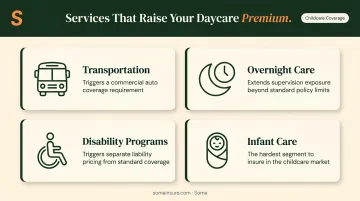
Each added service introduces a separate pricing layer:
- Transportation: Triggers commercial auto requirements and associated premium
- Overnight care: Introduces extended supervision exposure
- Specialized disability programs: Separate liability exposure that insurers price independently
- Infant care: Widely considered the hardest segment to insure, regardless of facility type
Location and State Requirements
State-specific factors drive real premium variation. Urban, high-litigation states — California, New York, and Florida — consistently show higher GL costs than rural states, driven by jury verdict trends and litigation environment.
State licensing requirements set a cost floor. Many states mandate minimum liability coverage limits as a condition of licensure, meaning providers can't insure below a threshold regardless of their actual risk preferences. Requirements differ by provider type, so confirm the minimums that apply to your license category before shopping coverage.
Claims History and Safety Practices
A clean claims record earns lower rates at renewal. Prior abuse allegations, injury claims, or negligence suits increase premiums significantly — and carrier applications like PHLY's require current plus three prior years of loss runs.
Safety investments that carriers actively evaluate during underwriting:
- Staff background checks
- Documented supervision protocols
- Fenced and secured play areas
- CPR and first aid certification
- Controlled facility entry systems
What Most Daycare Owners Miss About Insurance Costs
Three gaps come up repeatedly when reviewing daycare insurance programs:
Budgeting only for general liability. GL is the most visible requirement, so many providers stop there. But abuse and molestation claims, professional negligence suits, and employee injuries are among the most expensive claims in childcare — none of them covered by a standalone GL policy.
Assuming homeowners insurance is adequate. The NAIC's guidance explicitly states that most homeowners policies provide only limited liability coverage for home daycare operations. Even providers who add a home daycare endorsement typically find coverage limits are too low, and key risks — professional liability, abuse coverage — remain excluded. This surfaces after a claim is filed, not before.
Underestimating how costs scale with growth. Adding one employee, moving to a commercial space, or offering transportation doesn't add one new policy — it triggers cost increases across multiple coverage lines at once. Providers who don't re-evaluate their full program at each major operational change often discover they're underinsured during a licensing audit or after a claim.
How to Estimate the Right Daycare Insurance Budget
Budgeting for daycare insurance starts with understanding your actual risk profile, then finding competitive pricing for coverage that matches it. The cheapest policy rarely means the right policy.
Minimum coverage by operation type:
- Home daycare providers: At minimum, GL plus abuse and molestation coverage
- Commercial centers: Full stack — GL, professional liability, abuse and molestation, workers' comp, property, and commercial auto if transporting
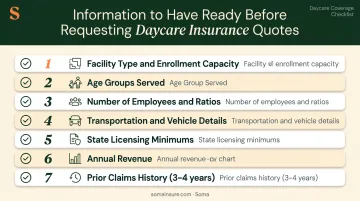
Information to have ready before requesting quotes:
- Facility type (home-based or commercial) and enrollment capacity
- Age groups served, including infant enrollment if applicable
- Number of employees and staff-to-child ratios
- Whether transportation is provided and vehicle ownership structure
- State licensing insurance minimums for your provider type
- Annual revenue (some insurers use this as a rating factor)
- Prior claims history — most carriers require 3–4 years of loss runs
Once you have that information ready, expect real variation in what carriers offer. Daycare is a specialty risk, and carrier appetite for abuse and molestation coverage and professional liability differs sharply between markets. Comparing quotes from multiple specialized carriers produces meaningfully different results than going to a single insurer.
Soma works with specialty carriers that write hard-to-insure child care programs — from infant care and transportation-involved operations to multi-site franchises that standard markets often decline or surcharge heavily. One application gets you competitive options across the market, without chasing multiple brokers for weeks.
Frequently Asked Questions
How much is insurance for a daycare per month?
Home daycares generally pay $35–$125/month for GL only, or $85–$210/month for a bundled package. Commercial daycare centers typically pay $90–$330+/month for GL or $250–$1,250+/month for comprehensive coverage. Final figures depend on enrollment size, coverage types, and location.
What type of insurance do daycares need?
Most daycares need general liability (required for licensing in many states) plus abuse and molestation coverage at minimum. Centers with employees need workers' compensation; those transporting children need commercial auto. Professional liability and commercial property are strongly recommended for most.
Does homeowners insurance cover a home daycare?
Standard homeowners policies exclude commercial business activities, including home daycare operations. Some insurers offer a limited endorsement, but coverage limits are typically too low. Key risks (professional liability, abuse allegations) stay excluded, so most home-based providers still need a separate commercial policy.
Is daycare insurance required by law?
Most states require general liability insurance as a condition of obtaining or renewing a childcare license, though minimum coverage amounts vary by state and provider type. Workers' compensation requirements also vary — California requires coverage with one employee, while Florida generally sets the threshold at four employees.
How can I lower my daycare insurance costs?
The most effective strategies: maintain a clean claims record, document safety practices (background checks, supervision protocols, CPR certification), bundle multiple policies with one carrier where possible, and compare quotes from multiple specialized carriers rather than accepting the first number you receive.
Does the age of children I care for affect my premium?
Yes. Centers caring for infants and toddlers typically pay higher premiums across general liability and professional liability lines because younger children require closer supervision and injury severity potential is greater compared to school-age programs. Insurers treat infant care as the hardest childcare segment to place.