Introduction
Running a daycare means accepting liability that most businesses never face. You're responsible for other people's children. A single incident — a slip during pickup, a playground injury, an unproven allegation — can generate a claim well into six figures.
The market isn't making it easier. According to NAEYC's 2024 survey of 1,173 educators, 80% of childcare providers reported cost increases, 32% faced a policy denial, and 32% faced nonrenewal — all since May 2023. The wrong insurer or coverage structure can leave you holding a six-figure claim with no policy to back it.
This guide covers what daycare insurance actually covers, which providers are worth considering, what you'll pay, and how to avoid the selection mistakes that cost daycare owners the most.
Key Takeaways
- Daycare insurance is specialized commercial coverage; standard homeowners policies exclude paid childcare activities
- Every daycare needs general liability at minimum; abuse & molestation, workers' comp, and commercial property are typically required for licensing
- General liability for in-home daycares runs $500–$1,500/year; commercial centers typically pay $1,100–$2,200/year
- Top providers include Next Insurance, Simply Business, Markel, Nationwide, and Chubb — each suited to different operation types
- Specialty brokers like Soma place hard-to-insure daycare risks with multiple carriers through a single application
What Does Daycare Insurance Cover?
Daycare insurance is a bundle of commercial coverage lines built specifically for childcare businesses. It is not a homeowners policy, and standard commercial general liability written for low-risk service businesses won't fill the gap either.
The NAIC is direct on this: if you're paid to provide daycare in your home, you must purchase additional insurance to cover the related liability. A standard homeowners policy won't respond to those claims.
General Liability
The foundation of any daycare insurance program. General liability covers third-party bodily injury, property damage, and reputational harm claims. In practice, this means:
- A child injured on playground equipment during care
- A parent who slips and falls during drop-off or pickup
- A claim that your center's negligence caused a child's illness
Most state licensing boards require proof of general liability before issuing or renewing a daycare license.
Abuse & Molestation Coverage
This is where daycare insurance differs most from standard commercial policies. General liability policies typically exclude abuse and molestation claims. That means a standard GL policy provides zero coverage if an allegation is made against a staff member or volunteer, even if the allegation is never proven.
Abuse & molestation coverage (available as an endorsement or standalone policy) responds to:
- Legal defense costs for actual, alleged, or threatened abuse claims
- Settlement costs and monetary judgments
- Protection for the business entity, even when an individual employee is the named party
The wording matters here. IRMI notes that only favorable versions of sexual-abuse exclusions expressly preserve defense coverage against unproven allegations — an endorsement title alone doesn't guarantee that protection. Always verify the defense trigger language before binding.
Commercial Property Insurance
Covers your equipment, supplies, furnishings, and building contents against fire, theft, and other covered perils. One distinction worth understanding:
- Actual cash value (ACV): Pays based on depreciated value — a five-year-old crib is worth far less than a new one
- Replacement cost: Pays the cost of new equivalent property without a depreciation deduction
For childcare equipment that gets heavy use and depreciates quickly, replacement cost coverage is the better choice for most daycare operators.
Workers' Compensation
Required in most states the moment you have even one employee — though the threshold varies:
| State | Workers' Comp Trigger |
|---|---|
| California | 1 employee |
| North Carolina | 3 or more employees |
| Florida | 4 or more employees |
| Texas | Generally optional for private employers |
Workers' comp covers medical bills and lost wages for work-related injuries. For daycare staff, back injuries from lifting children are among the most common claims.
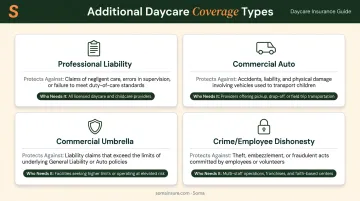
Additional Coverage Types
| Coverage | Protects Against | Who Needs It |
|---|---|---|
| Professional liability (E&O) | Claims of negligent instruction or supervision decisions | Preschools, Montessori programs |
| Commercial auto | Accidents while transporting children | Any daycare that runs a van or bus route |
| Commercial umbrella | Liability claims exceeding primary policy limits | Commercial centers, multi-location operations |
| Crime/employee dishonesty | Theft by staff | Multi-employee operations |
Best Daycare Insurance Companies and Providers
Providers below were evaluated on childcare-specific coverage options, geographic availability, financial strength ratings, ease of quoting, and fit across both home-based and commercial daycare operations. Each entry notes who the carrier suits best, what coverage they offer, and how to access it — including which carriers Soma works with directly as an appointed brokerage partner.
Next Insurance (ERGO)
For daycare owners who want speed and simplicity, Next Insurance is a digital-first insurer with a dedicated childcare product. Quote, bind, and receive a certificate of insurance entirely online — no agent required — with policy management available through their app around the clock.
AM Best Rating: A+ (Superior), confirmed September 2025
| Category | Details |
|---|---|
| Best For | In-home and small daycare providers who want fast, fully digital coverage with flexible limits |
| Coverage Available | General liability, professional liability, workers' comp, commercial property/BOP options |
| Standout Feature | Online quote and certificate of insurance available in minutes; 24/7 app-based policy management |
| AM Best Rating | A+ (Superior), confirmed September 2025 |
| Limitation | Not available in all states; no published daycare-specific state list |
Simply Business
Simply Business is an insurance marketplace, not an underwriter. It connects daycare owners with quotes from multiple carriers through a single application — useful for operators who want side-by-side pricing transparency before committing.
| Category | Details |
|---|---|
| Best For | Daycare owners who want to compare multiple carrier quotes before committing |
| Coverage Available | General liability, professional liability, commercial property (compares across 18 carriers) |
| Standout Feature | Multi-carrier quote comparison; licensed producer in all 50 states and DC |
| AM Best Rating | N/A — marketplace model; ratings apply at individual carrier level |
| Limitation | Carrier and product availability varies by state |
Markel
Markel is a specialty insurer with an explicit appetite for both in-home and commercial daycare operations — including operations that standard carriers decline. Their dedicated childcare package includes general liability with an abuse & molestation endorsement, and Markel's A&M form specifically covers actual, alleged, or threatened abuse with separate per-occurrence and aggregate limits.
AM Best Rating: A (Excellent), effective November 2025
| Category | Details |
|---|---|
| Best For | Commercial daycare centers and operations declined by standard market carriers |
| Coverage Available | GL, commercial property, abuse & molestation endorsement, professional liability |
| Standout Feature | Specialty market appetite for complex or higher-risk childcare operations; dedicated in-home and commercial childcare products |
| AM Best Rating | A (Excellent), effective November 2025 |
| Access | Requires an appointed agent; Soma holds an active carrier relationship with Markel for daycare placements |
Nationwide
Nationwide is a large, financially stable carrier with a long track record in commercial childcare insurance. Their OthersFirst commercial package names daycare centers — including those serving children with special needs — and includes optional abuse & molestation coverage. A Business Owner's Policy (BOP) bundling liability and property may be available, which can reduce total premium.
AM Best Rating: A (Excellent) for Nationwide Mutual and P&C affiliates
| Category | Details |
|---|---|
| Best For | Established daycare centers and preschool programs looking for a financially stable carrier |
| Coverage Available | General liability, commercial property, workers' compensation, commercial umbrella |
| Standout Feature | Financially strong carrier with commercial package options; suited for multi-staff operations |
| AM Best Rating | A (Excellent), Nationwide Mutual and P&C affiliates |
| Access | Agent/specialist route; not all products available in all states. Soma places daycare coverage with Nationwide directly |
Chubb
Chubb holds an AM Best A++ (Superior) group rating — the highest tier available — and operates across a broad commercial platform. Their human services and commercial lines capacity makes them relevant for larger daycare operations where standard market limits are insufficient. Access typically requires working through a specialized broker.
AM Best Rating: A++ (Superior), affirmed December 2024
| Category | Details |
|---|---|
| Best For | Larger daycare centers, multi-location operations, or programs requiring high coverage limits |
| Coverage Available | General liability, commercial property, umbrella, workers' compensation, abuse & molestation |
| Standout Feature | Highest AM Best tier; capacity for complex or multi-site operations |
| AM Best Rating | A++ (Superior), affirmed December 2024 |
| Access | Broker-distributed; working with a specialty brokerage like Soma — which has Chubb as an active carrier partner — is the typical access point |
How Much Does Daycare Insurance Cost?
Cost varies substantially by operation type, location, and coverage mix. Figures are drawn from Fit Small Business's January 2025 data and broader industry benchmarks:
| Coverage Type | Annual Premium Range | Typical Limits |
|---|---|---|
| General liability — in-home daycare | $500–$1,500 | $1M per occurrence / $2M aggregate |
| General liability — commercial center | $1,100–$2,200 | $1M per occurrence / $2M aggregate |
| Commercial property | $550–$990 | Varies by contents value |
| Workers' compensation | $5,500–$7,200 | Statutory limits |
| Abuse & molestation | Quote-dependent | Separate per-person/per-occurrence limits |
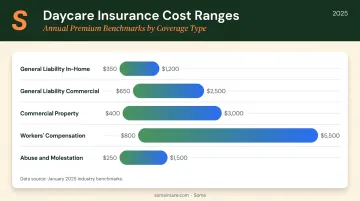
Insureon's June 2025 data for human and social services businesses reports a $91/month median for general liability — roughly $1,092 annually — though that sample is broader than daycare alone.
What Drives Your Premium
- Enrollment size — more children means higher exposure
- Home-based vs. commercial facility — commercial centers pay more
- State location — urban markets and states with strict licensing mandates typically cost more
- Employee headcount and payroll — directly affects workers' comp
- Claims history — prior incidents can push premiums significantly higher
- Overnight or drop-in care — extended hours can raise your premium or require additional riders
- Background check practices — documented screening can reduce A&M premiums
- Transportation exposure — van or bus routes add commercial auto requirements
Two practical ways to lower your total spend: bundle general liability and commercial property into a BOP, and pay annually rather than monthly. Neither requires dropping coverage — just structuring it smarter.
How We Chose the Best Daycare Insurance Providers
Providers were assessed on five criteria: childcare-specific coverage options, availability across states, financial strength (AM Best ratings where available), ease of quoting, and capacity to serve both home-based and commercial daycare operations.
Common Mistakes to Avoid
Daycare owners make predictable errors when selecting coverage:
- Choosing the cheapest quote without reading exclusions — a policy that excludes abuse & molestation is a gap that could cost hundreds of thousands
- Assuming general liability includes A&M — it typically doesn't; this coverage must be added separately or verified explicitly
- Not confirming state licensing compliance — 30 states require liability insurance for licensed centers, and the specific limits required vary by state
- Treating all providers as equivalent — a solo in-home provider and a multi-staff commercial center have different risk profiles and need different coverage structures
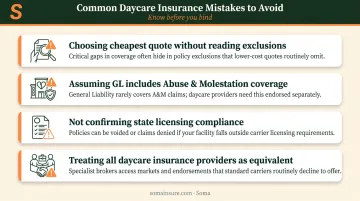
These mistakes share a common thread: assuming one approach fits every operation. A direct digital insurer works well for a simple in-home setup. But for infant care programs, faith-based operations, or daycares that transport children, a specialty carrier accessed through a broker is typically the only path that gets coverage placed at all.
Conclusion
The right daycare insurance structure depends on your operation type, state licensing requirements, staff count, and specific exposures — transportation, enrichment programs, infant care, and faith-based affiliations all change the equation.
For complex operations — particularly those that have been declined by standard carriers, need abuse & molestation coverage placed quickly, or operate across multiple locations — working with a specialty brokerage gives you something direct channels can't: access to multiple specialty carriers through a single application, with underwriting that reflects how childcare risk is actually evaluated.
Soma places coverage for the full range of childcare operations through specialty carriers who write hard-to-insure child care risk:
- In-home daycares and licensed commercial centers
- Preschools, Montessori programs, and faith-based programs
- Infant care, before/after-school care, and multi-site franchises
One application, ratio- and enrollment-based underwriting, and quotes fast enough to meet licensing deadlines.
Get a fast, no-obligation quote through Soma to see coverage options from multiple top carriers in a single application.
Frequently Asked Questions
What insurance covers daycare?
Daycare businesses typically need general liability, commercial property, abuse & molestation coverage, and workers' compensation. The specific mix depends on whether the operation is home-based or commercial, how many employees are involved, and whether children are transported.
What is the average cost of insurance for a daycare?
General liability for an in-home daycare typically runs $500–$1,500 per year; commercial centers generally pay $1,100–$2,200. Total costs rise when adding commercial property ($550–$990/year), workers' comp ($5,500–$7,200/year), and abuse & molestation coverage (typically $300–$800/year depending on enrollment and carrier).
Does homeowners insurance cover a home daycare?
No. Standard homeowners policies explicitly exclude commercial business activities. Some insurers offer limited endorsements for small-scale home childcare, but these rarely provide sufficient liability limits for full-time daycare operations.
Do I need daycare insurance if I only care for a few children?
Yes. Even small-scale in-home providers carry significant liability exposure, and many states require insurance as a condition of licensing. A single uninsured claim can result in out-of-pocket costs that far exceed years of premium payments.
What factors affect daycare insurance costs?
Primary drivers include enrollment size, home-based vs. commercial facility, state location, claims history, employee headcount, overnight or drop-in care, transportation exposure, and the coverage types selected.
Is abuse and molestation coverage required for daycares?
No universal mandate exists, though some state licensing bodies and landlords require it separately. What matters more: standard general liability policies typically exclude these claims entirely, making abuse & molestation coverage essential regardless of whether it's legally required.