The market for in-home care is growing. Child Care Aware counted 98,294 licensed family child care homes across 39 states in 2024 — up 4.3% from 2023. More providers entering the market means more providers who need proper coverage and often don't know what it costs or what to buy.
That's what this guide covers: realistic price ranges, how different coverage types add up, what pushes premiums higher or lower, and the mistakes that leave providers personally exposed.
Key Takeaways
- In-home daycare insurance typically runs $500–$2,500+ per year, depending on coverage type and business size
- Costs rise with enrollment size, staff on payroll, higher coverage limits, and prior claims history
- Solo providers with 1–3 children and clean records pay the least; those with staff or transportation exposure pay more
- Homeowners insurance does not cover daycare liability — a separate commercial policy is required
- Dropping professional liability or abuse and molestation coverage leaves providers exposed to five- or six-figure claims
How Much Does In-Home Daycare Insurance Cost?
There's no flat rate. What you pay depends on several factors:
- Coverage type selected (liability only vs. bundled policies)
- Enrollment size — how many children you care for daily
- State licensing requirements for your provider category
- Whether you have employees or operate solo
- Claims history from prior coverage periods
Two common mistakes follow from misunderstanding costs: underbudgeting leads to buying minimum coverage with significant gaps; overestimating causes providers to delay getting covered at all. Getting the number right from the start means neither outcome applies to you.
Here's how costs typically break down by coverage tier:
| Coverage Tier | Annual Cost | Core Coverages | Best For |
|---|---|---|---|
| Basic | $500–$800 | General liability only | Solo providers, 1–3 children, no employees |
| Standard | $800–$1,500 | General liability + professional liability | Licensed providers, 4–6 children |
| Comprehensive | $1,500–$2,500+ | Full bundle including abuse/molestation + workers' comp | Providers with employees or high enrollment |
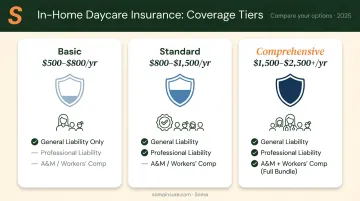
Basic Coverage ($500–$800/year)
Entry-level general liability only, with a per-occurrence limit around $300,000–$500,000. No professional liability, no business property coverage, no workers' compensation.
Best suited for solo providers caring for 1–3 children, no employees, and minimal equipment — particularly in states with lower licensing thresholds.
Standard Coverage ($800–$1,500/year)
General liability with $1 million per-occurrence limits, plus professional liability (errors & omissions). May include a business property endorsement covering equipment and educational materials.
Best for licensed in-home providers with 4–6 children who need solid foundational coverage.
Comprehensive Coverage ($1,500–$2,500+/year)
General liability, professional liability, business property, abuse and molestation coverage, and workers' compensation for helpers or assistants.
Best for providers with employees, higher enrollment, or states that mandate broader coverage. Note that commercial auto is priced separately if you transport children — it falls outside this range entirely.
What Types of Coverage Make Up Your Total Cost?
Most providers don't buy a single "daycare insurance policy." The total annual spend is usually the sum of several individual coverage lines. Understanding what each covers — and what it doesn't — helps avoid both unnecessary overlap and dangerous gaps.
General Liability Insurance
Covers third-party bodily injury, property damage, and reputational harm claims arising from your childcare operations. A child trips and breaks a wrist on your property; a parent claims your dog scared their child — general liability is the first line of defense.
This is the baseline policy most states require for licensure, and it's the starting point for every coverage package. NEXT Insurance notes that in-home daycare coverage can start around $18 per month, though actual costs vary based on enrollment, location, and limits selected.
Professional Liability (Errors & Omissions)
Covers claims of negligence, failure to supervise, or professional mistakes — situations where a parent alleges your care fell below an acceptable standard. Where general liability covers physical incidents, professional liability covers judgment calls: the allegation that supervision was inadequate or that a child in distress went unnoticed.
Many solo providers skip this line to save money. That's a mistake — a negligent supervision allegation doesn't require a physical injury to generate significant legal costs.
Business Property Insurance
Covers daycare equipment, educational materials, play structures, and home modifications if damaged by fire, theft, or vandalism. Standard homeowners policies explicitly exclude business property used in a commercial activity — meaning your $2,000 worth of childcare equipment and furniture could be uncovered without a separate policy.
Workers' Compensation Insurance
Required in most states the moment you hire even one part-time assistant. Covers medical bills and lost wages for work-related injuries. Two things daycare operators commonly misread about workers' comp:
- Payroll drives cost — a part-time helper at $12,000/year generates a meaningfully lower premium than a full-time employee at $35,000
- Contractor classification doesn't exempt you — many states apply workers' comp requirements regardless of how the working relationship is labeled
These are also the two areas most likely to surface as surprises at audit time.
Abuse & Molestation Coverage
One of the most commonly overlooked lines — until a claim makes it impossible to ignore.
Abuse and molestation (A&M) coverage addresses legal defense costs and settlement exposure for misconduct allegations. Standard general liability policies frequently exclude this exposure entirely. It's available as an endorsement or standalone policy through specialty carriers, but standard markets routinely decline to write it for childcare operations. Placement typically requires a brokerage with access to specialty markets.

Commercial Auto
Necessary if you regularly transport children — to a park, school, or activities. Two reference points worth knowing:
- Markel's in-home daycare program explicitly excludes automobile liability
- NEXT excludes field trips from its standard daycare program eligibility
Neither standard policy automatically covers child transport. A separate commercial auto or hired/non-owned auto policy is required.
Key Factors That Affect Your In-Home Daycare Insurance Premium
Insurers price these policies based on a combination of business characteristics and risk indicators. Knowing what they look at helps you prepare accurate information and anticipate where your costs land.
Number of Children in Your Care
More children enrolled means higher risk exposure and higher premiums. Markel's in-home program covers providers caring for 1 to 18 children with limits up to $1 million per occurrence/$3 million aggregate. NEXT's program allows up to 50 children, subject to a 25:1 child-to-provider ratio.
Providers who cross certain enrollment thresholds may also find that their operation no longer qualifies for an in-home policy and must move to a commercial childcare program — which carries different pricing.
Location and State Licensing Requirements
State rules vary considerably. California, for example, requires liability insurance at $100,000 per occurrence/$300,000 annual aggregate as a condition of licensure — though it permits a signed parental affidavit if the provider doesn't carry coverage. Texas requires proof of coverage before issuing a permit but doesn't publish an exact dollar minimum on its licensing page.
Urban areas and states with higher litigation rates generally carry higher premiums. A provider in a densely populated metro will typically pay more than one in a rural area.
Claims History and Business Experience
A prior claim flags your operation as higher risk. A clean claims history across multiple renewal cycles, on the other hand, works in your favor during underwriting. Carriers also look for signals that your operation is well-run, including:
- Formal childcare training or certifications
- Documented background check policies for staff
- Consistent, verifiable operational practices
Specific discount percentages vary by carrier and aren't universally published, but these factors can meaningfully influence your final rate.
Coverage Limits, Deductibles, and Policy Add-Ons
Higher per-occurrence and aggregate limits raise the premium; a higher deductible lowers it but increases what you pay out of pocket when a claim hits. A few tradeoffs worth weighing:
- A $2,500 deductible lowers your annual premium but can sting on a minor claim that a $500 deductible would have absorbed
- A Business Owner's Policy (BOP) bundles general liability and business property, often at a lower combined cost than buying each separately
- Not all carriers offer BOPs for home-based childcare — comparing quotes across multiple markets is the fastest way to find one that does
What Most In-Home Daycare Providers Get Wrong About Insurance Costs
Assuming Homeowners Insurance Is Enough
It isn't. Markel states explicitly that typical homeowners policies exclude liability from family daycare activities. Some insurers offer a daycare endorsement on a homeowners policy, but these carry low limits that rarely hold up against a serious claim — and many full-time providers won't qualify for an endorsement at all once enrollment crosses certain thresholds.
The consequence is that providers operating under a homeowners policy can find their personal assets (savings, home equity, personal property) at risk when a claim arises.
Optimizing for Premium Instead of Coverage
Skipping professional liability to save a few hundred dollars annually might seem reasonable until a parent files a negligent supervision allegation. Legal defense alone on a claim like that can run into five figures before any settlement is reached. The same logic applies to abuse and molestation coverage: the exposure is real, the legal costs are significant, and the premium is modest compared to the alternative.
Working with Brokers Who Don't Specialize in Childcare
Standard brokers often can't access specialty markets for childcare placements, particularly for abuse and molestation coverage or infant care, where standard carriers routinely decline. Working with a brokerage that specializes in childcare operations means access to markets that actually write these risks, accurate coverage recommendations, and faster quotes.
Soma specializes in placing coverage for childcare operations that standard markets decline, including infant care, faith-based programs, and multi-site facilities. One application gets quotes across general liability, professional liability, abuse and molestation, workers' compensation, commercial property, and commercial auto — without chasing multiple agents.
Not Reassessing Coverage as the Business Grows
Several common operational changes shift your risk profile and may require policy updates:
- Hiring a part-time helper (triggers workers' compensation considerations)
- Enrolling additional children beyond your original capacity
- Transporting kids to or from school (commercial auto exposure)
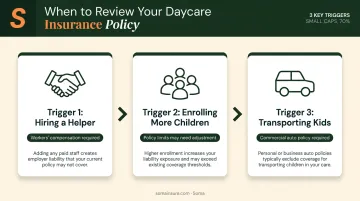
A basic policy that was adequate for a 3-child, solo operation may leave meaningful gaps once an employee is involved or enrollment climbs. Review coverage annually, and after any significant operational change.
Frequently Asked Questions
How do I charge for in-home daycare?
Rates typically depend on your local market, the ages of children in your care, hours of operation, and services provided. Check regional averages through your state's childcare resource agency, then factor in operating costs — including insurance premiums — to set rates that actually cover your expenses.
Does homeowners insurance cover an in-home daycare?
No. Standard homeowners policies exclude business activities, including paid childcare. Some insurers offer a daycare endorsement, but limits are typically low and coverage is rarely adequate for a full-time operation. A separate commercial policy is strongly recommended.
Is in-home daycare insurance required by law?
Most states require proof of liability insurance as a condition of childcare licensing. California, for example, requires $100,000 per occurrence/$300,000 aggregate. Requirements vary by state — check your state's childcare licensing agency for the specific minimums that apply to your operation.
What is the minimum liability coverage needed for a home daycare?
State minimums typically start around $100,000–$500,000 per occurrence. Many insurance professionals recommend at least $1 million per occurrence for adequate protection, given that legal defense costs alone on a childcare liability claim can be substantial.
Does in-home daycare insurance cover off-site activities or field trips?
Standard general liability policies cover incidents on your premises. Off-site activities typically require an endorsement, and child transport requires a separate commercial auto policy. Confirm your coverage scope with your insurer before assuming field trips are included — some carriers explicitly exclude them from standard daycare programs.
Can I bundle coverage types to save money?
Yes — bundling general liability and business property into a BOP often reduces total premium compared to buying each policy separately. Not all carriers offer BOPs for home-based childcare, so get quotes from multiple specialized providers to find one that does.