According to NAEYC's August 2024 liability insurance survey of 1,173 early childhood educators, 80% reported higher insurance costs over the preceding year. More troubling: 32% were denied coverage outright, 32% faced nonrenewal, and 65% said they would have to close if they couldn't find or afford insurance.
This isn't a fringe problem. The childcare insurance market is tightening, and providers who don't understand their coverage options — and what drives costs — are the most vulnerable.
This article covers what daycare insurance typically costs, which coverage types matter most, the factors that shape your premiums, and how to build a smarter insurance budget.
Key Takeaways
- Annual premiums range from roughly $500–$2,000 for in-home daycares to $20,000+ for large commercial centers with full coverage.
- Your location, enrollment size, age groups served, and claims history drive the biggest swings in premium cost.
- Abuse & molestation coverage is one of the most critical protections available — and increasingly difficult to place with standard carriers.
- Bundling coverage into a package (rather than buying policies separately) reduces total cost.
- A broker with access to specialty childcare carriers is often the deciding factor between getting covered and being declined.
How Much Does Daycare Insurance Cost?
Daycare insurance doesn't have a single fixed price. Providers who assume a generic ballpark without accounting for their specific operation often find themselves either underinsured or blindsided at renewal.
The variables that move the needle most: type of operation (home-based vs. commercial), enrollment count, services offered, state requirements, and coverage selected.
Cost Ranges by Operation Type
| Operation Type | Estimated Annual Cost |
|---|---|
| In-home / small home daycare (GL only) | ~$500–$1,500/year |
| In-home / home daycare (package with property) | ~$1,200–$4,000/year |
| Mid-size commercial daycare center (full package) | ~$4,000–$8,000/year |
| Large commercial center or multi-location operation | $8,000–$20,000+/year |
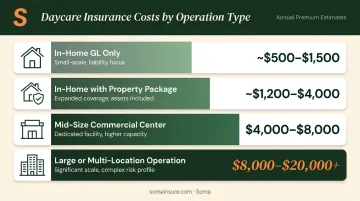
Note: These ranges reflect general market benchmarks. Verified customer distribution data from NEXT Insurance (2022) shows general liability costing approximately $675–$944/year for daycare customers at that time — treat these figures as directional, not as guaranteed quotes.
What's Typically Included — and What Isn't
Most package quotes include general liability, commercial property, and professional liability. What's commonly priced separately or excluded:
- Abuse & molestation coverage — Often an endorsement or separate policy; increasingly restricted in the current market
- Commercial auto — Required separately if you transport children
- Workers' compensation — Separate policy in most states; required if you have employees
- Commercial umbrella — Excess liability layer above primary policies
In-Home and Small Daycare Providers
Home-based providers typically pay the least — but face a common trap. Standard homeowners insurance explicitly excludes commercial business activity. Even if you add an endorsement, it usually has low limits and won't cover professional liability or abuse allegations.
A proper in-home daycare policy starts with a commercial general liability policy ($500–$1,500/year) and, for most full-time operations, should also include:
- Property coverage for business equipment and supplies
- A professional liability endorsement for claims tied to care decisions
- Abuse & molestation coverage, if available through your carrier
Mid-Size Commercial Daycare Centers
Licensed centers with dedicated facilities, 10–50+ children enrolled, and multiple employees need a fuller stack. A complete package typically includes:
- General liability and commercial property
- Professional liability and abuse & molestation coverage
- Workers' compensation for all employees
Expect to pay $4,000–$8,000/year for a full coverage package.
Large and Multi-Location Operations
Chains, franchises, and centers offering transportation, field trips, or extended care programs face the highest premiums. These operations typically add commercial auto, umbrella/excess liability, and employment practices liability on top of the base package. For these operations, $8,000–$20,000+ is a realistic starting point, not a ceiling.
Key Factors That Affect the Cost of Daycare Insurance
Underwriters treat daycare businesses as high-exposure accounts. Any incident involving a child can produce significant legal and financial consequences. Pricing reflects a combination of operational, structural, and historical risk factors.
Type of Operation and Services Offered
Home-based daycares are priced differently from commercial centers, but the bigger cost driver is usually what services you provide beyond basic childcare.
Activities that raise premiums or restrict carrier options:
- Child transportation (van/bus) — considered high-risk due to passenger vulnerability
- Water activities (pools, splash pads) — many carriers restrict or exclude these outright
- Field trips — NAEYC's 2024 survey found 26% of providers faced specific limitations involving field trips
- Overnight care — sharply increases exposure
- Inflatables — often excluded entirely by standard markets
Soma places coverage for programs that transport children as a specialty exposure — working with carriers who understand the risk rather than standard markets that often decline it outright.
Enrollment Count and Age Groups
More children means greater exposure — and higher premiums. But age mix matters just as much as headcount.
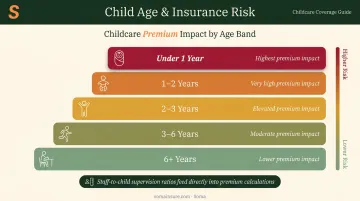
Infants and toddlers under 2 years carry significantly higher risk than school-age children due to physical vulnerability and supervision ratios. Carriers like Markel structure daycare applications around specific age bands:
- Under 1 year
- 1–2 years
- 2–3 years
- 3–6 years
- 6+ years
Classroom and outdoor staff-to-child ratios for each band feed directly into premium calculations. Infant care programs — whether in-home or licensed — are the hardest segment in childcare to place coverage for, with the fewest willing carriers.
Location and State Minimum Requirements
Urban markets with higher litigation rates generally carry higher premiums than rural locations. State-mandated minimums also set a cost floor.
A few verified state examples:
- Texas: As of January 1, 2026, HB 2789 reduced the licensed center requirement to $100,000 per negligent occurrence (down from the prior $300,000 threshold)
- Arkansas: Licensed centers with capacity 1–74 must carry $500,000 per occurrence; centers with 75+ capacity require $1 million
- Ohio: Covered licensed providers must carry at least $100,000 per incident / $300,000 aggregate — and failure to maintain required insurance is grounds for license revocation under Ohio Revised Code Section 5104.041
Always verify current state requirements before setting your coverage limits, as these change.
Claims History
A clean 3–5 year claims history is one of the strongest factors for securing lower premiums. Past abuse allegations, injury claims, or licensing violations can make a daycare difficult to insure at any price — not just expensive.
As carriers continue exiting the childcare segment, that dynamic has gotten worse. Prior claims now carry more weight than they did even two years ago, because there are fewer markets willing to absorb the risk. Providers with difficult claim histories need specialty market access — a standard broker submission won't cut it.
Employee Count and Staff Practices
Workers' compensation cost scales directly with payroll and headcount. But staff practices also influence how underwriters assess overall risk:
- Documented background check policies
- Staff first-aid and CPR certifications
- Written safety procedures and incident response protocols
- Supervision ratios maintained above licensing minimums
Some insurers offer premium reductions for documented vetting and training practices. Where formal discounts don't exist, these same factors still shape how underwriters price the account.
Daycare Insurance Cost Breakdown by Coverage Type
Most daycare operators need several coverage types working together. Here's what each costs, based on the best available data.
| Coverage Type | Approximate Annual Cost | Notes |
|---|---|---|
| General Liability | ~$675–$944/year (verified); up to $2,200 for larger operations | Covers third-party bodily injury, property damage, reputational harm |
| Commercial Property | ~$341–$740/year (verified) | Covers building, equipment, educational materials |
| Professional Liability (E&O) | ~$750–$1,200/year (estimated) | Covers negligence, improper supervision, professional errors |
| Abuse & Molestation | Varies widely by carrier and limits | Often an endorsement; limits from $100K to $1M+ depending on carrier |
| Workers' Compensation | ~$377–$733/year (verified); higher with larger payroll | Required in most states for daycare employers |
| Commercial Auto | $1,100–$4,400+/year (estimated) | Required if you transport children; separate from personal auto |
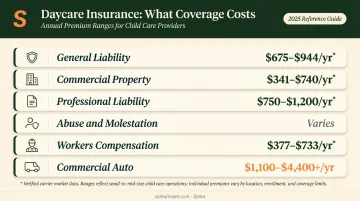
GL, property, and workers' comp figures are drawn from NEXT Insurance's actual customer distribution data (2022). Professional liability, auto, and abuse ranges are estimates — request quotes to verify for your operation.
The BOP Option
Many daycare operators can bundle general liability and commercial property into a Business Owner's Policy (BOP), which typically costs less than purchasing both separately. Insureon's broader sector data suggests BOPs in human services average around $135/month — a useful reference, though daycare-specific savings will vary by carrier and operation type.
If you want to go beyond a BOP, some specialty brokers — including Soma — place a full coverage stack (GL, property, professional liability, abuse & molestation, workers' comp, commercial auto, umbrella, and participant medical) through a single application. That approach can simplify administration and often yields better pricing than assembling each line separately.
Minimal Coverage vs. Comprehensive Daycare Insurance
Not all policies are equal. A bare-minimum general liability policy might satisfy state licensing requirements but leave significant gaps for the claims most likely to actually occur.
| Minimal Coverage | Comprehensive Package | |
|---|---|---|
| General Liability | ✅ Included | ✅ Included |
| Commercial Property | ❌ Often excluded | ✅ Included |
| Professional Liability | ❌ Not included | ✅ Included |
| Abuse & Molestation | ❌ Typically excluded | ✅ Included (or endorsed) |
| Workers' Compensation | ❌ Separate, often skipped | ✅ Included |
| Commercial Auto | ❌ Not included | ✅ If applicable |
| Umbrella/Excess | ❌ Not included | ✅ Available |
| Typical Premium | Lower upfront | Higher upfront, lower exposure |
That table gap is showing up in real claims data. According to NAEYC's 2024 survey, 36% of providers reported reduced or newly restricted limits — including exclusions for abuse, field trips, and playgrounds. Providers pushed into minimal policies by market conditions aren't necessarily paying less. They're paying for coverage that won't respond when it matters most.
A single uncovered abuse or negligence claim routinely generates six-figure legal costs. Against that exposure, the annual premium difference between minimal and comprehensive coverage can disappear within weeks of a claim filing.
How to Budget and Save on Daycare Insurance
The right coverage at the right price comes down to knowing your actual risk profile and working with markets that specialize in childcare.
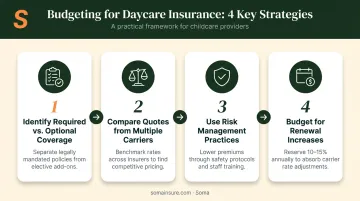
Core strategies:
Identify required vs. optional coverage before quoting. Know what your state mandates (GL minimums, workers' comp requirements) and what your operations create (transportation = commercial auto; employees = workers' comp). This prevents both gaps and unnecessary purchases.
Compare quotes from multiple carriers. Premiums vary significantly across insurers for identical coverage. Specialty carriers like Markel and Kinsale actively write childcare accounts that standard markets decline — accessing them requires either working directly with those carriers or using a broker with specialty market access. Soma submits one application across multiple specialty carriers, so you get competing quotes without chasing brokers for weeks.
Use risk management practices to your advantage. Documented background checks, staff first-aid certifications, written safety procedures, and incident response protocols signal lower risk to underwriters. Bundling coverage into a BOP where available also reduces total cost.
Budget for renewal increases. NAEYC's 2024 survey found that among center-based programs, 36% reported annual premium increases of $2,000–$4,999, and 13% reported increases of $10,000 or more. Auto-renewing without reviewing the market each year is an expensive habit.
What Most Daycare Owners Get Wrong About Insurance Costs
Three mistakes come up repeatedly — and each one can leave a daycare exposed at exactly the wrong moment.
- Choosing based on premium alone. The cheapest annual quote almost always excludes professional liability and abuse & molestation coverage — the two exposures most likely to generate catastrophic claims in childcare. One uncovered incident can cost more than a decade of premium savings.
- Assuming homeowners insurance covers an in-home operation. Homeowners policies are not designed for business use. Anyone paid to provide daycare at home needs separate commercial coverage. Endorsements exist, but they carry low limits and typically exclude professional liability and abuse coverage entirely.
- Ignoring renewal pricing. Renewal isn't automatic price stability. In NAEYC's 2024 survey, many center-based providers reported five-figure annual premium increases. Treat your renewal as an active budget decision, not administrative paperwork.
Frequently Asked Questions
What is the average cost of insurance for a daycare?
In-home daycares typically pay $500–$1,500/year for general liability alone, with total packages ranging from $1,200–$4,000. Commercial daycare centers generally pay $4,000–$8,000/year, with large or multi-location operations reaching $20,000+. Final cost varies by coverage types, enrollment, location, and claims history.
How much is insurance for a daycare in Texas?
As of January 1, 2026, Texas requires licensed centers to carry at least $100,000 per negligent occurrence (reduced from the prior $300,000 threshold by HB 2789). Workers' compensation is not mandated for most private Texas employers, though non-subscribers lose specific legal protections. Premiums generally track national averages but vary by urban vs. rural location.
What type of insurance do daycares need?
Most daycares need general liability (required in nearly all states), commercial property, professional liability, and abuse & molestation coverage. Centers with employees also need workers' compensation. Transportation programs require commercial auto. Larger operations should carry umbrella/excess liability above primary policy limits.
Does a home daycare need different insurance than a commercial center?
Yes. Home daycares need a separate commercial policy — not homeowners insurance — but at lower limits and cost than a licensed commercial center. Key differences: smaller property coverage needs, lower or no workers' comp exposure if operating solo, and typically no commercial auto requirement unless transporting children.
What happens if a daycare operates without insurance?
The owner faces personal financial liability for any injury, negligence claim, or property damage. In most states, operating without the required minimum coverage also puts your license at risk. In Ohio, for example, failure to maintain required liability insurance is a statutory ground for license revocation under Section 5104.041.
How can I lower my daycare insurance premiums?
Compare quotes from multiple carriers, bundle general liability and property into a BOP where available, and document staff background checks and safety procedures to support a clean claims history. A broker with specialty childcare carrier access — like Soma — will find options standard insurers won't quote.