Daycare liability insurance costs vary widely. Home-based providers pay very different rates than commercial centers. What you pay depends on your operation type, how many children you serve, whether you have employees, your location, and the coverage lines you actually carry.
This article breaks down published cost benchmarks by daycare type, the main coverage categories every operator should understand, and the factors that most directly shape your premium.
Key Takeaways
- Home daycares typically pay $500–$2,000/year for general liability; commercial centers average around $1,097/year for GL, with total costs climbing significantly for larger operations
- General liability alone is not enough — professional liability and abuse & molestation coverage fill gaps GL won't touch
- Standard homeowners policies do not cover daycare operations; a separate commercial policy is required
- Only about 13 states mandate liability insurance for home providers, but uninsured losses are your problem regardless
- A policy sized for a small home daycare can leave serious gaps once you add staff or transportation
How Much Does Daycare Liability Insurance Cost?
Daycare liability insurance costs vary widely — home providers might pay $500/year for basic GL, while a commercial center with employees and transportation could easily exceed $5,000/year once all coverage lines are included. What you actually pay depends on your daycare type, size, state, and which policies you carry.
Two common mistakes operators make: purchasing only the minimum required by their state license without considering whether those limits are actually adequate, and assuming one policy type covers every liability scenario.
Home Daycare Liability Insurance
According to Brightwheel's 2026 childcare industry estimates, home daycares typically pay $500–$2,000 per year for general liability coverage. That range covers the core exposures: bodily injury to children and visitors on premises, and property damage caused by the business.
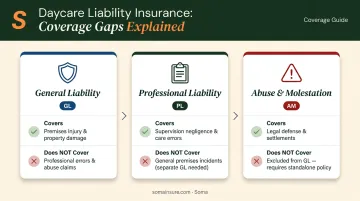
GL does not cover:
- Professional negligence or supervision errors
- Abuse and molestation allegations
- Injuries to employees
Home daycare operators adding professional liability and abuse & molestation coverage should budget considerably more. Brightwheel estimates professional liability alone at $750–$1,200/year for home providers — meaning a complete coverage stack can push total annual costs to $2,000–$3,500+.
Commercial Daycare Center
Commercial centers carry more exposure than home operations, and their premiums reflect that. Insureon's 2025 data for human and social services businesses — a category that includes daycare centers — shows an average GL cost of $91/month ($1,097/year). Centers with employees, transportation programs, or multiple classrooms will pay substantially more across all required coverage lines.
The table below shows published benchmarks by coverage type:
| Coverage Type | Home Daycare | Commercial Center |
|---|---|---|
| General Liability | $500–$2,000/year | ~$1,097/year avg. |
| Professional Liability | $750–$1,200/year | ~$99/month avg. |
| Business Property | $500–$900/year | ~$135/month avg. (BOP) |
| Abuse & Molestation | Quote-based | Quote-based |
| Workers' Compensation | Quote-based | Quote-based |
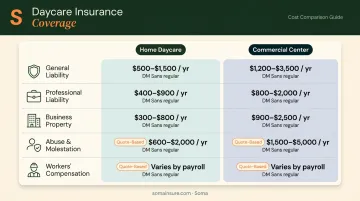
Sources: Brightwheel (2026), Insureon (2025). Abuse & molestation and workers' comp rates are operation-specific and require a quote.
Types of Liability Coverage Daycares Should Have
Daycare liability insurance covers several distinct exposures — and each requires its own policy type. Buying only general liability and stopping there leaves meaningful gaps that can surface at the worst possible time.
General Liability (GL) Insurance
GL is the foundation and the most commonly required coverage for state licensing. It covers:
- Bodily injury to children, parents, and visitors on premises
- Property damage caused by daycare operations
- Third-party claims arising from business activities
The standard recommended limits are $1 million per occurrence / $2 million aggregate. State licensing minimums are often lower — sometimes $100,000–$300,000 — but those thresholds can be exhausted quickly in a serious incident.
GL does not cover professional errors, intentional acts, or abuse allegations. Those require separate coverage.
Professional Liability Insurance
Professional liability (also called errors and omissions, or E&O) covers claims of negligence in supervision, failure to meet professional standards, or inadequate care. It's especially relevant for operations offering:
- Structured educational programs or curriculum-based instruction
- Specialized therapies or developmental support
- Care for children with specific medical or behavioral needs
A parent alleging a teacher failed to follow an IEP, or that improper supervision led to a developmental setback, would typically fall under professional liability — not GL.
Abuse and Molestation Insurance
Most standard GL policies explicitly exclude abuse and molestation claims. This is one of the most dangerous coverage gaps in the childcare sector.
This coverage addresses:
- Legal defense costs for abuse or misconduct allegations
- Settlements related to physical, emotional, or sexual misconduct
- Claims arising even from unsubstantiated allegations — because legal defense begins immediately regardless of outcome
A Washington State daycare abuse case resulted in a $24.5 million underlying settlement, which then triggered a separate coverage dispute between the parties. Without dedicated abuse & molestation coverage, a daycare facing any allegation — founded or not — carries the full cost of legal defense out of pocket.
Pricing varies by operation type, enrollment size, and carrier — expect quotes to differ widely between providers.
Workers' Compensation
If a daycare has employees, workers' comp is legally required in nearly every state (Texas is the principal exception for private employers). Childcare work involves physical handling of children, lifting, and active movement — the Bureau of Labor Statistics reports a 1.9 total recordable case rate per 100 full-time workers in child day care services for 2024.
Key factors that shape your workers' comp premium:
- State: Rates and regulatory requirements vary by state
- Payroll: Premiums scale directly with total payroll
- Claims history: Prior incidents drive rates up; clean records help keep them down
No published national average applies here. A quote from a carrier writing childcare workers' comp in your state is the only figure worth using.
Key Factors That Affect Your Daycare Liability Insurance Premium
Liability premiums for daycares are shaped by operational, geographic, and business-specific variables.
Daycare Type and Scale
Home daycares carry a lower risk profile than commercial centers — smaller enrollment, fewer employees, and limited premises exposure. As enrollment grows and the facility expands, premiums increase across every coverage line.
Ages of Children Served
Infant and toddler programs require more intensive supervision and carry higher injury severity risk. Insurers underwrite age mix specifically — carriers like PHLY collect separate attendance and staffing data for infants, toddlers, preschoolers, and school-age children. Centers serving primarily school-age children generally see lower GL and professional liability costs.
Services Offered
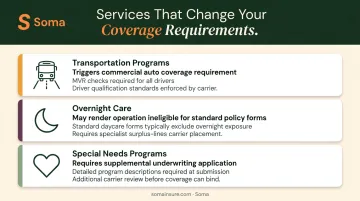
Add-on services create additional exposures that can change your coverage requirements entirely:
- Transportation programs: require commercial auto coverage; carriers ask detailed questions about driver standards, MVR checks, routes, and minimum child age
- Overnight care: some carriers exclude this exposure entirely, making operations ineligible for certain policy forms rather than simply charging more
- Special needs programs: documented in supplemental applications as a distinct underwriting factor; typically requires detailed program descriptions
Location and State Requirements
Location affects premiums through local litigation environments and state-mandated minimums. Insurance requirements also vary significantly:
- California — Family child care providers must maintain at least $300,000 in annual insurance or bond, or obtain signed parental affidavits
- Texas — Listed family homes must carry at least $100,000 per occurrence or provide required parental notice
- New York — Centers must submit proof of GL coverage upon licensure; no specific dollar minimum is stated in the regulation
- DC — Requires proof of "reasonable coverage" including GL, umbrella, and sexual abuse/molestation coverage for centers and smaller home programs
Notably, the Bipartisan Policy Center found that only about 23 states mandate liability insurance for commercial centers, and only 13 states require it for family home providers. The absence of a mandate, though, doesn't eliminate the financial exposure.
Claims History and Risk Management Practices
A clean claims history keeps premiums lower. Prior claims can raise rates materially at renewal. Underwriters also review your documented safety practices, which directly affect both carrier willingness to write the policy and final pricing:
- Background check policies for all staff
- Supervision protocols and child-to-staff ratios
- Staff training records and ongoing certification
- Incident response and documentation procedures
Operations with strong practices in these areas consistently attract better terms — and broader carrier options.
What Most Daycare Owners Miss When It Comes to Liability Insurance
Relying on State Minimums Alone
Many operators purchase the minimum coverage required to pass licensing — often $100,000–$300,000 per occurrence — without considering whether that's enough to cover a real claim. Legal fees, medical costs, and potential settlements in a serious incident can exhaust those limits before a case even goes to trial. The gap between minimum coverage and meaningful protection is real, and the premium difference between $300,000 and $1 million per-occurrence limits is typically modest.
Skipping Abuse and Molestation Coverage
Since GL explicitly excludes abuse claims in most policy forms, operators who don't carry separate coverage are unprotected against one of the most financially severe scenarios a childcare business can face. Even a false allegation generates immediate legal defense costs. This coverage is not optional for any operation working with children.
Not Revisiting Coverage as the Business Grows
A home daycare that expands to a commercial space, adds staff, or introduces a transportation program has a fundamentally different risk profile than when it started. Coverage that was appropriate for two rooms and no employees can be dangerously inadequate for a licensed center with a van and five caregivers.
Soma works with carriers across every childcare operation type — from in-home family daycares to multi-site franchises — so coverage can be restructured as operations grow. Operators don't need a new broker every time their exposure changes; the program adapts with the business.
Frequently Asked Questions
How much does liability insurance for a daycare cost?
Home daycares generally pay $500–$2,000/year for general liability based on current industry benchmarks. Commercial centers average around $1,097/year for GL, though total costs rise significantly when professional liability, abuse & molestation, and workers' comp are added. A full coverage package requires a quote specific to your operation type, enrollment, and state.
What type of insurance do daycares need?
Most daycares need at minimum four coverage types:
- General liability — required by most state licenses
- Professional liability — covers care and supervision claims
- Abuse & molestation coverage — explicitly excluded from most GL policies
- Workers' compensation — required if you have any employees
The right combination depends on your facility type, enrollment, and whether you offer transportation.
Does homeowners insurance cover a home daycare?
No — standard homeowners policies exclude business activities, including daycare operations. The Texas Department of Insurance confirms this, and a South Carolina federal case upheld a business-pursuits exclusion that left a home daycare operator with zero coverage for a child's injury. A separate commercial GL policy is required.
What liability coverage limits should a daycare carry?
The industry-standard baseline is $1 million per occurrence / $2 million aggregate. State licensing minimums are often lower — sometimes as little as $100,000 — but those amounts can be exhausted quickly in a serious claim. Most operators should treat the $1M/$2M structure as a floor, not a ceiling.
Do I need liability insurance if I only watch a few children at home?
State requirements vary — only about 13 states mandate coverage for family home providers. But caring for even one or two children for compensation creates real liability exposure. A separate policy is a necessary financial safeguard regardless of your scale or whether your state requires it.
What factors affect how much I pay for daycare liability insurance?
The main cost drivers include:
- Number and ages of children enrolled
- Number of employees on staff
- State and local litigation environment
- Services offered (especially transportation and overnight care)
- Prior claims history
- Coverage limits and policy types selected