What makes this harder is that insurance requirements aren't uniform. Some states mandate specific coverage minimums as a condition of licensing. Others leave the decision largely to the provider. Knowing which camp your state falls into — and what your license classification triggers — determines exactly what you need before you open your doors.
This article covers the coverage types you need, how state licensing rules connect to insurance mandates, what verified minimum limits look like across eight key states, and how to secure the right policy without spending weeks chasing quotes.
Key Takeaways
- Standard homeowners insurance excludes paid home daycare; you need a separate commercial policy
- State childcare licensing agencies (not insurance departments) set insurance mandates, tied to your specific license classification
- Verified minimum limits for licensed providers in California, Ohio, and Washington are $100,000 per occurrence / $300,000 aggregate
- Essential coverage types: general liability, professional liability, abuse and molestation, business property, and workers' comp if you have staff
- Specialty brokerages access carriers that standard markets won't write daycare risk with
Why Standard Homeowners Insurance Won't Protect Your Daycare
The ISO HO-3 homeowners policy — the form most insurers use — defines a "business" as any activity undertaken for compensation. Section II excludes personal liability and medical payments for bodily injury arising from a business at the insured location. The moment you accept payment for watching someone else's child, that exclusion applies.
Two narrow exceptions exist: unpaid care exchanges and care provided to a relative. Everything else — paid care for unrelated children — falls on the business side of the line.
What About Daycare Endorsements?
Some insurers offer ISO form HO 04 97, a home daycare endorsement that can be added to a homeowners policy. It does provide some coverage, but the gaps are significant:
- Subject to an annual aggregate limit tied to the base Coverage E amount
- Excludes employee injuries
- Excludes vehicle and watercraft exposures
- Excludes injury arising from sexual molestation, corporal punishment, or physical or mental abuse
- Contains no professional errors and omissions coverage
For a part-time, unlicensed provider watching two children a few afternoons a week, an endorsement might offer minimal protection. For a licensed, full-time provider, it won't satisfy state requirements and won't cover your most serious exposures.
If a claim is filed while you're relying on homeowners coverage, your insurer can deny it entirely under the business pursuits exclusion — leaving you personally responsible for legal fees, medical costs, and any settlement.
Essential Types of Insurance Coverage for In-Home Daycare Providers
General Liability
This is the foundational coverage and the one most states require for licensing. It covers bodily injury — a child falls and breaks an arm, a parent trips on your steps — and third-party property damage while children are in your care. Most licensing mandates specify a per-occurrence minimum for this coverage.
Professional Liability (Errors & Omissions)
Professional liability covers claims of negligent professional judgment — for example, a parent alleging their child was improperly supervised or that you failed to respond appropriately to a medical situation. General liability won't respond to allegations about your decision-making. That's a separate exposure, and one worth covering before a complaint lands.
Abuse and Molestation Coverage
This is the coverage most often missing from daycare policies, and the most critical to verify explicitly. ISO endorsement CG 21 46 removes abuse or molestation coverage when attached to a commercial general liability form. A policy carrying that endorsement leaves you unprotected against these allegations entirely.
Ask any prospective insurer for written confirmation that your policy affirmatively includes A&M coverage, covering:
- Legal defense costs
- Employees and volunteers
- Allegations of negligent hiring or supervision
Soma's daycare program includes abuse and molestation liability as a named coverage line, placed through specialty carriers who write childcare risk and treat this exposure as non-negotiable.
Business Property Insurance
Your homeowners policy won't cover toys, educational materials, kitchen appliances, or childcare equipment used in a business context. Business property coverage fills that gap for losses from:
- Fire or smoke damage to equipment and supplies
- Theft of business-use items from your home
- Vandalism affecting your daycare setup
Workers' Compensation
The moment you hire any employee — including a part-time assistant — workers' compensation becomes relevant. In several states, it's mandatory from the first employee. Coverage triggers vary by state (see the workers' comp section of the state-by-state table below).
In-Home Daycare Insurance Requirements by State
State childcare licensing agencies (not insurance departments) set insurance mandates for home daycare providers. Requirements are tied directly to your license classification, which varies by state. A "family daycare home" in California operates under different rules than a "group day care home" in Illinois, even if the physical setup looks identical.
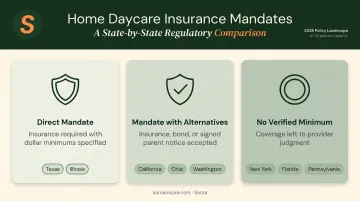
The Three Regulatory Models
| Model | How It Works | Example States |
|---|---|---|
| Direct mandate | Insurance required; dollar minimums specified | Texas (licensed/registered), Illinois (group homes) |
| Mandate with alternatives | Insurance or bond or signed parent notice | California, Ohio, Washington |
| No verified minimum | Coverage left to provider judgment or separate program rules | New York, Florida, Pennsylvania |
State-by-State Overview
| State | License Class | Verified Minimum | Requirement Status | Workers' Comp Trigger |
|---|---|---|---|---|
| California | Family Child Care Home | $100,000/occurrence, $300,000 aggregate (or bond or parent affidavits) | Mandatory with alternatives | 1+ employees |
| Texas | Licensed/Registered Child-Care Home | $100,000 per occurrence of negligence | Mandatory for licensed/registered; notice alternative for listed homes | Generally elective for private employers |
| Illinois | Group Day Care Home (private residence) | $100,000/occurrence | Mandatory for group tier; no mandate for ordinary day care homes | 1 employee (even part-time) |
| Ohio | Type A and licensed Type B | $100,000/occurrence, $300,000 aggregate (or signed parent statement) | Mandatory with notice alternative | Verify directly with Ohio BWC |
| Washington | Licensed Family Day Care | $100,000/occurrence, $300,000 aggregate (or written parent notice) | Mandatory with opt-out option | Any nonexempt worker; domestic workers exempt unless 2+ work 40+ hrs/week |
| New York | Family Day Care (Part 417) | No verified minimum in licensing regulations | No confirmed mandate | Virtually all employers must insure |
| Florida | Family Day Care Home | No verified minimum in licensing statute | No confirmed mandate | 4+ nonconstruction employees |
| Pennsylvania | Family Child Care Home (Ch. 3290) | No verified minimum in family-home regulations | No confirmed mandate | 1+ employees |
Important caveat on Florida: The $100,000/$300,000 minimum that appears in some Florida sources applies to School Readiness program eligibility: a funding-program condition, not a general family-home licensing minimum. These are different requirements.
The Parent-Notice Alternative
California, Ohio, Washington, and Texas (for listed family homes) permit providers who cannot obtain insurance, or whose coverage limits have been exhausted, to operate under a notice-based alternative. Requirements vary by state but generally involve:
- A signed affidavit or written statement from each parent acknowledging the provider does not carry the statutory coverage
- Retained copies of all signed documents
These notices transfer information, not liability. They satisfy the licensing agency's administrative requirement and inform parents of the coverage gap, but they offer no financial protection if a claim is filed.
Always verify current requirements directly with your state's childcare licensing agency. Minimums are updated periodically, and non-compliance can result in license denial or revocation.
How Much Does In-Home Daycare Insurance Cost?
In-home daycare insurance is priced individually — there's no standard rate card. The 2025 Child Care Aware brief documents rising liability costs and shrinking coverage options across the sector, but doesn't publish specific price ranges for home-based providers. What you pay depends on your specific risk profile.
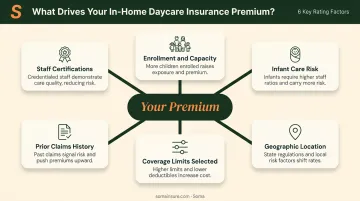
What Drives Your Premium
- Enrollment and capacity — more children means higher exposure; underwriting is typically ratio- and enrollment-based
- Infant care is the hardest segment to insure and consistently carries the highest premiums
- Geographic location — litigation environment varies significantly by state
- Coverage limits selected — higher limits cost more; some states' minimums are already at the lower end of what's practical
- Prior claims history — even one prior claim can affect your rate or eliminate certain carrier options entirely
- Staff certifications and training — documented childcare credentials can support lower premiums with some carriers
Getting Accurate Numbers
The factors above explain why published cost ranges are rough orientation at best — specialty carriers price each risk individually. The most useful approach is to quote apples-to-apples across multiple childcare-focused carriers. When comparing:
- Request quotes on identical limits and policy forms
- Check what's included vs. excluded on abuse and molestation (A&M) coverage
- Confirm how each carrier handles professional liability and defense costs
How to Secure the Right In-Home Daycare Insurance for Your State
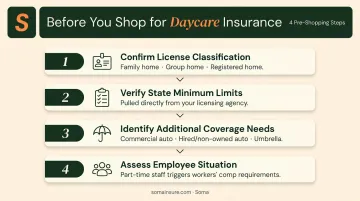
Pre-Shopping Checklist
Before requesting any quotes, confirm:
- Your exact license classification — family daycare home, group home, listed home, registered home. The name matters because insurance mandates are tied to license tier
- Your state's minimum required limits — pulled directly from your licensing agency, not a third-party summary
- Additional coverage needs — commercial auto if you transport children, hired and non-owned auto, umbrella/excess if your exposure warrants it
- Your employee situation — even a part-time assistant triggers workers' comp requirements in several states
What to Look for in an Insurer
Generic small-business insurers often miss childcare-specific exclusions. Look for:
- A carrier with documented experience writing home-based childcare risk
- Affirmative confirmation of A&M coverage in the policy form (not just the absence of an exclusion)
- A certificate of insurance that your licensing agency will accept
- Clear treatment of defense costs — some policies pay defense costs within the limits; others pay them in addition to limits
Working With a Specialist Brokerage
In-home daycare is categorized as a hard-to-insure risk by most standard markets. The combination of residential setting, child supervision liability, and infant care exposure causes many standard carriers to decline outright.
Soma places in-home and family daycare coverage through specialty carriers that write childcare risk specifically — markets that standard brokers rarely access.
One application reaches multiple childcare-focused carriers simultaneously. Soma's daycare program covers:
- General liability
- Professional liability
- Abuse and molestation liability
- Business property
- Workers' compensation
- Commercial auto
Submissions are structured around licensing and renewal deadlines, so coverage doesn't lapse mid-cycle.
Frequently Asked Questions
How much is insurance for an in-home daycare?
Annual costs vary based on state, enrollment size, coverage types, and claims history. General liability is typically the largest component, with premiums influenced primarily by capacity and age group served. Request quotes on identical forms from multiple specialty childcare carriers to get an accurate picture for your specific operation.
What type of insurance do daycares need?
The core coverage types are general liability, professional liability (errors and omissions), abuse and molestation liability, and business property insurance. Workers' compensation is also required if you have any employees, with thresholds varying by state.
Does homeowners insurance cover an in-home daycare?
Standard homeowners policies exclude paid childcare under the business pursuits exclusion. Some insurers offer a daycare endorsement, but these carry significant gaps on abuse and molestation coverage and professional liability — a standalone childcare policy provides far more reliable protection.
Is in-home daycare insurance required to get a childcare license?
Several states — including California, Texas (for licensed and registered homes), Illinois (for group homes), Ohio, and Washington — require proof of liability insurance or an approved alternative as a condition of licensing. New York, Florida, and Pennsylvania have no verified minimum in their family-home licensing regulations.
What is abuse and molestation coverage for daycare?
It covers legal defense costs and settlements when a child or parent files an allegation of abuse or misconduct. Confirm it affirmatively in writing before binding, because some general liability forms attach an exclusion endorsement that removes this coverage entirely.
Do I need workers' compensation for my home daycare?
Yes, if you employ staff. Most states set a trigger based on employee count — California, Illinois, and Pennsylvania require it from the first employee, while Florida's threshold is four or more. Check your state's specific requirement before bringing anyone on payroll.