Choosing the wrong insurance provider compounds the problem. Many daycare operators discover coverage gaps only after a claim is filed, at which point exclusions in the fine print become very expensive lessons. This article compares the top daycare insurance providers — Nationwide, Liberty Mutual, Markel, Philadelphia Insurance Companies (PHLY), and Chubb — so childcare operators can make an informed decision before a loss occurs.
Key Takeaways
- Daycare insurance requires specialized coverage that standard business or homeowners policies don't provide
- Abuse and molestation (A&M) liability is often excluded from generic GL policies — always verify its inclusion
- PHLY and Markel offer the most documented childcare-specific programs among the carriers compared
- Most states require licensed daycares to carry general liability at minimum
- Workers' comp is typically mandatory for any operation with employees
- A specialized childcare broker can pull quotes from multiple carriers through a single application
What Is Daycare Insurance and Why Does It Matter?
Daycare insurance combines commercial coverage policies for childcare operations — including home daycares, licensed childcare centers, preschools, and after-school programs. It covers risks from supervising children in a structured setting: bodily injury, property damage, professional negligence, and abuse allegations.
Federal law doesn't mandate liability insurance for daycares. Under 45 CFR Part 98 (CCDF regulations), the federal government requires states to have licensing requirements in place — but liability insurance is a state-level requirement, not a federal one.
State requirements vary considerably:
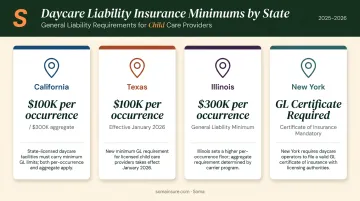
- California: Family child care homes must carry at least $100,000 per occurrence / $300,000 annual aggregate in liability insurance, or obtain signed parental affidavits
- Texas: Effective January 1, 2026, the required minimum is $100,000 per occurrence for listed childcare operations
- Illinois: Current rules require daycare centers to carry at least $300,000 per occurrence
- New York: Centers must provide a GL certificate at initial application and renewal
Those minimums exist for good reason. A single bodily injury claim, an allegation of inadequate supervision, or a sexual abuse accusation can generate legal costs and settlements that far exceed what most small childcare operations can absorb — and without adequate coverage, one incident can shut a program down for good.
Types of Daycare Insurance Coverage
General Liability Insurance
General liability (GL) is the foundational coverage for any daycare. It protects against third-party bodily injury claims (such as a child injured on-site), property damage, and personal injury. Most state licensing agencies treat this as the minimum required coverage — without a current GL certificate, many states won't issue or renew a childcare license.
Professional Liability (Errors & Omissions) Insurance
Professional liability covers claims that the daycare failed to provide adequate supervision or care — for example, a developmental program that allegedly harmed a child through negligence. This is distinct from GL because it addresses how care was delivered, not just physical accidents. Some carriers bundle professional liability into a Business Owner's Policy (BOP); others quote it as a standalone line.
Abuse and Molestation Coverage
The ISO CGL form includes an abuse or molestation exclusion endorsement (CG 21 46) that has been standard since 1987. Many generic commercial GL policies carry this exclusion — meaning an allegation of abuse may receive no coverage at all under a standard policy.
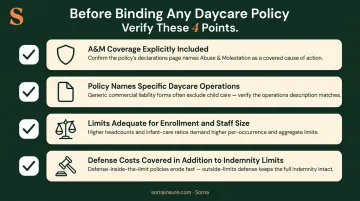
Before binding any daycare policy, confirm the following:
- Abuse and molestation coverage is explicitly included — not just assumed
- The policy names the daycare's specific operations (in-home, center-based, preschool, etc.)
- Limits are adequate for the number of children enrolled and staff employed
- Defense costs are covered in addition to indemnity limits
For the population served — children — this is non-negotiable coverage. Treat its absence as a disqualifying gap, not a minor omission.
Workers' Compensation and Commercial Property Insurance
Workers' compensation is legally required in most states for any daycare with employees. Texas is the only state where it remains optional for private employers. Workers' comp covers medical costs and lost wages for staff injured on the job.
Commercial property insurance protects the facility, equipment, and supplies from fire, theft, vandalism, and other covered perils. For home-based daycares, this coverage is especially critical — homeowners insurance does not cover losses related to a home daycare operation. The NAIC's consumer guide confirms that operating a paid daycare from home requires liability coverage beyond any standard homeowners policy.
Best Daycare Insurance Providers Compared
The carriers below were evaluated on childcare-specific coverage options, AM Best financial strength ratings, policy customization, and suitability across different daycare sizes. AM Best ratings referenced reflect current confirmed ratings as of the publication date.
Nationwide
Nationwide Mutual Insurance Company holds an AM Best rating of A (Excellent), affirmed November 7, 2025. Daycare centers — including those serving children with special needs — are eligible through Nationwide's OthersFirst human services program, which uses a commercial package policy structure rather than a daycare-specific BOP.
| Category | Details |
|---|---|
| Coverage Highlights | General liability, professional liability, commercial property, business income, abuse & molestation, crisis response, optional enhancement endorsements |
| Best For | Small-to-mid-sized home daycares and independent childcare centers seeking bundled coverage with broad state availability |
| Key Differentiator | 24/7 claims support and accessible online quoting for smaller operators; broad availability across U.S. states |
Note: Nationwide's daycare coverage comes through a broader human-services commercial package — not a dedicated childcare-only product. Verify A&M inclusion or endorsement on the actual quote.
Liberty Mutual
Liberty Mutual Insurance Company carries an AM Best rating of A (Excellent), affirmed September 10, 2025. As one of the largest commercial insurers in the U.S. — ranked ninth globally by 2025 gross written premium — Liberty Mutual offers scalable commercial lines for businesses of varying sizes.
| Category | Details |
|---|---|
| Coverage Highlights | Commercial general liability, commercial property, umbrella/excess liability, workers' compensation |
| Best For | Medium-to-large daycare centers or multi-location childcare businesses that need scalable commercial coverage and financial stability |
| Key Differentiator | SafetyNet risk control platform providing training and loss prevention resources for commercial clients |
Important caveat: No official Liberty Mutual source reviewed explicitly names daycare or childcare as a named eligibility class within a dedicated program. Their commercial lines are broad, but operators should confirm childcare appetite and A&M availability directly before binding.
Markel
Markel Insurance Company holds an AM Best rating of A (Excellent), affirmed November 21, 2025. Unlike generalist carriers, Markel maintains dedicated Commercial Child Care Insurance and In-Home Daycare Insurance product pages — one of the clearest childcare-specific programs among the carriers reviewed.
| Category | Details |
|---|---|
| Coverage Highlights | General liability, professional liability, abuse & molestation, accident medical coverage for daycare centers |
| Best For | Childcare centers needing specialty coverage including A&M protection, or home daycare providers who need a standalone policy |
| Key Differentiator | Dedicated childcare product lines covering both commercial centers and in-home providers; specialty underwriting experience with hard-to-place childcare risks |
Markel includes A&M coverage for childcare clients, though the policy documentation doesn't always specify whether it's embedded or requires a separate endorsement. Ask your broker to confirm before binding.
Philadelphia Insurance Companies (PHLY)
Philadelphia Indemnity Insurance Company holds an AM Best rating of A++ (Superior) (the highest possible rating) effective October 23, 2025. PHLY operates a dedicated Child Care Package for both nonprofit and for-profit childcare organizations, with product pages and application requirements specifically built around childcare underwriting.
| Category | Details |
|---|---|
| Coverage Highlights | General liability, professional liability (including teachers' acts and omissions), commercial property, business income, crime/fidelity, physical and sexual abuse coverage with separate limits, directors & officers, commercial auto, excess limits |
| Best For | Established childcare centers, nonprofits running childcare programs, after-school care operators, and any program where comprehensive A&M protection is a priority |
| Key Differentiator | Physical and sexual abuse coverage with separate stated limits; risk management services through PHLYSENSE platform; abuse prevention partnerships with Abuse Prevention Systems and MinistrySafe |
PHLY stands out for transparency: its childcare application explicitly requests enrollment, child ages, staffing, transportation details, and three years of loss runs — reflecting genuine childcare underwriting depth rather than a generic commercial appetite.
Chubb
Chubb's grouped subsidiaries hold an AM Best rating of A++ (Superior), affirmed January 16, 2026. Chubb is a global commercial insurer operating across 54 countries, known for high-limit, premium commercial coverage.
| Category | Details |
|---|---|
| Coverage Highlights | Commercial GL, commercial property, employment practices liability (EPLI), workers' compensation, commercial auto (for educational institutions) |
| Best For | Larger, well-established childcare organizations with significant property assets that need high-limit commercial coverage and premium claims service |
| Key Differentiator | Superior financial strength rating and high-capacity limits; premium risk advisory and claims services for complex commercial accounts |
Material caveat: Chubb's reviewed sources name educational institutions and schools as eligible classes, but do not specifically list daycare or early childhood centers. Middle-market GL and umbrella show limited documented appetite for childcare. Chubb's strength ratings are unmatched, but operators should confirm childcare eligibility and A&M availability through a broker before assuming coverage.
How We Chose the Best Daycare Insurance Providers
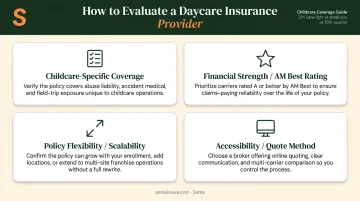
The evaluation framework prioritized four factors:
- Childcare-specific coverage — Does the carrier have a documented daycare program or named eligibility? Does it explicitly offer A&M coverage?
- Financial strength — AM Best rating confirmed for the underwriting entity, not just the brand
- Policy flexibility — Can coverage scale from a single home daycare to a multi-site franchise?
- Accessibility — Available through direct quote, broker placement, or both?
Common mistakes daycare operators make when shopping for insurance:
- Relying on a homeowners policy to cover a home daycare operation (it won't)
- Comparing premiums without reviewing exclusions — especially A&M
- Buying a generic small business BOP without confirming childcare eligibility
- Assuming professional liability is included in a GL policy when it's often separate
Each of these mistakes is avoidable — and a specialized broker cuts the process down to a single application. Soma, an independent commercial insurance brokerage that places coverage for hard-to-insure businesses, works with carriers including Chubb, Markel, Liberty Mutual, and Nationwide. Its daycare program covers the full range of childcare operations: infant care (widely considered the hardest segment to insure), faith-based programs, multi-site franchises, and programs that transport children.
One application routes to multiple specialty carriers simultaneously — more efficient than approaching each carrier separately, with less risk of coverage gaps.
Conclusion
No single carrier is the right choice for every daycare. The best provider depends on operation size, whether abuse and molestation (A&M) coverage is needed — and it almost always is, state licensing requirements, and budget. What's consistent across all scenarios: comparing coverage terms matters more than comparing premiums, because the exclusions you don't notice until a claim is filed are the ones that cost the most.
Soma's risk management team specializes in placing coverage for childcare businesses and can match operators with the right carrier from its network of hundreds of partners — with quotes fast enough to meet licensing and renewal deadlines. Get a customized daycare insurance quote through Soma to compare childcare-specific options without filling out applications at five different carriers.
Frequently Asked Questions
What are the main types of daycare insurance coverage?
The five core types are general liability, professional liability (E&O), abuse and molestation liability, commercial property, and workers' compensation. Most daycares need a combination of these — no single policy typically covers all five, though some carriers bundle several into a package.
What does "daycare" mean in insurance?
In an insurance context, daycare refers to any organized childcare operation — including home daycares, licensed childcare centers, preschools, and after-school programs. This classification triggers specific coverage requirements and exclusions not found in standard homeowners or general commercial policies.
How much does daycare insurance cost per year?
Costs vary based on coverage type, enrollment size, location, staffing, and claims history. The most reliable way to get accurate figures is to request quotes with your specific details — child ages, staff ratios, and whether you transport children.
Do home daycares need different insurance than daycare centers?
The core coverage types are the same, but home daycares cannot rely on homeowners insurance. They need a standalone daycare liability policy or endorsement. Larger centers typically require higher limits, commercial property coverage for the facility, and additional lines like EPLI that aren't usually necessary for smaller home-based operations.
Is daycare insurance required by law?
Requirements vary by state, but most licensing agencies require general liability at minimum, and daycares with employees are typically required to carry workers' compensation. Check your state's childcare licensing regulations for the exact minimums — rules differ significantly across states like California, Texas, New York, and Illinois.
Can working with a broker help me find better daycare insurance?
Yes. A specialized broker with access to multiple carriers can compare childcare-specific policies through a single application, identify coverage gaps like missing A&M protection, and often secure more competitive terms than going directly to one carrier — especially for hard-to-place risks like infant care or faith-based programs.