Compliance pressure compounds the problem. Most state licensing agencies require specific insurance coverage before a daycare can legally operate, meaning the wrong carrier isn't just a financial risk — it's a licensing risk. NAEYC's 2024 survey identifies 30 states requiring liability insurance for licensed centers, with requirements varying significantly by state and provider type.
Choosing the right insurer means matching your coverage stack to your operation's size, structure, and state requirements. This guide breaks down the top daycare insurance carriers, what they cover, what they don't, and where each one makes the most sense.
Key Takeaways
- No single policy covers all daycare exposures — you need a combination of general liability, abuse and molestation (A&M), professional liability, and workers' comp at minimum.
- A&M coverage is excluded from standard GL policies but required by most state licensing agencies — verify a carrier offers it before you commit.
- General liability alone typically runs $56–$78/month for daycare operators, according to NEXT Insurance data — but total coverage costs more once A&M and professional liability are added.
- Match your carrier to your operation: small home daycares have different coverage needs than multi-site centers running transportation programs.
- If standard carriers decline your application, a specialty broker can access markets that don't quote direct — often at comparable rates.
Why Daycare Centers Need Specialized Insurance
Standard business owners policies (BOPs) are built around common commercial risks: slip-and-fall claims, property damage, basic professional errors. Childcare operations stack exposures on top of each other in ways a BOP can't address cleanly.
A single incident can trigger multiple coverage questions simultaneously: Is this a general liability claim? A professional liability claim? Does the abuse and molestation exclusion apply? Which policy responds first? These aren't hypothetical edge cases — they're the claims daycare operators actually face.
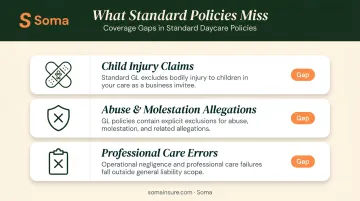
Three Layers Standard Policies Miss
- Child injury claims: GL covers third-party bodily injury, but disputes arise quickly when the injured party is an enrolled child in the provider's direct care
- Abuse and molestation allegations: ISO form CG 21 46 explicitly excludes injury from actual or threatened abuse or molestation, plus negligent hiring and supervision connected to the alleged actor. A standard GL policy won't respond to these claims at all.
- Professional care errors: GL doesn't cover negligence claims tied to care decisions, medication administration mistakes, or failures to follow individualized care plans
Those coverage gaps matter on their own — but they're compounded by regulatory requirements that most operators can't ignore.
Compliance Requirements Add Another Layer
Most state licensing agencies mandate minimum GL limits as a condition of licensure.
Tennessee, for example, requires $500,000 per occurrence / $500,000 aggregate for licensed centers and $100,000 per occurrence / $300,000 aggregate for A&M coverage specifically, effective November 2025. Texas requires at least $100,000 per involved child for listed family homes.
Landlords, government subsidy programs, and corporate childcare contracts often add their own proof-of-insurance requirements on top of state minimums.
Home-based providers face an additional gap: standard homeowners policies explicitly exclude commercial activities. The Texas Department of Insurance confirms that homeowners policies generally exclude losses tied to home daycare businesses. Even policies with home-business endorsements cap coverage at limits far below what a real childcare claim would require.
Best Daycare Insurance Companies Compared
These carriers were evaluated on affordability, coverage depth (especially A&M availability), ease of obtaining proof of insurance, and fit across different daycare operation sizes.
NEXT Insurance
NEXT is a fully digital insurer that lets daycare providers quote, bind, and generate a certificate of insurance (COI) in roughly 10 minutes — a practical time-saver for providers managing frequent licensing renewals or landlord COI requests.
| Criteria | Details |
|---|---|
| Best For | Home-based providers and small centers with high COI request volume |
| Coverage Highlight | General liability, professional liability, commercial property (bundling discount available) |
| Average Monthly Cost | GL starting at $20.83/month (minimum Texas premium); 67% of daycare customers pay $56–$78/month for GL |
Limitations:
- Enrollment capped at 50 children; maximum 25:1 child-to-provider ratio and 15 care hours per day
- Overnight care, field trips, and pools are excluded
- No confirmed A&M availability — verify directly before binding if A&M is a licensing requirement in your state
The Hartford
The Hartford offers the broadest documented coverage depth among daycare insurers, with sexual abuse and molestation coverage available as an optional GL endorsement — directly addressing the highest-severity claim type that standard policies exclude entirely.
| Criteria | Details |
|---|---|
| Best For | Licensed centers needing A&M coverage and strong compliance documentation support |
| Coverage Highlight | GL with A&M endorsement, workers' comp, commercial property, business income insurance |
| Average Monthly Cost | No authoritative daycare-specific starting premium publicly available — get a direct quote |
Worth noting: The Hartford routes applicants through Tivly rather than offering direct quoting, which adds time to the proof-of-insurance process. For licensed centers with complex requirements, the coverage breadth justifies the extra steps.
Hiscox
For small daycare businesses and in-home providers, Hiscox offers flexible policy options backed by strong customer experience ratings — with coverage designed to scale as the operation grows.
| Criteria | Details |
|---|---|
| Best For | Solo providers and small daycares prioritizing customer service and policy flexibility |
| Coverage Highlight | General liability, professional liability, business owners policy (BOP) |
| Average Monthly Cost | No authoritative daycare-specific starting premium publicly available — get a direct quote |
Limitations:
- Coverage breadth ranks below The Hartford — gaps may emerge as enrollment grows
- Less suited to providers who need enterprise-level limits or A&M documentation for licensing compliance
Nationwide
Nationwide ranks near the top for coverage quality and is a strong fit for mid-sized daycare centers needing robust GL limits, workers' comp, and commercial auto for transportation programs. Nationwide's human services insurance program lists daycare as an eligible service type and confirms A&M coverage availability.
| Criteria | Details |
|---|---|
| Best For | Mid-sized licensed centers with 10 or more employees and active transportation programs |
| Coverage Highlight | General liability, workers' comp, commercial auto, commercial property |
| Average Monthly Cost | No authoritative daycare-specific starting premium publicly available — get a direct quote |
Worth noting: Pricing runs above average for smaller operations. The cost equation improves with headcount — Nationwide becomes more competitive for established centers than for solo or micro providers.
biBERK
Backed by Berkshire Hathaway, biBERK offers straightforward online quoting at competitive rates — a practical option for small daycare centers that want reliable coverage without going through a broker.
| Criteria | Details |
|---|---|
| Best For | Small daycare centers seeking budget-friendly coverage from a financially stable carrier |
| Coverage Highlight | General liability, workers' comp, professional liability, commercial property |
| Average Monthly Cost | No authoritative daycare-specific starting premium publicly available — get a direct quote |
Limitations:
- Coverage menu is narrower than The Hartford — not built for complex requirements
- A&M availability is unconfirmed; daycare materials flag the need to check exclusions but don't commit either way
- Not suitable for government contract endorsements or enterprise-level A&M limits
Types of Insurance Daycare Centers Need
General Liability
The foundational policy required by most state licensing agencies before a daycare can legally operate. Covers child injury claims, visitor bodily injury, and third-party property damage. Does not cover abuse and molestation claims — that exclusion is written directly into standard GL policy forms.
Abuse and Molestation (A&M)
A separate policy or endorsement because standard GL explicitly excludes these claims. As the primary caregiver, any allegation traces back to the operator. Most state licensing agencies require this as a standalone condition of licensure — Tennessee now mandates specific limits as of November 2025.
Professional Liability (Errors & Omissions)
Covers care decisions that result in negligence claims — administering medication incorrectly, failing to follow a child's individualized care plan, or missing a mandatory reporter obligation. Standard GL doesn't cover these claims.
Workers' Compensation
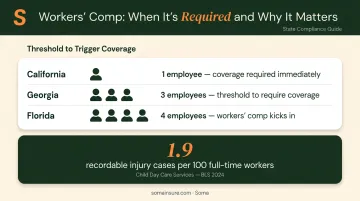
Legally required in most states once any paid employee is hired — including part-time aides. Workers' comp threshold examples: California requires coverage with one employee, Georgia at three, Florida at four for non-construction employers.
The BLS reports 1.9 total recordable injury cases per 100 full-time workers in Child Day Care Services in 2024 — a real risk given the physical demands of the work. That rate means workers' comp isn't optional protection — it's an active exposure to manage.
Beyond those mandatory lines, several situational coverages can close gaps depending on how your center operates.
Additional Coverages to Consider
| Coverage | When You Need It |
|---|---|
| Commercial property | Equipment, playground infrastructure, leasehold improvements |
| Commercial auto | Any child transportation by van or bus |
| Cyber liability | Digital storage of medical records, custody orders, or payment data |
| Employment practices liability | Centers with multiple staff and real wage-and-hour exposure |
How Much Does Daycare Insurance Cost?
NEXT Insurance's daycare cost data provides the most specific publicly available benchmarks:
| Coverage Type | Typical Monthly Cost |
|---|---|
| General liability | $56–$78/month (67% of NEXT daycare customers) |
| Workers' compensation | $31–$61/month (34% of NEXT daycare customers) |
| Commercial property | $28–$62/month (43% of NEXT daycare customers); standard $500 deductible |
| Professional liability | No authoritative daycare-specific benchmark publicly available |
| Commercial auto / A&M | No authoritative daycare-specific benchmark publicly available |
What Drives Your Premium
Several factors shift costs significantly:
- Enrollment size — more children enrolled means higher exposure
- Facility type — home-based providers typically pay less than licensed commercial centers
- Employee count and classifications — each hire adds workers' comp exposure
- Services offered — transportation programs, infant care, and overnight care each increase premium
- Claims history — prior claims are the fastest way to see rate increases
- Coverage limits — state-mandated minimums set the floor; higher limits cost more
- Location — state-specific licensing minimums and workers' comp rate tables vary considerably
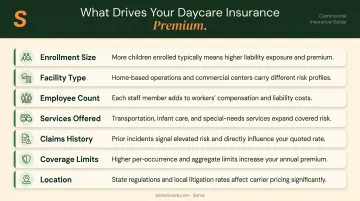
A solo home-based provider carrying basic GL and professional liability will pay a fraction of what a licensed center with 30 enrolled children, five employees, and a transportation program pays — even within the same coverage type.
How We Chose the Best Daycare Insurance Companies
The carriers in this comparison were evaluated across five dimensions:
- A&M availability — whether the carrier offers abuse and molestation coverage as a standard or optional feature
- Coverage depth — the breadth of the coverage stack available for daycare-specific exposures
- Affordability across operation sizes — whether pricing scales reasonably from solo providers to mid-sized centers
- Proof-of-insurance speed — how quickly a COI can be generated for licensing or landlord requirements
- Claims handling quality — carrier reputation for responsiveness when claims actually occur
Most daycare operators with straightforward coverage needs will find a workable option among the five carriers above. Operations with multiple locations, government contracts, higher enrollment caps, or hard-to-place A&M coverage require a different approach.
For those situations, a specialty brokerage gives you direct access to markets that standard carriers won't touch. Soma places daycare coverage across hundreds of carrier partners — including Chubb, Markel, Nationwide, and Liberty Mutual — and handles infant care programs, the hardest segment to insure in childcare.
One application covers the full coverage stack, with quotes generated across multiple carriers simultaneously rather than requiring providers to approach each one individually.
Conclusion
There's no universal best daycare insurance company. The right carrier depends on your operation size, state licensing requirements, whether A&M coverage is mandated, and how your coverage needs have evolved as the business has grown.
Start by identifying what you're legally required to carry, what your contracts demand, and what your specific operation's exposures are — then compare carriers against that list. Choosing a carrier because it's cheapest, without confirming A&M availability or verifying it meets state minimums, creates a compliance gap that can surface at the worst possible moment.
For daycare operators with complex coverage needs — multi-site operations, transportation programs, infant care, faith-based programs, or hard-to-place A&M requirements — Soma's brokerage model lets you submit one application and receive quotes across hundreds of carriers. That means faster placement without the back-and-forth of chasing individual brokers or carriers.
Reach out at somainsure.com to get started.
Frequently Asked Questions
What is the average cost of insurance for a daycare?
General liability for daycare centers typically runs $56–$78/month based on NEXT Insurance's customer data, with workers' comp adding $31–$61/month and commercial property $28–$62/month. Total cost depends on coverage type, operation size, and state. The cost section above breaks down each coverage line in detail.
What type of insurance do daycares need?
At minimum: general liability, abuse and molestation coverage, professional liability (E&O), and workers' comp once any employee is hired. Commercial auto, cyber liability, and employment practices liability apply depending on the operation's specific services and size.
Is daycare insurance required by law?
NAEYC's 2024 survey identifies 30 states requiring liability insurance for licensed centers. Workers' comp is legally mandated in most states the moment any paid employee is hired, including part-time staff.
Does a home daycare need separate insurance from homeowners?
Yes. Standard homeowners policies exclude commercial activities, and even home-business endorsements cap coverage well below what a real childcare claim would require. A separate daycare liability policy is necessary for any home-based provider accepting paying clients.
What is abuse and molestation insurance for daycares?
A&M coverage is a separate policy or endorsement covering legal defense and settlement costs related to allegations of abuse or misconduct. It's excluded from standard GL policies and required by most state licensing agencies — Tennessee now mandates specific minimum limits as of November 2025.
How can I get multiple daycare insurance quotes quickly?
You can go directly to carriers, use comparison platforms, or work with a specialty broker. Soma submits one application across multiple carriers — including those that write infant care, multi-site, and hard-to-place A&M risks — cutting turnaround time significantly versus approaching each carrier on your own.