Introduction
Running a licensed daycare in Florida means navigating one of the most complex insurance environments in the country. Between state-specific statutory exclusions, hurricane exposure, and a litigation climate that consistently ranks among the most expensive in the nation, standard policies frequently leave operators exposed before a claim makes that clear.
Florida Statute 627.70161 makes this explicit: residential property policies do not cover family daycare liability claims unless that coverage is specifically added by endorsement. That single statutory gap has blindsided in-home providers when claims are filed.
What follows covers the required coverages, how Florida licensing interacts with insurance, what drives costs, and how to build a program that holds up when a claim is filed.
Key Takeaways
- Standard homeowners policies are legally prohibited from covering family daycare liability under Florida law
- School Readiness Program providers must carry general liability with at least $100,000/$300,000 limits — requirements vary by DCF license type
- Abuse and molestation coverage is excluded from standard GL policies and requires a separate endorsement
- Workers' compensation is required once your daycare reaches four or more employees
- Florida's hurricane exposure and litigation environment both push insurance costs above national averages
Why Standard Home or Business Insurance Isn't Enough for a Florida Daycare
Most homeowners policies exclude commercial business activities. If a parent's child is injured at your in-home daycare and they file a claim, your residential insurer can deny both coverage and the duty to defend. Florida Statute 627.70161 codifies this directly — residential property insurance does not cover family daycare home liability unless coverage is specifically included or added through a business rider or endorsement.
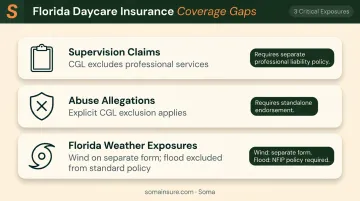
The Three Coverage Gaps That Matter Most
Even operators who recognize the homeowner policy problem often underestimate how many gaps exist across commercial policies:
Gap 1: Supervision claims aren't covered. Standard commercial general liability (CGL) policies routinely exclude professional services. Allegations of inadequate supervision or failure to monitor a child's health fall into professional liability territory — not general liability — and require a separate policy.
Gap 2: Abuse allegations fall outside standard CGL. Most CGL policies contain explicit sexual abuse exclusions, meaning allegations of abuse by staff, volunteers, or even another enrolled child are not covered. This must be purchased separately or added as a specific endorsement.
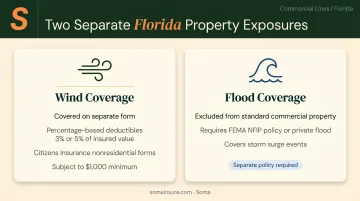
Gap 3: Florida's weather creates two distinct property exposures. Wind coverage is frequently written on a separate form from standard commercial property, with its own deductibles. Citizens Insurance, Florida's insurer of last resort, applies 3% or 5% per-occurrence wind deductibles on commercial nonresidential policies, subject to a $1,000 minimum.
Flood damage — including hurricane storm surge — is a separate exposure entirely and requires its own NFIP or private flood policy.
Essential Coverage Types Every Florida Daycare Needs
General Liability Insurance
General liability is the foundation of any daycare insurance program. It covers:
- Third-party bodily injury (a parent slips in your facility)
- Third-party property damage
- Personal and advertising injury claims
For daycares participating in Florida's School Readiness Program, Florida Statute 1002.88 sets a minimum of $100,000 per occurrence and $300,000 aggregate, including transportation liability if you transport School Readiness children. Daycares outside that program should check their specific DCF license category under Chapter 65C for applicable minimums.
Given the daily volume of foot traffic — children, parents, and staff cycling through continuously — adequate per-occurrence limits matter. A single serious injury claim can exhaust a low per-occurrence limit quickly.
Professional Liability (Errors & Omissions) Insurance
Professional liability covers claims of negligence in the professional services your daycare provides:
- Allegations of inadequate supervision
- Failure to monitor a child's medical condition
- Improper hiring or staffing decisions
- Failure to follow established care protocols
Unlike general liability, which covers physical accidents, professional liability addresses the supervisory decisions and judgment calls behind childcare operations. Legal defense costs alone — even for a meritless claim — can reach tens of thousands of dollars, making this coverage essential for any facility.
Abuse and Molestation Liability
This is a non-negotiable coverage for any childcare provider. It covers legal defense costs and settlements arising from allegations of physical, emotional, or sexual abuse by an employee, volunteer, or another child in care.
Key points:
- Excluded from standard GL policies — add it as a standalone policy or endorsement
- Required by many licensing bodies and landlords — confirm with your specific DCF license category and facility lease
- Defense costs apply regardless of outcome — allegations alone trigger significant legal expense
Soma places abuse and molestation liability as a named coverage separate from the GL policy, using specialty carriers that write this risk when standard markets won't.
Commercial Property Insurance
Commercial property covers your building (if owned), playground equipment, learning materials, furniture, and business electronics against covered perils like fire, theft, and vandalism.
For Florida daycares, two property issues require specific attention:
- Wind coverage — Confirm whether your policy includes wind damage or whether it must be written separately. Citizens Insurance offers both commercial nonresidential multiperil and wind-only forms; wind deductibles are typically percentage-based, not flat dollar amounts.
- Flood coverage — Storm surge and flooding are not covered by standard commercial property policies. FEMA's NFIP program provides commercial flood coverage for businesses in participating communities.
Additional Coverages to Consider for Florida Daycares
Workers' Compensation and Business Interruption
Florida requires workers' compensation once a daycare reaches four or more employees (full-time or part-time). This is the standard non-construction threshold under Florida Chapter 440, and it applies to daycare operators the same as any other employer.
Common daycare injuries — back strain from lifting children, slip-and-falls on wet floors — make this coverage practical even for operations hovering near that four-employee threshold.
Business Interruption insurance pairs with commercial property: if a covered loss forces a temporary closure, it replaces lost income during the recovery period. For daycares with families depending on consistent care, an unexpected closure without income replacement can be financially devastating.
Commercial Auto and Non-Owned Auto Liability
If your daycare transports children — field trips, pickup and drop-off routes — personal auto policies provide no coverage for those activities. You need:
- Commercial auto for any owned van or bus used in daycare operations
- Hired and non-owned auto (HNOA) for rented vehicles or staff personal vehicles used for child transport
Soma includes both commercial auto and HNOA within its daycare coverage program, covering operations that run van and bus routes.
Umbrella and EPLI
Two coverages worth adding as your operation grows:
- Commercial umbrella extends liability limits above your primary policies — useful when a landlord, lender, or licensing body requires higher aggregate limits than your base coverage provides. Soma includes umbrella/excess liability within its daycare coverage stack.
- Employment Practices Liability (EPLI) protects against employee claims: wrongful termination, discrimination, and harassment. Florida daycares with five or more employees are particularly exposed here, since staff turnover in childcare is high and disputes are common.
Florida's Licensing and Insurance Requirements for Daycares
The Florida Department of Children and Families (DCF) licenses child care facilities across 62 of Florida's 67 counties. Your license classification determines which insurance requirements apply to your operation, so it's the right starting point. DCF recognizes three provider types:
| Provider Type | Key Characteristics |
|---|---|
| Family Day Care Home | Up to 10 children; operated from a residence |
| Large Family Child Care Home | 11–12 children; licensed separately |
| Licensed Child Care Facility | Commercial center; separate facility standards |
Insurance Requirements by Program and Trigger
Insurance obligations for Florida daycares arise from multiple separate legal mechanisms — not a single universal rule:
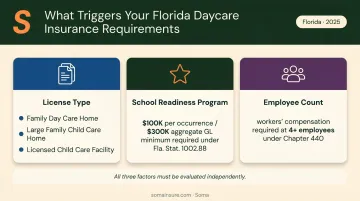
- School Readiness Program providers : Fla. Stat. 1002.88 requires minimum general liability of $100,000 per occurrence / $300,000 aggregate, including transportation liability when transporting SR children
- Family daycare homes : Subject to the residential policy exclusion under 627.70161; must confirm coverage through DCF's current Child Care Licensing requirements for their license class
- Workers' compensation — Required at four or more employees, no daycare-specific exception
- Local requirements — Broward County administers its own child care licensing under separate county rules; other counties may have additional requirements. Confirm with your county's DCF office
Your insurance obligations depend on three separate factors: your license type, whether you participate in the School Readiness Program, and your employee count. Each triggers distinct requirements — and missing any one of them creates a compliance gap.
How Much Does Daycare Insurance Cost in Florida?
Florida daycare insurance premiums vary significantly from one operation to the next. Carriers price these policies based on a combination of risk factors specific to your facility — there's no flat rate, and the gap between a small in-home provider and a licensed multi-site center can be substantial.
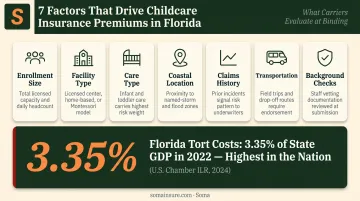
Key Factors That Drive Florida Daycare Premiums
- Enrollment and child-to-staff ratios — Carriers price based on enrollment size and staff ratios; more children and a higher child-to-staff ratio generally increases exposure
- Facility type — In-home daycares typically present a different risk profile than large licensed commercial centers
- Type of care — Infant care is widely considered the hardest segment to insure, and commands higher premiums
- Coastal location — Proximity to the Florida coast directly affects commercial property premiums due to named-storm exposure
- Prior claims history — A clean claims record is one of the most effective premium management tools available
- Transportation — Operating vans or buses for child transport adds a separate, higher-risk exposure
- Background check practices — Carriers in the specialty childcare market may factor staff screening practices into underwriting
Beyond facility-specific factors, Florida's litigation climate pushes general liability premiums higher across the board. According to a 2024 study by the U.S. Chamber Institute for Legal Reform, Florida's tort costs equaled 3.35% of state GDP in 2022 — the highest share of any state. Childcare operations are not exempt from that pressure.
Strategies for Managing Costs
- Bundle coverages — Combining general liability, property, and related lines through a single program reduces administrative costs and often lowers overall premiums
- Pay annually — Most carriers offer a discount for annual premium payment versus monthly installments
- Maintain clean claims history — Consistently the strongest lever for keeping premiums down over time
- Obtain staff certifications — CPR, first aid, and childcare professional certifications may improve carrier perception of risk quality
- Work with a specialist broker — Specialty brokers with access to daycare-focused carriers can compare programs that standard markets don't offer — and know which exclusions to watch for
How to Get the Right Daycare Insurance Coverage in Florida
Step 1: Identify Your License Type and Applicable Requirements
Before requesting any quote, confirm:
- Your DCF license category (family daycare home, large family child care home, or licensed center)
- Whether you participate in the School Readiness Program
- Your employee count relative to the four-employee workers' comp threshold
- Whether you transport children
These four factors determine which coverage obligations are triggered before you evaluate optional coverages.
Step 2: Map Your Operational Exposures
Walk through each operational risk:
- Do you own or rent your facility? (determines property coverage structure)
- Do you operate near the coast? (wind and flood coverage considerations)
- Do you transport children? (commercial auto or HNOA needed)
- Do you have four or more employees? (workers' comp required)
- What is your enrollment composition? (infant care triggers specialty underwriting)
Step 3: Work with a Specialist, Not a Generalist
A general commercial insurance broker may write a standard CGL policy and miss the professional liability exclusion, the abuse and molestation gap, and the Florida wind structure entirely. These are the gaps that produce real losses in childcare operations — not hypothetical risks.
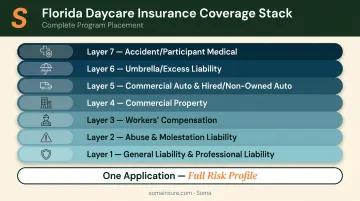
Soma places coverage across the full range of Florida daycare operations — from in-home family daycares and licensed commercial centers to Montessori programs, faith-based daycares, infant care programs, and multi-site franchises. One application covers the full risk profile, with underwriting based on your enrollment and ratios through specialty carriers that write childcare when standard markets won't.
The coverage stack includes:
- General liability and professional liability
- Abuse and molestation liability
- Workers' compensation
- Commercial property
- Commercial auto, hired and non-owned auto
- Umbrella/excess liability
- Accident/participant medical
Step 4: Review and Reassess Annually
Once your broker has placed coverage, a final review before binding protects you from gaps that surface at claim time. Confirm:
- Abuse and molestation liability is explicitly included or endorsed
- Off-premises activities (field trips) are covered under your GL policy
- Wind coverage is addressed — either included or written on a separate form with confirmed deductible structure
- Flood exposure is evaluated based on your facility's location
Reassess coverage annually. Enrollment changes, staff additions crossing the workers' comp threshold, and facility expansions all change your risk profile and may affect your licensing compliance.
Frequently Asked Questions
How much is daycare insurance in Florida?
Premiums vary based on enrollment size, facility type, location, care category (infant care typically carries higher rates), and claims history. No standardized published ranges exist for Florida daycares specifically. Request a quote from a specialist broker to get a figure based on your actual operation.
Does Florida law require daycares to carry insurance?
Yes. Florida's School Readiness Program requires general liability with minimums of $100,000 per occurrence and $300,000 aggregate (Fla. Stat. 1002.88). Workers' compensation applies at four or more employees under Chapter 440. Confirm your DCF license category for the requirements specific to your operation.
Does homeowners insurance cover an in-home daycare in Florida?
No. Florida Statute 627.70161 prohibits residential property insurers from covering family daycare liability unless coverage is specifically added through a business rider or endorsement. In-home providers need a separate commercial or daycare-specific policy.
What is abuse and molestation liability and do I need it for my Florida daycare?
Abuse and molestation liability covers defense costs and settlements for allegations of physical, emotional, or sexual abuse involving staff, volunteers, or children in care. Standard GL policies exclude it — it must be purchased separately. Many licensing bodies and landlords require it as a condition of operation.
Does a Florida daycare need workers' compensation insurance?
Florida requires workers' compensation for any daycare with four or more employees — full-time or part-time. Common daycare injuries like lifting strain and slip-and-fall accidents make this coverage practically necessary even for operations approaching that threshold.
What happens if a Florida daycare operates without the required insurance?
Operating without required insurance can result in DCF license denial or revocation. An uninsured claim from an injured child, a parent lawsuit, or an employee injury can expose the operator to out-of-pocket costs most small businesses cannot absorb.