Key Takeaways
- General liability runs $2,000–$5,000/year; full multi-line packages reach $5,000–$35,000+ based on center size
- Abuse and molestation coverage is excluded from standard general liability and is the most dangerous gap to leave unfilled
- Workers' comp, professional liability, and auto can collectively double or triple your base premium
- Coverage gaps discovered at claims time cost far more than the premium savings that created them
- Growing centers (new staff, vehicles, infant rooms) must update coverage at each expansion milestone
How Much Does Commercial Daycare Insurance Cost?
Commercial daycare insurance doesn't have a single price point. Your total premium depends on which policies you carry, how many children you serve, what services you offer, and where you operate. Underbudgeting catches more daycare operators off guard than any other financial mistake in this business.
The three most expensive mistakes stem from misunderstanding costs:
- Buying only general liability and assuming it covers everything
- Skipping abuse and molestation coverage because it seems optional
- Failing to account for workers' compensation as staff grows
Cost Range by Center Size
The table below uses published figures from Hotaling Insurance's 2026 daycare liability cost analysis. Note that verified data covers two primary tiers; no authoritative source publishes a distinct range for centers with fewer than 20 children.
| Center Size | General Liability (Annual) | Full Multi-Line Package (Annual) | Typical Coverage Included |
|---|---|---|---|
| Single center, 20–75 children | $2,000–$5,000 | $5,000–$12,000 | GL, abuse/molestation, property, workers' comp, EPLI, hired/non-owned auto, umbrella |
| 2–4 centers, 100–300 children | $8,000–$20,000 | $15,000–$35,000 | All above + commercial auto fleet, regulatory defense, business income |
| Enterprise, 5+ locations, 300+ children | $20,000–$50,000 | $40,000–$100,000+ | Layered excess program, dedicated abuse tower, cyber, D&O |
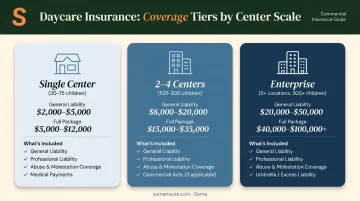
A second source citing Virginia commercial centers puts the range at $3,000–$15,000+ annually for a single center — a reminder of how much location and coverage choices move the needle.
The multi-line package figures above include EPLI and hired/non-owned auto, but not a commercial auto policy for vehicles your center actually owns. Centers that run their own vans or buses should budget accordingly — that coverage adds a separate line item.
Key Factors That Affect Commercial Daycare Insurance Costs
No two centers pay the same rate, even within the same city. Premiums are shaped by a combination of operational, geographic, and risk factors specific to how you run your center.
Number of Children and Age Groups Served
Enrollment size is a direct rating input. Every insurer treats a larger headcount as greater exposure. More children means more opportunities for injury, illness, or supervision failures.
Age group matters too. Infant and toddler care involves more intensive supervision, more physical handling, and greater injury severity potential compared to school-age programs. Most carriers price this accordingly, though no publicly verified surcharge percentage exists.
What is confirmed: at least one major daycare insurance program caps eligibility at 50 children and a maximum 25:1 child-to-provider ratio — meaning enrollment affects not just price but whether you qualify for certain programs at all.
Staffing Size and Workers' Compensation
Workers' comp is calculated as a percentage of payroll, using a classification code specific to your industry. For commercial daycare centers, NCCI classification code 8869 applies to operations that assume the care and custody of children.
Key facts about daycare workers' comp:
- Most states require coverage from the first employee — Colorado and Massachusetts, for example, mandate coverage regardless of employee count
- Every new hire adds to your premium base directly through increased payroll
- Physical handling of children places childcare workers in a higher-risk classification than office staff
- Rates vary considerably by state, so a center in Georgia pays differently than one in California for the same payroll
Location and State Litigation Environment
General liability premiums reflect the litigation environment of your state. The U.S. Chamber Institute for Legal Reform's 2024 tort cost study found that per-household tort costs ranged from $2,132 in West Virginia to $8,026 in Delaware — nearly a 4x spread. States like New York ($7,027 per household) and Florida ($5,768) sit at the expensive end of this range.
This doesn't translate to a proportional daycare-premium difference, but it explains why identical centers in different states can see materially different GL quotes.
Services Offered
Each additional service broadens your risk profile and requires separate coverage consideration:
- Transportation: Center-owned vehicles require commercial auto coverage — personal auto policies explicitly exclude business use of vehicles transporting children
- Overnight care: Extends liability hours significantly; some carriers decline to insure overnight programs at all
- Infant care: Widely considered the hardest segment to insure in the childcare market; specialty carrier placement is often required
- Special needs programs: Introduce additional supervision and medical-related exposures priced separately by underwriters
Claims History and Safety Practices
A clean claims history typically produces lower renewal rates. Past claims — particularly injury or misconduct allegations — can raise premiums sharply or limit your carrier options.
Underwriters also look for evidence of risk management practices, including:
- Documented safety protocols and emergency procedures
- Staff background checks and training records
- Incident logs maintained consistently over time
The specific weight given to each varies by carrier, but presenting this documentation at renewal can make a measurable difference in your quote.
Commercial Daycare Insurance Cost Breakdown by Coverage Type
Most centers need five or six distinct coverage lines. Each has its own pricing logic.
| Coverage Type | Annual Cost Range | What It Covers | Key Notes |
|---|---|---|---|
| General Liability | $2,000–$5,000 (20–75 children) | Third-party bodily injury and property damage | Required for licensing in many states; $1M/$2M limits are standard |
| Professional Liability (E&O) | No verified standalone range | Negligence, inadequate supervision, failure to meet care standards | Not covered by GL — requires a separate policy or endorsement |
| Abuse & Molestation | No verified standalone range | Alleged or actual abuse claims, defense costs, judgments | ISO endorsement CG 21 46 excludes this from standard GL entirely |
| Commercial Property / BOP | Included in package totals above | Building, furniture, playground equipment, classroom supplies | Bundling GL and property in a BOP is typically more cost-effective |
| Workers' Compensation | Payroll-rated; varies by state and headcount | Employee injuries on the job | Required in nearly every state; NCCI code 8869 covers childcare operations |
| Commercial Auto | No verified daycare-specific range | Business-owned vehicles used to transport children | Personal auto policies do not cover commercial child transport |
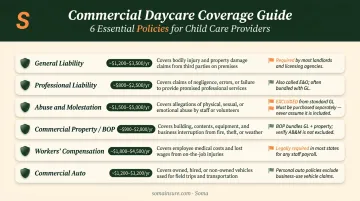
Three coverage gaps catch daycare operators off guard:
- Abuse and molestation is not automatically included. You must verify whether your GL policy carries an exclusion endorsement (ISO CG 21 46). If it does, you have no coverage for these claims.
- Hired/non-owned auto is not the same as commercial auto. If your center owns a van, you need commercial auto. Hired/non-owned covers vehicles you don't own but use for business purposes.
- Standard business interruption insurance doesn't cover a licensing suspension; you need a policy with a specific regulatory suspension trigger.
What Most Commercial Daycare Owners Get Wrong About Insurance Costs
Focusing Only on the GL Premium
Many operators compare quotes by looking at a single line item. Consider a center with 40 children and 8 employees. Their general liability might be $3,500 annually. But add:
- Workers' compensation for 8 employees: potentially $4,000–$6,000+
- Professional liability: additional premium
- Abuse and molestation coverage: additional premium
- Commercial property: additional premium
That $3,500 GL quote becomes a $10,000–$15,000 total program — and that's before any commercial auto. Centers that budget only for GL often find themselves underinsured by 50–70% of their actual coverage cost.
Skipping Abuse and Molestation Coverage
Of all the coverage gaps daycare operators carry, this one carries the highest financial risk.
Standard general liability policies frequently carry ISO endorsement CG 21 46, which explicitly excludes abuse and molestation claims. Texas alone recorded 55 priority-1 and 1,114 priority-2 DFPS abuse/neglect investigations involving children ages 0–4 in licensed centers during FY2023 — and that's investigations, not proven claims.
The financial reality: legal defense costs on a single unproven allegation can exceed the lifetime premium of an abuse and molestation policy within weeks of a claim being filed. Carriers like Great American maintain separate limits for this exposure specifically because it cannot be absorbed within a standard CGL framework.
Not Updating Coverage as the Business Grows
A policy that fit your center at 20 children likely doesn't fit at 60. Specific scenarios that trigger underinsurance:
- Adding a van without updating to commercial auto leaves transportation claims uninsured
- Hiring four more staff without updating workers' comp payroll creates a premium shortfall at audit
- Opening an infant room without notifying your carrier may void coverage for that program entirely, since some carriers exclude infant care from existing programs
At renewal, run a full exposure review — comparing current enrollment, staffing, services, and property values against what your policy actually covers. A broker with access to specialty childcare markets can identify gaps a single-carrier relationship often misses.
Frequently Asked Questions
How much is business insurance for a daycare?
For a single commercial center serving 20–75 children, expect to pay $5,000–$12,000 annually for a full multi-line package. Larger operations across multiple sites can run $15,000–$35,000+. The figure varies widely based on location, services, staffing, and which coverage lines are included.
What type of insurance do daycares need?
Commercial daycares should carry general liability, professional liability (E&O), abuse and molestation coverage, commercial property, and workers' compensation at minimum. Centers that transport children need commercial auto as well. Each coverage addresses a distinct exposure that the others don't.
Does commercial daycare insurance cost more than home daycare insurance?
Yes, generally. Commercial centers carry larger enrollments, higher staff counts, greater property values, and broader liability exposure than in-home providers. The coverage requirements are also more extensive, which drives total premiums higher.
Is abuse and molestation coverage required for commercial daycares?
It's rarely mandated, but skip it at your own risk. Standard GL policies frequently exclude this exposure outright, meaning a single uninsured claim — regardless of merit — can generate defense costs that dwarf the coverage's lifetime premium.
Can I lower my commercial daycare insurance costs?
Yes. Maintain a clean claims history, bundle GL and property as a BOP where possible, document safety protocols and background check procedures, and work with a childcare-specialist broker who can compare quotes across multiple carriers. Higher deductibles lower premiums but should match your actual cash reserves.
What happens if a commercial daycare operates without insurance?
Operating without coverage leaves owners personally exposed to injury claims, lawsuits, and property losses. Many states mandate minimums — Texas requires at least $300,000 per occurrence and annual verification — and failing to comply can trigger license suspension or center closure, separate from any uncovered claim costs.