This scenario plays out more often than most home daycare providers expect. According to the NAIC, standard homeowners insurance is not designed for business activities — meaning any incident involving children in your care falls outside your coverage the moment you accept payment for childcare.
The exposure is real. Medical bills, legal defense costs, a parent's attorney fees — any of these can become a personal financial crisis without the right coverage in place. This guide breaks down exactly which policies a home daycare needs, what they cover, and how to build a coverage package that protects your program without leaving gaps.
Key Takeaways
- Standard homeowners insurance excludes business activity — home daycare requires dedicated business coverage
- 13 states currently mandate liability insurance for family home-based providers; others require disclosure to parents
- Core coverage types include general liability, professional liability, commercial property, and workers' compensation
- Even small operations watching two or three children face real legal and financial liability
- A childcare-specialist broker helps close coverage gaps that generalist brokers typically overlook
What Is Home Daycare Insurance?
Home daycare insurance is a category of business insurance built specifically for childcare providers operating out of a residential setting. Standard homeowners policies and generic commercial coverage both fall short — each leaves a gap that home daycare providers can't afford to ignore.
Why Homeowners Insurance Falls Short
Most homeowners policies contain explicit exclusions for commercial activity. Common scenarios that trigger a denial include:
- A child in your care gets hurt during the day
- A parent slips on your steps at drop-off or pickup
- A family alleges inadequate supervision
In each case, your insurer can — and likely will — deny the claim on the grounds that you were running a business.
Markel, one of the primary carriers in the childcare space, specifically notes that standard homeowners policies exclude liability for family daycare activities. The exclusion is intentional — not a loophole or fine-print surprise.
The Licensing Connection
Most state licensing agencies require proof of insurance before issuing or renewing a home daycare license. ChildCare.gov, the federal resource for child care licensing information, links to each state's specific requirements — a good starting point for understanding what your state mandates before you apply.
What Types of Insurance Does a Home Daycare Need?
General Liability Insurance
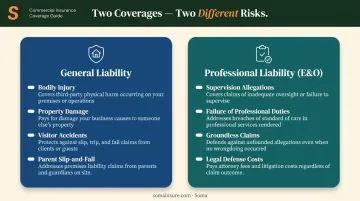
General liability is the foundation. It covers:
- Bodily injury to children, parents, or any visitor on your property
- Property damage you or a child in your care causes to someone else's belongings
- Personal and advertising injury, including reputational claims
This policy pays both medical bills and legal defense costs if a parent files a lawsuit. Carriers like Markel offer limits up to $1 million per occurrence / $3 million aggregate for in-home daycare providers — meaningful protection, since even a minor injury claim can generate substantial attorney fees before any settlement reaches court.
General liability is also the coverage most states point to when they require proof of insurance for licensing.
Professional Liability (Errors & Omissions) Insurance
General liability covers physical accidents. Professional liability covers something harder to defend: allegations that you failed in your professional duties as a childcare provider.
A parent might claim their child was harmed because you weren't supervising closely enough, or that a developmental concern went unaddressed. These claims don't need to be valid to cost you money — legal defense alone can run into tens of thousands of dollars before a case reaches a courtroom.
Professional liability (also called E&O) pays attorney fees and settlements for these types of claims, even when the allegation is groundless. For any provider running a program with structured care responsibilities, this policy fills a gap that general liability leaves open.
Commercial Property Insurance
Your homeowners policy won't replace the educational toys, outdoor play equipment, furniture, tablets, or curriculum materials your daycare depends on if they're damaged or stolen in a business context. Commercial property insurance covers your physical assets specifically in their role as business equipment.
Many providers find a Business Owners Policy (BOP) to be the most cost-effective route. A BOP bundles general liability with commercial property coverage, and typically includes business interruption protection, which replaces lost income if a covered event like a fire or flood forces your program to close temporarily.
Workers' Compensation Insurance
The moment you bring on a paid employee or assistant (even part-time), workers' compensation becomes relevant. Most states have legal requirements that kick in at that point, and employee-count thresholds vary by state.
Workers' comp pays for:
- Medical treatment following a work-related injury
- A portion of the employee's lost wages during recovery
- Protection against the employee suing you personally for the incident
Operating without this coverage when it's required can result in significant penalties. Illinois, for example, can fine employers up to $500 per day with a $10,000 minimum for knowing violations.
Additional Coverages to Consider
Two coverages tend to get skipped on initial quotes, yet both carry serious exposure for childcare operations:
- Abuse and Molestation Coverage: Covers legal defense costs and settlements for allegations of misconduct involving children in your care. The allegation alone triggers legal costs before any facts are established. Any childcare provider, regardless of size, should carry this — it's available through specialty carriers and included in dedicated childcare insurance programs.
- Cyber Liability Insurance: Home daycare providers store more sensitive data than they often realize: health records, emergency contacts, medication logs, billing information. A breach involving that data carries notification costs, regulatory exposure, and potential legal liability. The HHS Child Care Technical Assistance Network specifically addresses cybersecurity risk mitigation for family childcare programs, reflecting how seriously regulators now treat this risk.
How Much Does Home Daycare Insurance Cost?
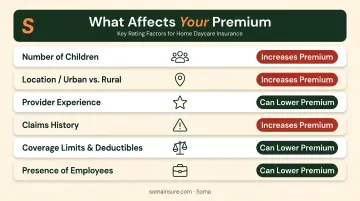
Exact premium ranges depend heavily on your specific situation, but the following factors drive how insurers price home daycare coverage:
| Rating Factor | Impact on Premium |
|---|---|
| Number of children in care | Higher enrollment = higher premium |
| Location (urban vs. rural) | Urban areas typically see higher rates |
| Provider experience | More experience can lower premiums |
| Claims history | Prior claims increase rates significantly |
| Coverage limits and deductibles | Higher limits = higher premiums; higher deductibles = lower premiums |
| Presence of employees | Triggers workers' comp requirement |
The Deductible Trade-Off
A higher deductible reduces your monthly premium but raises what you pay out of pocket when a claim occurs. Think about your program's incident history: if you've had recurring minor claims, a lower deductible may save more money over time than the reduced premium would.
Budgeting for Coverage
Get quotes from multiple brokers or carriers based on your enrollment and location. When setting your per-child rate, treat insurance as a standard operating cost — the same way you'd budget for supplies or curriculum materials.
A few practical steps to manage costs:
- Compare at least 2–3 carrier quotes before committing to a policy
- Build your annual premium into your per-child rate from the start
- Review coverage limits annually as your enrollment grows
How to Choose the Right Home Daycare Insurance Coverage
Getting the right coverage comes down to three things: who you work with, what you compare, and how often you revisit.
Work with a childcare-experienced broker. A broker who regularly places childcare risks understands state licensing minimums, knows which carriers write home daycare (many don't), and will catch exclusions that a generalist misses. Off-premises incidents and field trip exclusions are common blind spots for generalist brokers.
Compare at least three quotes with equivalent terms. Comparing a $500,000 occurrence limit to a $1 million limit isn't a fair comparison. Set your parameters first, then evaluate prices. Also check the financial strength of any carrier you're considering through AM Best, which rates insurers on their ability to meet ongoing obligations.
Review coverage annually. A policy that fits a six-child program with no employees may fall short once you've added an assistant, enrolled two more children, or upgraded your outdoor play equipment. Coverage needs change as programs grow. Build an annual review into your calendar the same way you'd renew your license.
How Soma Can Help
Soma is an independent insurance brokerage that specializes in placing coverage for complex, hard-to-insure businesses — and home daycare qualifies on both counts. Many standard markets decline or underwrite home daycare conservatively, particularly programs that include infant care, providers with prior claims, or those in states with higher litigation frequency.
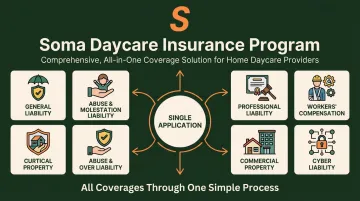
Soma's daycare insurance program covers the full range of childcare operations — including in-home and family daycares — with access to specialty carriers that specifically cover hard-to-insure childcare operations. All coverage is placed through a single application:
- General liability
- Abuse and molestation liability
- Professional liability (E&O)
- Workers' compensation
- Commercial property
- Cyber liability
Carrier partners include Chubb, Markel, Kinsale, Liberty Mutual, and Nationwide, among others. For providers facing licensing or renewal deadlines, Soma's ratio- and enrollment-based underwriting process is built for speed — quotes without weeks of back-and-forth.
Conclusion
Home daycare providers run a real business with real liability exposure. The right insurance coverage is what separates a manageable claim from one that threatens your program, your finances, and potentially your personal assets.
Your risk profile isn't static, either. Adding an employee, expanding enrollment, or making significant equipment purchases all shift your exposure. An annual policy review is the only reliable way to catch those gaps before a claim forces the issue.
Frequently Asked Questions
What type of insurance does a home daycare need?
At minimum, a home daycare needs general liability insurance. Most providers should also carry professional liability (E&O), commercial property coverage, and workers' compensation if they have employees. A Business Owners Policy (BOP) can bundle general liability with commercial property cost-effectively.
How much does insurance for an in-home daycare cost?
Costs vary based on location, enrollment, claims history, and coverage limits. Contact multiple brokers for quotes specific to your operation — a childcare-experienced broker can compare options from carriers that actually write home daycare risk.
Is homeowners insurance enough for a home daycare?
No. Standard homeowners insurance explicitly excludes commercial business activity. Any claim involving children in your care — injury, property damage, or supervision allegations — would likely be denied without a dedicated business policy.
Do I need insurance if I only watch a few children?
Yes. Even caring for two or three children creates business liability exposure. Many states require proof of insurance regardless of how few children are in care, and the financial risk of a lawsuit doesn't scale with enrollment.
Does my state require insurance to run a home daycare?
Most states require at minimum general liability insurance as a condition of home daycare licensing. ChildCare.gov links to each state's licensing agency, where you can find the specific requirements for your state.
What is abuse and molestation coverage, and do home daycares need it?
This coverage pays legal defense costs and settlements for allegations of abuse or misconduct involving children in your care. Any childcare provider — regardless of size — should carry it. Allegations generate significant legal costs long before facts are established, making this coverage essential even for small operations.