Many software companies assume their general liability or cyber insurance covers these situations. It doesn't. General liability handles physical injury and property damage. Cyber insurance addresses data breaches and attacks on your own systems. Neither covers the gap in between: what happens when your work itself falls short of what the client expected.
This article breaks down what E&O insurance actually covers for software companies, why the financial and contractual stakes make it non-negotiable, and how to get the most value from a policy.
TL;DR
- E&O (Errors & Omissions) insurance covers professional mistakes — bugs, missed deliverables, service failures — that cause client financial harm
- General liability and cyber insurance leave a critical gap that E&O fills
- A single client lawsuit can cost tens of thousands in legal fees before any settlement, even if you're not at fault
- Enterprise clients routinely require proof of E&O before signing vendor contracts
- Soma places Tech E&O for software companies through Chubb, Hiscox, Kinsale, and Liberty Mutual — one application, same-day quotes for startups
What Is E&O Insurance for Software Companies?
IRMI defines technology errors and omissions insurance as coverage designed for providers of technology services or products. It activates when a client claims your software or service caused them financial harm through an error, omission, or failure to perform.
As Travelers notes, customer allegations often include lost profits or business disruption — damages that commercial general liability won't touch.
What It Covers in the Software Context
Tech E&O (also called Technology Professional Liability) applies to claims arising from:
- Software bugs causing client operational disruption or financial loss
- Service outages or unplanned downtime
- Missed project milestones or incomplete deliverables
- Incorrect technical advice or recommendations
- Products that don't meet promised specifications
- Data mishandling that doesn't rise to the level of a breach
How It Differs from Other Policies
| Policy | What It Covers |
|---|---|
| General Liability | Physical injury, property damage |
| Cyber Insurance | Data breaches, cyberattacks on your own systems |
| Tech E&O | Professional errors and service failures causing client financial harm |
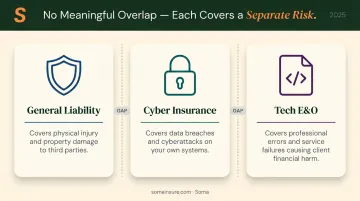
Each policy covers a separate risk category, with no meaningful overlap. Software companies that face client-facing, cyber, and general liability exposure typically need all three to avoid gaps in coverage.
Key Advantages of E&O Insurance for Software Companies
The advantages below connect to concrete business outcomes: financial stability, enterprise client access, and the ability to grow without fear of a single incident derailing operations.
Financial Protection Against Legal Liability
When a client blames your software for a business disruption, the financial exposure doesn't stay proportional to your contract value. It can multiply fast.
Consider the scale of real software disputes: Delta sued CrowdStrike after a faulty Falcon update caused 7,000 canceled flights and more than $500M in claimed losses. Waste Management sued SAP over a failed implementation, seeking $500M. MillerCoors filed a $100M suit against HCL over a botched ERP project. These cases show what's at stake when enterprise clients depend on your software for critical operations.
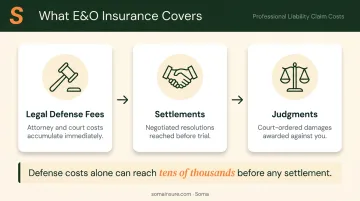
E&O insurance activates before a case is resolved. According to Hartford, technology professional liability can cover:
- Legal defense fees and attorney costs
- Court costs and administrative expenses
- Settlements and judgments
That last point matters. Defense costs alone — before any settlement — can run into the tens of thousands. E&O converts that unpredictable exposure into a fixed, manageable policy cost.
This protection matters most when:
- Clients depend on your software for revenue-generating operations
- You're serving regulated industries like healthcare or financial services
- Contract values are high and client operations are complex
- You're deploying enterprise SaaS or critical system integrations
KPIs protected: Legal defense spend, settlement exposure, cash reserves, business continuity
Contract Compliance and Enterprise Deal Enablement
E&O isn't just a safety net — it's increasingly a deal prerequisite.
Public procurement records confirm this directly. The University of Nevada, Reno requires Network Security/Privacy and Technology E&O coverage for technology contracts. King County's public health department lists professional liability/E&O requirements for software, network administration, and IT consulting contracts. Larimer County requires a certificate of insurance before a SaaS vendor begins work.
These aren't edge cases. As enterprises and government buyers mature their vendor risk programs, proof of Tech E&O has become a standard checklist item — the same way SOC 2 compliance has.
Without E&O coverage, software companies face two bad outcomes:
- Lost deals — procurement teams disqualify vendors who can't provide a certificate of insurance
- Delayed close — lengthy compliance reviews that stall revenue while the legal team investigates your risk posture
With coverage in place, that bottleneck disappears. It signals to procurement teams that you're operationally mature and financially accountable — which shortens sales cycles, not just protects against claims.
This matters most for companies pursuing enterprise or government contracts, software vendors serving healthcare, fintech, or education technology buyers, and any company whose client contracts include performance guarantees or liability clauses.
KPIs impacted: Deal close rate, sales cycle length, enterprise client acquisition, vendor onboarding speed
Business Continuity and Confidence to Innovate
Software development is inherently iterative. New features, third-party integrations, fast deployment cycles — every release carries some level of risk. That's not a flaw in how you operate — it's the nature of the business.
E&O insurance removes the all-or-nothing dimension from that risk. Teams can ship updates, take on complex engagements, and enter new vertical markets without a single incident threatening the entire company.
Without coverage, even a frivolous lawsuit can:
- Drain cash reserves needed for operations or growth
- Redirect leadership attention away from product and clients for months
- Force difficult decisions about client capacity during active litigation
- Damage relationships with prospective clients who learn about the dispute
For startups scaling quickly, a single uninsured claim can be company-ending. The cost of defending one professional liability lawsuit — even when you win — typically exceeds a year's worth of policy premiums.
This matters most for:
- Startups signing first enterprise clients
- SaaS companies releasing frequent product updates
- Software firms entering new verticals or regulated markets
KPIs protected: Business continuity, leadership bandwidth, ability to take on new clients, long-term growth trajectory
What Happens When Software Companies Skip E&O Insurance
Going without E&O coverage doesn't eliminate risk — it just removes the financial buffer between a client complaint and your company's bank account.
If a client files a professional liability claim and you have no coverage, every dollar of the legal response comes directly out of company funds: attorney fees, court costs, expert witnesses, potential settlement, and any judgment. No insurer picks up the tab.
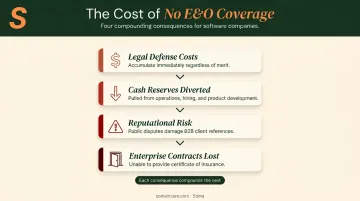
The sequence typically compounds:
- Legal defense costs accumulate immediately, regardless of merit
- Cash reserves get diverted from operations, hiring, or product development
- Reputational risk emerges if the dispute becomes public — especially damaging in B2B markets where client references matter
- Future enterprise contracts may be inaccessible because you still can't provide a certificate of insurance
Each of those consequences hits small and mid-sized software companies harder than it would a large enterprise vendor. They face the same liability landscape — complex client dependencies, high-stakes deployments, demanding SLAs — but without the cash reserves or legal infrastructure to absorb a major claim. One uninsured dispute can do more damage than years of growth built up to that point.
How to Get the Most Value from Your E&O Policy
Coverage is only as good as how well it matches your actual operations. A few practices that matter:
Match limits to contract scale. If your engagements involve clients whose operations depend on your software, your coverage limit should reflect the potential financial impact — not just the value of the contract itself.
Look for enterprise-wide definitions. Good Tech E&O policies cover new product versions released during the policy period, not just the version that existed at inception. Confirm this before binding.
Reduce claim likelihood — and potentially premiums — with internal documentation:
- Scoped service-level agreements with clearly defined deliverables
- Written QA and testing protocols
- Milestone records and change logs
- Documented communication throughout client engagements
These practices reduce the likelihood of a claim escalating and give your insurer a defensible record if one does.
Work with a broker who knows the tech market. Soma places Tech E&O for software companies through carriers including Chubb, Hiscox, Kinsale, and Liberty Mutual. A single application covers E&O alongside cyber, IP protection, data breach response, and business interruption — so you're not chasing multiple brokers for overlapping coverage.
For startups, same-day binding is available. That's a faster path to coverage than the multi-week quote cycles common with generalist brokers.
Frequently Asked Questions
Is E&O insurance required for software companies?
Not universally by law, but many enterprise clients and government buyers require it as a contract condition before onboarding a software vendor. For companies pursuing B2B growth, lacking coverage disqualifies you from a growing number of procurement processes.
What is the difference between E&O insurance and cyber insurance for software companies?
E&O covers professional mistakes and failures (bugs, missed deliverables, bad advice) that cause client financial loss. Cyber insurance covers data breaches and cyberattacks affecting your own systems. Both are often needed, but they address distinct categories of risk and don't substitute for each other.
Does E&O insurance cover a software bug that causes client downtime?
Yes, and this is exactly what E&O is designed for. If a software error causes client operational disruption or financial loss, E&O can cover legal defense costs, settlements, and judgments arising from that claim.
How much does E&O insurance typically cost for a software company?
Premiums vary by company size, revenue, coverage limits, and the industries you serve. Hiscox cites IT consultant professional liability starting around $42.92/month at a $500,000 limit; Hartford puts the small-business average at about $76/month. A broker with access to multiple carriers can give you a realistic Tech E&O range quickly.
When should a software company buy E&O insurance?
Before signing client contracts that include performance guarantees or liability clauses — specifically when the company begins delivering technology services to paying clients. Waiting until after a claim has arisen isn't an option; E&O doesn't cover incidents that predate the policy.
Can a small software startup benefit from E&O insurance?
Startups are often the most exposed. They lack the cash reserves to absorb a legal dispute and can't afford the distraction of extended litigation. E&O policies scale to smaller budgets, and the cost of coverage is almost always less than defending even one professional liability claim without it.