
For IT consultants, professional indemnity insurance (also called errors and omissions or E&O insurance in the US — the terms mean the same thing) is the primary financial safeguard against these situations. A single lawsuit, even one you ultimately win, can cost tens of thousands in legal fees alone.
This guide breaks down what IT consultants actually pay, what moves premiums up or down, what coverage you're actually buying, and how to budget for the right level of protection.
TL;DR
- IT consultant professional indemnity insurance typically costs $50–$150+ per month, depending on firm size, specialty, and coverage limits
- Biggest cost drivers: type of IT work, annual revenue, coverage limits, and claims history
- Solo freelancers doing general IT support pay less; cybersecurity and healthcare IT consultants pay 2–3× more
- Adequate coverage limits matter more than the cheapest premium; underinsurance leaves you personally exposed to claim costs
How Much Does IT Consultant Professional Indemnity Insurance Cost?
There's no single fixed price. Costs vary based on specialty, business size, location, and how coverage is structured. IT work carries higher liability exposure than most advisory services, and premiums are priced accordingly.
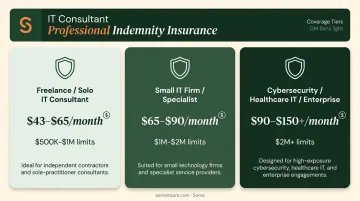
Typical Cost Ranges by Tier
| Tier | Typical Monthly Cost | Coverage Basis |
|---|---|---|
| Freelance / solo IT consultant | $43–$65/month | $500K–$1M limits, higher deductibles |
| Small IT firm / specialist | $65–$90/month | $1M–$2M limits, standard deductibles |
| Cybersecurity / healthcare IT / enterprise | $90–$150+/month | $2M+ limits, tech E&O bundle |
Data sources behind these ranges:
- Insureon reports a $65/month median for IT consultant E&O
- NEXT Insurance cites a $90/month average for IT consultants and software developers
- Hiscox's published example shows a California IT consultant at $150K revenue paying $42.92/month — but that uses a $500K limit and $5,000 deductible, not a standard $1M baseline
- TechInsurance reports $67/month for technology E&O broadly, and $65/month specifically for IT consultant E&O at $1M/$2M aggregate limits
Those ranges tell you what to budget — here's what you actually get at each level.
What Each Tier Typically Includes
Entry-level / freelance IT consultants ($43–$65/month)
- $500K–$1M per-occurrence / aggregate limits
- Deductibles of $500–$5,000 depending on limit selected
- Basic professional liability for advisory errors, missed deliverables
- Best for: sole proprietors doing general IT support, helpdesk advisory, short-term contracts
Mid-range / small IT consulting firms ($65–$90/month)
- $1M–$2M aggregate limits
- Coverage for implementation errors and system downtime claims
- Often bundled with cyber liability
- Best for: multi-client engagements, cloud/network/ERP work, managed infrastructure
Higher-cost / specialized IT consultants ($90–$150+/month)
- $2M+ limits, sometimes required by contract
- Broad coverage including data loss, business interruption, regulatory defense costs
- Tech E&O bundles that explicitly address cyber exposure
- Best for: cybersecurity consultants, healthcare IT, fintech, government contract work
Key Factors That Affect the Cost of IT Consultant Professional Indemnity Insurance
Underwriters don't see IT consulting as a single risk category. The same engagement that feels routine to you can look like significant exposure to an insurer. These are the factors that actually move your premium.
Type and Specialty of IT Work
This is the most significant rating factor. General IT support and helpdesk advisory sit at the lower end of the risk spectrum. Cybersecurity consulting, healthcare IT, fintech systems, and mission-critical software implementations are rated higher — clients in those sectors face larger financial consequences when things go wrong, which translates to larger potential claims against you.
Insureon's cybersecurity consultant benchmark comes in around $83/month for E&O, compared to the $65/month IT consultant median. Software developers working in healthcare, finance, or e-commerce also see higher premiums because of data sensitivity and regulatory exposure.
Business Size and Annual Revenue
Insurers use annual revenue as a proxy for exposure. A solo consultant billing $80K/year represents a smaller potential claim than a five-person firm billing $600K. The more revenue flowing through your practice, the larger the damages a client could credibly argue, and premiums follow that logic accordingly.
Coverage Limits and Deductibles
The mechanics here are straightforward:
- Higher limits = higher premium. Most IT consultants start at $1M per-occurrence / $1M aggregate. Insureon data shows 56% of E&O buyers choose $1M/$1M, and 11% choose $2M/$2M.
- Higher deductible = lower premium. A $5,000 deductible costs less monthly than a $500 deductible, but you're absorbing more risk out of pocket if a claim occurs.
- Standard deductible range for IT consultants runs from $500 to $2,500, though Hiscox's low-price example uses $5,000.
Claims History
A prior professional liability claim — even one that was resolved in your favor — signals elevated risk to underwriters. Clean claims history, especially over five or more years, often results in noticeably lower rates. A single claim can affect your renewal pricing for three to five years.
Client Contract Requirements
Enterprise clients and government agencies frequently dictate minimum coverage limits as a condition of engagement. A few examples from actual contract requirements:
- Minnesota state professional/technical contracts: $2M per claim / $2M annual aggregate
- University of Nevada/NSHE technology contracts: $5M per occurrence for certain contracts
- Tufts University vendors: $1M per occurrence minimum
If your contract requires $2M aggregate and you're carrying $1M, you'll need to upgrade mid-policy — at additional cost — or risk losing the engagement.
Location and Business Structure
Premiums vary by state. California and New York, both active litigation environments, tend to run higher than lower-volume markets. Sole proprietors typically pay less than LLCs or incorporated firms with employees, because employee actions expand the range of conduct a firm can be held liable for.
What Does the Cost Actually Cover?
The monthly premium is just one number in the actual financial picture. Here's what it covers, and where coverage tends to fall short.
What Your Premium Pays For
Covered costs when a claim is filed:
- Attorney fees and legal defense costs
- Court costs and administrative defense expenses
- Settlements and judgments arising from the claim
Allegations typically covered:
- Professional negligence or mistakes in your work
- Inaccurate advice that caused client financial loss
- Missed deliverables or late project delivery
- Failure to deliver promised IT services
Standard Exclusions to Know
- Intentional misconduct or criminal acts are not covered under any professional liability policy
- Bodily injury and property damage fall under general liability, not E&O
- Patent infringement is excluded across most standard policies
- Explicit written guarantees — if you promised a specific outcome in a contract, claims tied to that guarantee may fall outside coverage
The Cyber Gap Problem
This is where IT consultants get caught. A data breach caused by your negligence might not clearly fall under either professional liability or cyber coverage — it depends on how each policy is written.
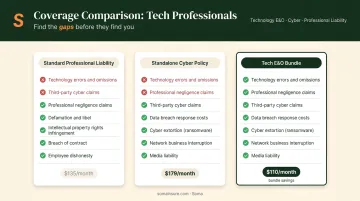
A standard professional liability policy may exclude technology-related errors entirely. A cyber policy typically covers your own breach response costs but may not cover third-party client claims arising from your professional mistake.
A technology E&O policy — which bundles professional liability with third-party cyber coverage — covers both exposures in a single policy. Insureon prices tech E&O bundles at an average of $110/month, compared to $179/month for standalone cyber insurance at IT firms. The combined coverage handles professional oversight errors and the downstream cyber consequences — which matters for any consultant handling client data or systems.
Soma places tech E&O bundled with cyber liability for IT consultants through carriers including Chubb, Hiscox, Kinsale, and Liberty Mutual, so the combined product is available through a single application.
Low-Cost vs. High-Cost Coverage — What's the Real Difference?
Cheaper isn't always worse, but for IT consultants it frequently is. Here's what you're actually trading off:
| Factor | Lower-Cost Policy | Higher-Cost / Specialist Policy |
|--------|------------------|-------------------------------|
| Coverage limits | $500K–$1M aggregate | $2M+ aggregate |
| Deductible | Higher ($2,500–$5,000) | Lower ($500–$1,000) |
| Technology errors | May be excluded | Explicitly covered |
| Cyber events | Often excluded | Included via tech E&O bundle |
| Claims handling | General defense team | Dedicated tech/IT claims specialists |
| Data loss coverage | Typically excluded | Addressed in specialist policies |
The specific risk for IT consultants: a cheap general professional liability policy that excludes technology errors leaves you unprotected against your most likely claims. System failures, implementation errors, and data loss aren't edge cases — they're the scenarios IT consultants get sued over most often. A policy that doesn't cover them doesn't reduce your exposure; it just reduces your premium.
Claims handling quality also matters more than most consultants expect. When a claim turns on technical specifics — how a system integration was scoped, whether a configuration error caused downstream data loss — a generalist adjuster is at a disadvantage. Carriers like Chubb assign claims professionals with technology backgrounds to these cases, which can significantly affect how a dispute resolves.
How to Estimate the Right Budget for Your IT Practice
The right budget is the premium that matches your actual financial exposure, not simply the lowest available number. A consultant billing $50K/year on advisory work has a very different risk profile than one implementing enterprise ERP systems for Fortune 500 clients.
A Practical Budgeting Framework
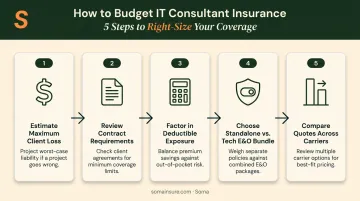
- Estimate maximum credible client loss — what's the largest amount a client could plausibly claim against your work? That number sets the floor for your aggregate limit.
- Review all active contracts for minimum coverage requirements before choosing limits — don't discover the requirement after you've already bound a policy.
- Factor in the deductible as part of your real out-of-pocket exposure, not just an afterthought. A $2,500 deductible on a $70/month policy might be more expensive overall than a $1,000 deductible on a $90/month policy if you ever file a claim.
- Decide between standalone professional liability and a tech E&O + cyber bundle based on whether you handle client data, systems, or infrastructure. If you do, the bundle is usually the more complete choice.
- Compare quotes across multiple carriers — pricing for the same coverage can vary by 30–50% or more between insurers.
Soma runs simultaneous quotes across its carrier panel — Chubb, Hiscox, Kinsale, Liberty Mutual — so IT consultants can compare their actual options side by side before committing to a policy.
Common Mistakes That Inflate or Undercut Your Coverage
- Using general consultant benchmarks instead of IT-specific ones — your exposure as an IT implementer is categorically different from a business strategy advisor
- Treating the monthly premium as the only cost — deductibles and exclusions can make a "cheaper" policy far more expensive when a claim hits
- Skipping cyber coverage when your work touches client data or systems — confirm explicitly whether your professional liability policy covers technology errors
- Waiting for a contract requirement to trigger a coverage upgrade instead of right-sizing from the start
Frequently Asked Questions
How much does professional indemnity insurance cost for an IT consultant?
IT consultants typically pay between $50 and $150+ per month depending on firm size, specialty, and coverage limits. The industry median sits around $65–$90/month for standard $1M E&O coverage, with solo freelancers at the lower end and cybersecurity or enterprise-focused consultants at the higher end.
What insurance do I need as an IT consultant?
Most IT consultants need professional indemnity (E&O/professional liability) insurance at minimum, and many also need cyber liability and general liability. A technology E&O policy often bundles professional liability with third-party cyber coverage, making it a practical single-policy solution for IT-specific work.
Is professional indemnity insurance the same as errors and omissions insurance in the US?
Yes. Professional indemnity insurance, errors and omissions (E&O) insurance, and professional liability insurance all refer to the same coverage type in the US. Insurers and brokers use the terms interchangeably, and the underlying policy protects against the same claims.
Is professional indemnity insurance required for IT consultants?
It's not legally mandated for IT consultants in any US state, but it's frequently required by client contracts, especially with enterprise, healthcare, or government clients. Given the financial exposure involved in IT work, it's widely considered essential regardless of whether a contract requires it.
What coverage limits should an IT consultant choose?
$1M per-occurrence / $1M aggregate is the most common starting point, but IT consultants working on larger projects or with enterprise clients should consider $2M aggregate or higher, particularly when client contracts specify minimum limits. Government and healthcare contracts sometimes require $2M–$5M.
How can IT consultants lower their professional indemnity insurance premiums?
A few practical steps make a real difference:
- Maintain a clean claims history
- Scope contracts clearly to limit open-ended liability
- Choose a higher deductible if you can absorb the out-of-pocket cost
- Compare quotes across multiple carriers through a specialist broker
Pricing for equivalent coverage varies considerably between insurers, so shopping around is worth the effort.