The problem? Most business owners either overpay by guessing, or underbuy by defaulting to the cheapest option without understanding what they're getting. According to Hiscox's 2025 Underinsurance Report, 77% of U.S. small businesses are underinsured — up from 75% in 2023. And 74% couldn't correctly describe what general liability actually covers.
This guide breaks down what a $1M CGL policy costs by industry, what drives that price up or down, whether $1M is actually enough for your business, and how to budget without leaving yourself exposed.
TL;DR
- Annual premiums for a $1M/$2M CGL policy range from roughly $350 to $2,940+, depending on your industry and risk profile
- Most small, low-risk businesses land in the $400–$900/year range
- The biggest pricing variables: industry type, revenue, employee count, location, and claims history
- $1M per-occurrence / $2M aggregate is the standard structure, though higher-risk businesses often need more
- Spending more on the right limits is almost always cheaper than an uncovered claim
How Much Does a $1 Million CGL Policy Actually Cost?
"$1 million in CGL coverage" is not a fixed price. The same limit can cost a management consultant $400/year and a general contractor $2,500/year. That gap leads buyers to either overbuy coverage they don't need or underbuy and leave real exposure on the table.
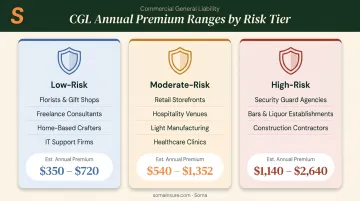
Here's how premiums break down by risk tier:
Low-Risk Businesses
These are desk-based, professional-service operations with minimal public interaction and low claims frequency: consultants, photographers, accountants, engineers, IT professionals.
Typical annual premiums for $1M/$2M CGL:
| Business Type | Estimated Annual Premium |
|---|---|
| Photographer | ~$421 |
| Engineering firm | ~$500 |
| Accountant | ~$604 |
| Business consultant | ~$720 |
Sources: The Hartford, Hiscox (Texas consultant example: $350/year)
What keeps costs low: no physical client visits, no products, no foot traffic. Underwriters see fewer chances for a covered incident to occur.
Moderate-Risk Businesses
Retail stores, cleaning services, small manufacturers, restaurants, and food businesses fall here. Higher public exposure, physical premises, and product liability push premiums into this range.
Typical annual premiums for $1M/$2M CGL:
| Business Type | Estimated Annual Premium |
|---|---|
| Retail store | ~$660–$712 |
| House cleaner / janitorial | ~$720–$900 |
| Baker / caterer | ~$540 |
| Restaurant | ~$1,352 |
Sources: NEXT Insurance, The Hartford
One cost-reduction option at this tier: bundling CGL with a Business Owner's Policy (BOP), which combines general liability and commercial property in one package. For eligible businesses, a BOP often delivers more coverage per dollar than purchasing each policy separately.
High-Risk and Complex Businesses
General contractors, roofers, electricians, auto repair shops, daycares, and hospitality venues pay the most — and for clear reasons. Work performed at client sites, heavy equipment, subcontractor exposure, and higher average claim values all drive premiums well above the moderate tier.
Typical annual premiums for $1M/$2M CGL:
| Business Type | Estimated Monthly | Estimated Annual |
|---|---|---|
| Handyman | $95/mo | ~$1,140 |
| Electrician | $120/mo | ~$1,440 |
| Carpenter | $145/mo | ~$1,740 |
| Daycare | $175/mo | ~$2,100 |
| General contractor | $210/mo | ~$2,520 |
| Auto repair shop | $220/mo | ~$2,640 |
Source: NEXT Insurance
Some businesses in this tier — particularly those with complex operations, prior claims, or unusual risk profiles — can't get competitive rates from standard admitted markets. That's when surplus lines carriers like Kinsale, Markel, or CRC Group become necessary.
Placing coverage in these specialty markets typically requires a broker with direct access to surplus lines carriers, not a standard retail agent quoting online.
Key Factors That Drive Your CGL Premium
Underwriters don't price two businesses the same way even if they're the same size. A retail boutique and a roofing contractor carry very different liability profiles. Here's what they actually look at:
Industry and Nature of Work
Industry is the single largest pricing variable. The contrast is stark: Insureon data shows a national median of $45/month for small businesses broadly, but NEXT's quote examples show a photographer at $25/month and a general contractor at $210/month — for the same $1M/$2M limit structure.
The label alone doesn't capture the full picture. A company that manufactures, ships, and installs equipment carries exposure at every stage. A consultant who only advises carries exposure almost nowhere.
Business Size, Revenue, and Employee Count
Underwriters use gross annual revenue as a primary rating factor because revenue is a proxy for business activity. Higher revenue means more customers, more transactions, and more chances for a covered incident.
Employee count adds another layer of exposure:
- More workers = more interactions with third parties
- Field-based employees (contractors, delivery, technicians) carry more exposure than office-based staff
- Payroll is often used as a rating base alongside or instead of revenue for service businesses
Location and Claims History
State location affects your premium more than most businesses expect. Insureon broker data shows Florida's median GL cost at $55/month versus $44/month in New York and $42/month in California. State-level tort costs and jury award trends directly influence what insurers charge.
Claims history sends an equally direct signal to underwriters. A clean five-year record can hold premiums stable or earn modest reductions at renewal. Prior claims — especially large ones — carry real consequences:
- Raised premiums at renewal
- Additional coverage conditions or exclusions
- Placement into non-standard (higher-cost) markets
Carriers use experience modifiers to adjust standard premiums up or down based on past loss experience.
What's Actually Included in a $1 Million CGL Policy
The Structure: Per-Occurrence vs. Aggregate
Most businesses encounter this structure: $1M per-occurrence / $2M aggregate.
- Per-occurrence limit ($1M): The maximum the insurer pays for any single covered event
- General aggregate limit ($2M): The total the insurer pays across all claims during the policy year
Those two numbers work independently. If three separate claims cost $800K each in a single year, the insurer pays the first two in full ($1.6M) and only a portion of the third. Once the aggregate is exhausted, no further claims are covered until renewal.
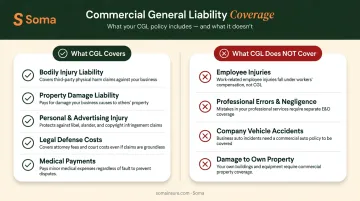
What a Standard $1M CGL Covers
Per the ISO CG 00 01 coverage form — the standard policy most insurers use — a CGL policy includes three core coverage areas:
- Bodily injury and property damage liability (Coverage A): a customer slips at your location; you accidentally damage a client's equipment
- Personal and advertising injury liability (Coverage B): libel, slander, copyright infringement in your business advertising
- Medical payments (Coverage C): limited medical costs for third-party injuries, regardless of fault
One detail worth understanding: the insurer has a duty to defend you in covered lawsuits, including groundless ones. Under the standard ISO form, defense costs are paid on top of the per-occurrence limit, not subtracted from it.
What CGL Does NOT Cover
This is where budgeting errors happen. A standard CGL policy excludes:
- Employee injuries — requires workers' compensation and employer's liability
- Professional errors or negligence — requires E&O / professional liability insurance
- Company-owned vehicle accidents — requires commercial auto coverage
- Damage to your own property — requires commercial property insurance
Each of these is a separate policy. Treating CGL as a standalone solution leaves real gaps — gaps that only surface when a claim gets denied.
Cost Structure
Beyond the coverage itself, a CGL policy carries three main cost components:
- Annual premium: the primary recurring cost, which varies by industry, revenue, and claims history
- Deductibles: typically $500–$1,000, paid only when a claim is filed
- Endorsements: add-ons like additional insured endorsements or contractual liability extensions carry additional cost, but clients, commercial leases, and government contracts often require them
Is $1 Million in Coverage Enough?
When $1M Is Sufficient
For most low-to-moderate risk small businesses, $1M/$2M is adequate. This includes:
- Consultants, freelancers, and home-based service businesses
- Small professional services firms with limited public interaction
- Businesses without contractual requirements for higher limits
- Operations where the realistic worst-case claim cost falls well under $1M
When $1M Is Not Enough
$1M can fall short in several situations:
- Contracts often demand more: Commercial leases, government contracts, and large clients routinely require minimum CGL limits — California DGS and King County, WA public health contracts both specify $1M per-occurrence / $2M aggregate as a floor, not a ceiling
- Industry risk changes the math: Construction, healthcare, and hospitality regularly face claims that approach or exceed $1M. In construction specifically, $2M aggregate is effectively the standard baseline
- Client asset exposure: If you work on-site at facilities with expensive equipment or machinery, a single property damage claim can approach your limit quickly
Those risks are compounded by rising verdict values. Travelers reports that average awards in the Top 100 U.S. verdicts more than tripled from $64M to $214M between 2015 and 2019 — catastrophic claims are rare, but they happen.
Commercial Umbrella: Extending Your Coverage
Commercial umbrella insurance layers additional limits on top of your underlying CGL policy. Key facts:
- biBerk estimates the first $1M of umbrella coverage costs $200–$400/year for most small businesses
- Insureon reports small businesses pay an average of $86/month for umbrella, with annual premiums ranging from $400 to over $7,000 depending on industry and risk
- NEXT offers umbrella limits starting at $1M, with rates from $25/month
- Umbrella limits typically start at $1M and can reach $10M or more
Businesses that most commonly need umbrella coverage include those with high foot traffic, construction or installation operations, and vehicle fleets — anywhere large third-party claims are realistic.

For complex or hard-to-insure operations, competitive umbrella coverage often requires a specialist broker. Soma works across construction, hospitality, and healthcare with access to hundreds of carrier partners to place coverage that standard markets won't touch.
How to Budget for CGL and Avoid Common Mistakes
Start With the Right Questions
Before comparing quotes on price, answer these first:
- What limits do your clients, landlord, or contracts require?
- What is the realistic worst-case liability claim in your industry and location?
- What is your current revenue and employee count — and where will they be in 12 months?
- Do you need CGL alone, or a suite of policies (workers' comp, E&O, commercial auto)?
Your answers size the right coverage. Price comes after.
Common Mistakes That Cost More Later
- Choosing the cheapest quote without checking carrier financial strength ratings or policy exclusions
- Copying competitors' limits rather than assessing your actual exposure
- Ignoring the aggregate limit — $1M does not cover every incident infinitely; multiple claims in a year can exhaust coverage
- Treating CGL as a complete solution when the business also needs workers' comp, E&O, or commercial auto
Getting Accurate Quotes
Comparing quotes across multiple carriers with a single application is the most direct way to nail down your actual budget. For straightforward businesses, online quoting through carriers like Hiscox or The Hartford is sufficient. For businesses in construction, manufacturing, trucking, healthcare, or hospitality — where standard markets regularly issue declinations — working with a specialized brokerage like Soma gives you access to hundreds of carrier partners simultaneously, including surplus lines markets that generalist brokers typically can't access.
Frequently Asked Questions
What should a $1,000,000 umbrella policy cost?
Commercial umbrella coverage typically adds $200–$400/year per $1M of additional limits for low-to-moderate risk businesses, according to biBerk. Insureon's data puts the average small-business umbrella cost at $86/month, though high-risk industries pay significantly more.
What does a $1 million general liability policy actually cover?
It covers third-party bodily injury, third-party property damage, personal and advertising injury (libel, slander, copyright infringement), and legal defense costs — up to $1M per occurrence and $2M aggregate annually. Defense costs are paid on top of those limits, not subtracted from them.
Is $1 million in CGL coverage enough for a small business?
For most low-to-moderate risk businesses without high contractual minimums, yes. Contractors, healthcare providers, hospitality venues, and businesses with commercial leases or large-client contracts often need $2M aggregate minimums or umbrella coverage layered on top.
What is the difference between per-occurrence and aggregate limits?
The per-occurrence limit is the maximum the insurer pays for any single claim. The aggregate limit is the total across all claims during the policy year. Once the aggregate is exhausted, the insurer pays nothing further until the policy renews.
How can I lower the cost of my $1 million CGL policy?
Several tactics help:
- Maintain a clean claims history
- Document safety procedures in writing
- Bundle CGL with a BOP if your business qualifies
- Consider a higher deductible
- Compare quotes across multiple carriers instead of auto-renewing
Do restaurants and contractors pay more than consultants for identical $1M/$2M CGL limits?
Yes — often three to five times more. A business consultant might pay $600–$720/year while a general contractor pays $2,500+ for the same limit structure.