Introduction
Running a nightclub means managing risks that most businesses never encounter — patron fights, liquor liability incidents, slip-and-falls at 2 a.m., property damage from events that spiral. When something goes wrong, the way you file your insurance claim matters as much as having coverage in the first place.
Many owners discover that gap too late. A delayed report, a missing piece of documentation, or a misunderstanding about which coverage applies can turn a legitimate claim into a denied one — or a full payout into a fraction of your actual losses.
This guide is written for US nightclub and bar owners who want a clear, practical walkthrough of the claims process — covering:
- What to do immediately after an incident
- What to document and how
- What mistakes to avoid
- How to stay prepared before anything goes wrong
TL;DR
- Report every incident to your insurer immediately — delayed notification is a leading cause of claim denial
- Documentation (photos, CCTV footage, witness statements, financial logs) determines whether you get paid fairly
- Follow six steps: report promptly, document thoroughly, review your policy, submit the claim, cooperate with the adjuster, and appeal if denied
- Liquor liability and assault and battery claims often require separate coverage — verify before assuming they're included
- Claims-ready venues recover faster: keep organized records, an accessible policy, and a direct insurer contact on hand
What Does a Nightclub Insurance Claim Actually Cover?
A nightclub insurance claim is a formal request to your insurer for financial compensation following a covered incident — whether that's a patron injury, a fire, or equipment failure. What matters is whether the loss falls within your specific policy's coverage scope.
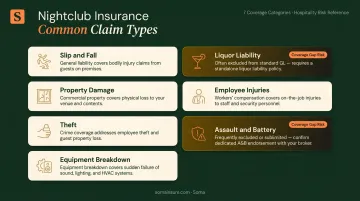
Common Claim Types for Nightclub Owners
- Slip-and-fall injuries — covered under commercial general liability (CGL) for third-party bodily injury tied to your premises
- Liquor liability claims — when an intoxicated patron causes injury or property damage after being served at your venue
- Assault and battery incidents — coverage is policy-specific; may be excluded from standard CGL, sublimited, or added by endorsement
- Property damage — fire, water damage, vandalism, and storm damage to your building, inventory, and equipment
- Theft and burglary — Hartford's 2025 small-business claims data places burglary and theft at 20% of claims, with average customer injury costs around $45,000
- Equipment breakdown — mechanical or electrical failure of your sound system, HVAC, or refrigeration units
- Employee injuries — handled by workers' compensation, not CGL
The Coverage Gap Most Owners Miss
The list above covers the obvious categories. What the list doesn't show is where policies quietly leave gaps — and two exposures account for most of the surprises.
First, standard CGL policies exclude liquor liability for businesses that sell, serve, or provide alcohol. A separate liquor liability policy or endorsement is required. Second, assault and battery coverage is commonly written as an exclusion on both CGL and liquor liability forms — particularly relevant for venues with bouncers, late-night hours, or high foot traffic.
Don't assume either is included. Ask your broker to pull the exclusions section of each policy and confirm coverage before you need to file.
The 6 Essential Steps for Filing a Nightclub Insurance Claim
Following these steps in sequence protects your right to compensation and prevents the errors that most commonly lead to delays, underpayment, or outright denial.
Step 1: Report the Incident to Your Insurer Immediately
Contact your insurer as soon as possible after an incident occurs. Policy language typically requires reporting "as soon as practicable" — for claims-made-and-reported policies, late notice can defeat coverage entirely because timely reporting is a condition, not just a recommendation.
When you call, have the following ready:
- Date, time, and location of the incident within the venue
- Type of incident and parties involved
- Whether law enforcement was contacted and the report number
- Names of any witnesses
Record the claim reference number and the name of every representative you speak with. These details matter if there's ever a dispute about when or how the claim was reported.
Step 2: Document Everything at the Scene
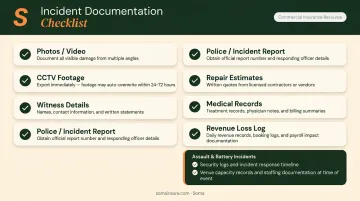
Thorough documentation is what separates a paid claim from a disputed one. Collect the following immediately:
- Photos and video of all damage, injuries, and the surrounding scene
- CCTV footage — export it now. Camera systems vary, but some begin overwriting footage within days. Don't rely on a default retention cycle
- Witness names and contact details
- Police or incident report numbers and first responder names
- Repair estimates from licensed contractors for property damage
- Medical records if injuries occurred
- Revenue loss log if the incident forced closure or reduced operations
For assault and battery incidents specifically, document security staff actions, entry logs, and whether posted capacity limits were observed. Adjusters assess these details when evaluating whether the venue exercised reasonable care.
Step 3: Review Your Policy Before Submitting
Filing under the wrong coverage delays processing and can complicate the entire claim. Before completing the claim form, confirm:
- Which coverages apply to this specific incident (general liability, liquor liability, property, assault and battery, business interruption)
- Your coverage limits and deductibles for each applicable line
- Any exclusions relevant to the incident type
If policy language around assault and battery exclusions or liquor liability conditions is unclear, contact your broker before submitting — not after.
If you placed coverage through Soma, their Risk Management Team places nightclub coverage across carriers including Markel, Nationwide, and Liberty Mutual — spanning liquor liability, general liability, property damage, and business interruption. Reach out to them to confirm which coverage applies before you file.
Step 4: Submit a Complete Claim Package
A complete submission upfront moves faster than a partial one. Include:
- Completed claim form — every section, no blanks
- All supporting documentation from Step 2 (photos, video, witness statements, reports)
- Written incident narrative — a factual, chronological account of what happened
- Financial documentation — repair estimates, medical records, revenue loss calculations
Keep copies of everything. Log every submission confirmation: email receipts, portal confirmation numbers, or certified mail tracking numbers. If a dispute arises later, your submission records matter.
Step 5: Cooperate Fully with the Insurance Adjuster
The adjuster is assigned by your insurer to independently investigate the claim, inspect damages, review documentation, and determine a settlement value. They are not your adversary, but the process works best when you treat it like a professional transaction.
Practical guidance:
- Provide venue access promptly when requested
- Answer questions accurately and completely
- Document every communication — follow up phone conversations with a confirming email that summarizes what was discussed
- Log any requests for additional documentation so nothing gets missed
Delays on your end give adjusters reason to slow the process — consistent responsiveness keeps the claim moving toward resolution.
Step 6: Review the Settlement Decision and Appeal If Necessary
Once the insurer issues a decision, review it carefully against your policy. Confirm that all covered losses are addressed, the payout reflects actual damages, and you understand any reductions or denials.
If you disagree with the decision:
- Request a written explanation for any denial or reduction
- Submit additional supporting evidence if you have documentation that wasn't included originally
- Escalate through mediation or arbitration as outlined in your policy or state program — note that commercial liability claims are generally excluded from residential mediation programs
- Consult a public adjuster or insurance attorney for large or complex claims, particularly those involving liquor liability or assault and battery
State timelines apply in some cases. California requires insurers to accept or deny claims within 40 calendar days after proof of claim. Texas requires acceptance or rejection within 15 business days after required proof. New York requires a decision within 15 business days of receiving all required documentation, with 90-day updates if investigation continues.
What NOT to Say or Do During a Nightclub Insurance Claim
Certain mistakes can jeopardize coverage even on a legitimate claim.
Avoid these statements and actions:
- Admitting fault or speculating about cause before the investigation is complete — stick to documented facts only
- Making inconsistent statements between your initial report and later adjuster conversations
- Inflating or exaggerating losses (insurance fraud costs the industry over $308 billion annually; claim forms explicitly warn that false statements can result in criminal charges, civil penalties, or denial)
- Discarding damaged property before the adjuster has inspected it
- Letting CCTV footage get overwritten before you've exported it
- Altering the scene before photographs are taken
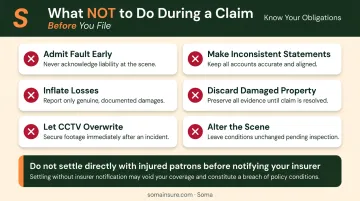
One mistake that surprises owners: settling directly with an injured patron or making informal payments before involving your insurer can void coverage for that incident and create additional legal liability. Always report the incident to your insurer before taking any action with the injured party.
How to Stay Claims-Ready Before an Incident Happens
Being claims-ready doesn't require a complicated system. It requires consistency.
Practical steps:
- Designate a staff member responsible for documenting incidents the night they occur — not the following day
- Maintain a running incident log that captures date, time, parties involved, and a brief factual description
- Keep policy documents accessible — not buried in a filing cabinet the manager doesn't know about
- Know your insurer's claims contact before you need it
- Train staff on responsible alcohol service; programs like TIPS have trained over 5.5 million participants and are widely recognized by carriers as a risk-reduction measure
Review Your Coverage Regularly
As your operation grows — new DJ booth, expanded outdoor patio, larger-capacity events — coverage needs shift and gaps can appear. A hospitality-focused broker can check whether your current policy keeps pace with your actual operations.
Soma places nightclub and bar coverage across multiple carriers, which means they can identify gaps and match the right endorsements for liquor liability, business interruption, and assault and battery exposure — rather than fitting you into a one-size policy.
Investing in CCTV coverage, written security protocols, and documented staff training doesn't just reduce the chance of a claim. It also strengthens your position during the claims process by demonstrating that your venue took its duty of care seriously.
Conclusion
Filing a nightclub insurance claim doesn't have to be overwhelming. Owners who report promptly, document thoroughly, understand their policy before submitting, and cooperate fully with the adjuster are in the strongest position to receive a fair and timely settlement.
Preparation before an incident matters just as much. The right coverage, organized records, and a knowledgeable broker — like Soma, which specializes in placing coverage for bars and hospitality businesses — make the process faster and less stressful when something goes wrong. Having those pieces in place before a claim is filed is what separates a smooth resolution from a prolonged dispute.
Frequently Asked Questions
How much is insurance for a nightclub?
Costs vary based on venue size, hours of operation, alcohol revenue percentage, security measures, and claims history. According to Hartford's data, a bar business owner's policy averages around $1,687 per year — nightclubs with late-night operations or prior claims typically pay more.
What should you not say when making an insurance claim?
Avoid admitting fault, speculating about cause, or making statements inconsistent with your original report. Don't exaggerate losses — false or misleading claim statements can result in denial or, in serious cases, criminal charges. Report facts accurately.
What are the four types of claims in insurance?
Property damage (building, equipment, inventory), liability (third-party bodily injury or property damage, including slip-and-falls), business interruption (lost income from covered property damage), and workers' compensation (employee injuries). Each applies in a nightclub context, and each requires separate coverage verification.
How quickly should I file a nightclub insurance claim?
Report the incident to your insurer as soon as possible. Most commercial policies require notice "as soon as practicable," and for claims-made policies, late reporting can void coverage entirely. File immediately — even if you're still gathering documentation.
What types of incidents are typically covered by nightclub insurance?
Slip-and-falls, liquor liability claims, property damage, theft, employee injuries, and equipment breakdown. Assault and battery coverage depends on whether your policy includes it as an endorsement — it's excluded from many standard forms.
What if my nightclub insurance claim is denied?
Request a written explanation, then submit any additional evidence that supports your claim. If the dispute isn't resolved, pursue mediation or arbitration as outlined in your policy. For complex claims involving liquor liability or significant losses, a public adjuster or insurance attorney can be a worthwhile resource.