That gap is exactly where general liability (GL) insurance comes in. This article breaks down what GL actually covers for a trucking LLC, what the federal public liability requirement actually says, and why most trucking LLCs need GL regardless of what the law mandates.
Key Takeaways
- GL covers non-vehicle incidents — loading dock injuries, property damage at a shipper's facility, advertising injury claims — risks your LLC structure won't absorb financially
- FMCSA mandates public liability financial responsibility under 49 CFR Part 387, with minimums ranging from $300,000 to $5,000,000 by freight type
- GL and primary (auto) liability are separate, complementary policies — one does not replace the other
- Most freight brokers and shippers contractually require GL proof — independent of any federal filing requirements
What Is General Liability Insurance for a Trucking LLC?
General liability insurance is a commercial policy that pays for third-party bodily injury, property damage, and personal or advertising injury claims arising from your business operations — specifically those not caused by your vehicle while it's moving on the road.
What a Standard GL Policy Includes
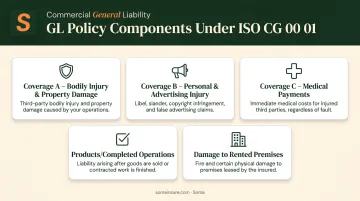
Based on the ISO CG 00 01 coverage form, a standard GL policy for trucking includes:
- Coverage A – Bodily injury and property damage liability for third-party claims from non-auto incidents
- Coverage B – Personal and advertising injury covering slander, libel, disparagement, and infringement of copyright, title, or slogan
- Coverage C – Medical payments for guest injuries on your premises or because of your operations
- Products/completed operations coverage for bodily injury or property damage arising after a delivery is complete
- Damage to premises rented to you for leased terminals, yards, or office space
How GL Differs from Primary (Auto) Liability
Primary auto liability covers accidents your truck causes while operating on the road. GL covers everything else. A few concrete examples:
- A vendor slips and falls at your loading dock while you're staging a shipment
- Your driver damages another company's conveyor system while unloading at their warehouse
- Your trucking company is sued for using a competitor's slogan in a marketing flyer
None of those scenarios involve a moving truck. None would be covered by your primary auto policy. That's the gap GL fills.
Keep in mind that the ISO CGL policy's auto exclusion defines "use" of a vehicle to include "loading or unloading." This means some loading/unloading claims may fall under auto liability rather than GL depending on the specific facts. Which policy responds comes down to the incident details — a practical reason trucking LLCs typically carry both.
Does Forming an LLC Mean You Don't Need General Liability Insurance?
No — and this is where the LLC misconception does real damage.
An LLC creates legal separation between your personal assets and your business. According to the SBA, it protects owners from personal liability in most instances. But as Maryland's People's Law Library notes, if the LLC is sued, money and assets belonging to the LLC can be used to satisfy claims. The LLC's trucks, equipment, contracts, and bank accounts are fully exposed.
GL insurance is what protects those business assets when a claim arises.
The "Piercing the Veil" Risk
Courts can sometimes hold LLC owners personally liable (called piercing the corporate veil) when the business was operated carelessly or when personal and business finances were mixed. GL addresses this directly: it pays claims before the question of personal liability ever reaches a courtroom, keeping the dispute at the business level.
Contractual Requirements Often Override the Debate
Personal liability risk aside, GL also determines which loads you can actually take. Many freight brokers and shippers require proof of GL coverage before they'll work with a carrier — Sims Metal's Logistics Broker Services Agreement, for instance, requires commercial general liability on an occurrence form with limits of at least $1 million per occurrence. The TIA Model Broker/Carrier Agreement includes the same type of insurance and certificate requirements.
If you don't carry GL, you may simply be excluded from loads and contracts — regardless of your LLC status.
An LLC and GL insurance aren't substitutes. The LLC limits personal exposure; GL pays for the business's liabilities when claims arise.
What Does General Liability Insurance Cover for Trucking Companies?
Standard general liability covers third-party bodily injury and property damage — but for trucking, the key distinction is that it covers incidents outside the vehicle. Motor Truck General Liability applies to business activities not directly tied to operating the truck itself, including incidents at loading docks, customer premises, truck stops, and rest areas.
Common exposures covered include:
- Slip-and-fall injuries at a shipper or receiver's facility
- Property damage caused while loading or unloading
- Completed operations claims arising after delivery
- Advertising injury or reputational harm claims
Products/completed operations is particularly relevant. If your driver delivers colored pellets to a manufacturing facility but puts them in the wrong bin, and that mistake damages a production line after the driver has left, completed operations coverage responds. The incident happened as a result of your work, even though the truck was long gone.
What GL Does NOT Cover
| Risk | Policy That Covers It |
|---|---|
| On-road vehicle accidents | Primary (auto) liability insurance |
| Employee workplace injuries | Workers' compensation insurance |
| Damage to your own trucks | Physical damage coverage |
| Cargo losses | Motor truck cargo insurance |
| Claims exceeding GL limits | Commercial umbrella insurance |
| Pollution/hazmat spill cleanup | Transportation pollution liability |
A single trucking operation faces every one of these exposures. GL is one layer of a complete insurance program — not a substitute for the others.
Standard GL Policy Limits
The most common structure is $1,000,000 per occurrence and $2,000,000 aggregate. That means the policy covers up to $1M per individual claim and $2M total across all claims in the policy period. Many broker and shipper contracts specifically require $1M per occurrence, so this structure aligns with standard contract demands. Higher limits are available, and some contracts require them.
Is General Liability Insurance Required for Your Trucking LLC?
The Federal Requirement: Public Liability, Not CGL
49 CFR Part 387 requires motor carriers to maintain minimum financial responsibility for "public liability" — defined under 49 CFR 387.5 as liability for bodily injury, property damage, and environmental restoration. This is not a mandate to purchase a commercial general liability policy specifically.
The FMCSA uses filing mechanisms — Form MCS-90, BMC-91, and BMC-91X — to confirm a carrier has adequate liability insurance. These attach to a motor carrier's liability insurance policy and serve as the compliance mechanism.
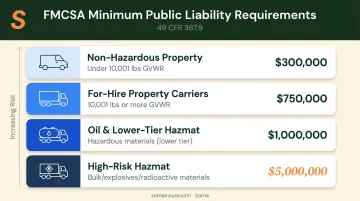
Minimum public liability thresholds under 49 CFR 387.9:
| Freight Category | Minimum Limit |
|---|---|
| Non-hazardous property, GVWR under 10,001 lbs | $300,000 |
| For-hire property carriers, GVWR 10,001 lbs or more | $750,000 |
| Oil and lower-tier hazmat categories | $1,000,000 |
| High-risk hazmat (bulk substances, explosives, radioactive) | $5,000,000 |
Why GL Still Matters Beyond the Federal Mandate
The federal requirement addresses public liability for vehicle-related operations. A separate GL policy covers the off-road, premises, and completed operations exposures the MCS-90 endorsement doesn't touch.
State-level regulations add another layer on top of federal minimums:
- California requires combined single-limit liability coverage from $300,000 to $5,000,000 depending on operations
- Texas requires proof of financial responsibility for intrastate carriers
- Pennsylvania requires motor carrier insurance filings through the PUC
Beyond state rules, brokers and shippers routinely require GL coverage as a condition of doing business. For any trucking LLC working with established logistics partners, carrying a GL policy is effectively a commercial necessity.
How to Get General Liability Insurance for Your Trucking LLC
To shop for GL coverage, gather the following before requesting quotes:
- USDOT number and MC authority documentation
- Types of freight hauled (especially if hazmat)
- Operating radius (local, regional, or interstate)
- Driver count and driving records
- Revenue estimates
- Any existing claims history
Compare coverage terms across multiple carriers, not just price. A trucking-specific GL policy — sometimes called Motor Truck General Liability — may provide broader coverage for premises liability, loading/unloading scenarios, and completed operations than a generic commercial GL form.
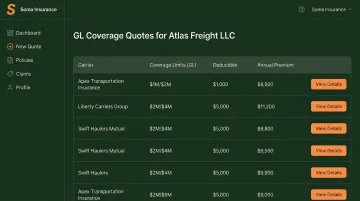
If you're unsure where to start, a trucking-specialized broker can handle the comparison work. Soma places GL coverage with carriers including Chubb, Progressive, Kemper, and Ascend — from owner-operators to long-haul fleets. The program covers hard-to-insure risks such as new ventures, drivers with violations, and hazmat haulers, and includes DOT and FMCSA filings. One application generates quotes from multiple carriers, so you see real options side by side.
Frequently Asked Questions
Do I need general liability insurance for my trucking LLC?
Yes, for two reasons. An LLC protects your personal assets but doesn't shield the business itself from lawsuits — GL fills that gap for off-road incidents. FMCSA public liability requirements and broker-shipper contract demands make GL practically necessary for most operating carriers.
How much does a $1,000,000 general liability policy cost for a trucking LLC?
Premiums depend on freight type, operating radius, driver history, and claims record — no single figure applies across the board. Get actual quotes from carriers who specialize in trucking rather than relying on general estimates.
What is the difference between general liability and primary liability insurance for truckers?
Primary (auto) liability covers bodily injury and property damage your truck causes in an on-road accident. GL covers off-road incidents — injuries at your facility or a shipper's premises, loading dock accidents, completed operations claims, and advertising injury. Both are necessary; neither replaces the other.
What does general liability insurance NOT cover for a trucking company?
GL does not cover on-road vehicle accidents (primary auto liability), employee injuries (workers' comp), cargo losses (cargo insurance), damage to your own equipment (physical damage), or pollution/hazmat cleanup (transportation pollution liability). Each requires a separate policy.
Do freight brokers require trucking companies to have general liability insurance?
Many do. Broker-carrier agreements frequently require GL on an occurrence form with $1M per occurrence limits as a condition of tendering loads. Carriers without current GL certificates may be excluded from contracts regardless of their primary auto liability coverage.