That's dram shop liability in practice. For any business that serves alcohol, understanding how these laws work isn't optional — it's essential risk management.
This article breaks down what dram shop acts are, how strict liability applies, which scenarios most commonly trigger claims, how state laws differ, and what steps your business can take to reduce exposure before an incident occurs.
TL;DR
- Dram shop acts are state statutes holding bars, restaurants, and other licensed alcohol vendors civilly liable for injuries caused by patrons they over-served.
- Strict liability means a business can be held responsible even if it took precautions — the prohibited sale is what triggers liability.
- Laws vary widely: New York imposes strict liability; Florida and California significantly limit it.
- 43 states plus D.C. have some form of dram shop statute, according to FindLaw's dram shop law overview.
- Documented staff training and a liquor liability insurance policy directly reduce your exposure when a claim is filed.
What Are Dram Shop Acts?
The term "dram shop" traces back to 18th-century Britain, where establishments sold spirits by the dram — a small unit of liquid measure. Today, the term applies to any licensed commercial vendor of alcohol: bars, restaurants, hotels, nightclubs, and liquor retailers.
Law.com defines a Dram Shop Act as a statute making a business that sells alcoholic drinks liable for damages caused by an obviously intoxicated customer or minor. Vendors are in a position to prevent over-service — and therefore bear partial responsibility for the harm that follows when they don't.
What the Statutes Actually Cover
Most dram shop statutes apply specifically to licensed commercial vendors. Some states also address social hosts — private individuals hosting gatherings — but with more limited standards.
A few important scope distinctions:
- Commercial vendors face the broadest exposure under most statutes
- Social hosts face liability in roughly half of states, typically only for serving minors
- Injured third parties (someone hit by a drunk driver) are the primary plaintiffs in most states
- First-party claims by the intoxicated person themselves are permitted in only a handful of states and are often limited by assumption-of-risk principles
Statutory vs. Common Law
Unlike standard negligence claims — which exist through common law — dram shop liability is statutory. It only exists because a state legislature passed an enabling statute.
Under common law, alcohol consumption, not the furnishing of alcohol, was traditionally treated as the proximate cause of injury. States without a dram shop statute may have no civil remedy at all, or may rely on narrow judicial interpretations of negligence.
How Strict Liability Works Under Dram Shop Laws
Strict liability is where many business owners get surprised. In a standard negligence case, a plaintiff must prove the defendant acted unreasonably. Under strict liability, that requirement disappears.
The business is liable because the prohibited sale occurred. Whether it trained its staff, implemented responsible service policies, or had no reason to suspect intoxication may not change that outcome.
The Four Elements a Plaintiff Must Prove
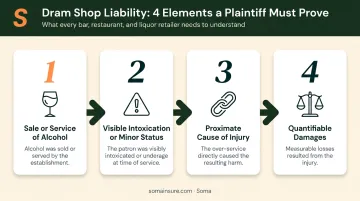
Per Justia's analysis of dram shop liability, a plaintiff in a dram shop claim typically needs to establish:
- The defendant sold or served alcohol to the patron
- The patron was visibly intoxicated or a minor at the time of service
- The continued intoxication from that service was a proximate cause (meaning a direct, foreseeable link) to the injury
- The plaintiff suffered quantifiable damages
The Visible Intoxication Standard
"Visible intoxication" is a perception-based standard, not a scientific one. Courts focus on observable signs, not blood-alcohol content readings. Common indicators include:
- Slurred speech
- Unsteady gait or stumbling
- Bloodshot or glassy eyes
- Disoriented behavior or impaired judgment
New York courts have established that plaintiffs can prove visible intoxication through circumstantial evidence — eyewitness testimony, server accounts, and surveillance footage. High BAC alone, without proof of visible signs, is generally insufficient to establish the claim.
That makes this standard difficult for defendants to disprove, particularly when multiple witnesses observed the same patron.
Sales to Minors
Unlike visible intoxication — which hinges on a server's perception — age is an objective fact. When a vendor serves someone under 21, many states apply an even stricter standard, removing the "I didn't know" defense that vendors sometimes raise for visible intoxication claims. Some states provide a limited defense if the patron presented a convincingly fraudulent ID, but this defense is narrow and state-specific.
Available Defenses
Even in strict liability jurisdictions, certain factors can affect outcomes:
- Comparative fault rules — a plaintiff's own intoxication may reduce their recovery
- Statutory damages caps in select states
- Responsible vendor safe harbor provisions in states like Texas, where certified training and written policies can reduce or affect liability
- Statute of limitations deadlines, which often differ from standard personal injury timelines
In New York, for example, General Obligations Law Section 11-101 contains no training safe-harbor language — meaning documented training does not eliminate liability there, though it can still influence jury perception and damage awards.
Common Scenarios That Trigger Dram Shop Claims
Drunk Driving Accidents
This is the most frequent trigger. A patron is served at a bar or restaurant, drives away, and causes a collision. NHTSA reports that 11,904 people died in alcohol-impaired driving crashes in 2024 — roughly one person every 44 minutes.
The injured victim (or their estate in a wrongful death case) can pursue both a negligence claim against the drunk driver and a separate dram shop claim against the serving establishment. These claims run in parallel.
On-Premises Injuries
A heavily intoxicated patron assaults another guest, causes a fall, or creates a dangerous situation inside the venue. Here, dram shop liability may run alongside a premises liability claim against the same defendant — creating two overlapping theories of recovery and significantly increasing the business's exposure.
Multi-Venue Complications
Real-world incidents often involve a patron who visited multiple bars before an accident. Courts must determine which establishment's service was the proximate cause of harm. The 1959 New Jersey Supreme Court case Rappaport v. Nichols documented an 18-year-old being served at four separate venues before a fatal collision — illustrating that factual complexity doesn't eliminate liability for all vendors involved. It makes the litigation harder — and makes adequate liability coverage more important for every establishment in the chain.
How Dram Shop Laws Vary by State
There is no uniform national standard. What creates liability in one state may not in another.
A Side-by-Side Comparison
| State | Liability Standard | Key Trigger |
|---|---|---|
| New York | Strict liability | Sale to visibly intoxicated person or minor |
| Texas | Cause of action exists | Person was "obviously intoxicated" and presented clear danger |
| Florida | Significantly limited | Only for sales to minors or known habitually addicted individuals |
| California | Largely barred | Only for sales to obviously intoxicated minors |
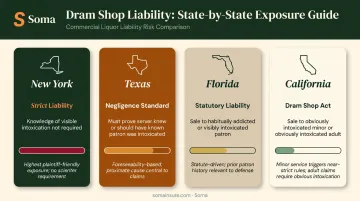
Florida's statute (Section 768.125) is explicit: a vendor who serves a person of lawful drinking age is not liable for resulting injury unless it willfully served a minor or knowingly served a habitually addicted individual. Simply serving a visibly intoxicated adult does not create liability in Florida.
California goes further. Under Business and Professions Code Section 25602, furnishing alcohol is not the proximate cause of injuries inflicted by an intoxicated person — with only the narrow exception in Section 25602.1 for sales to obviously intoxicated minors.
For multi-state hospitality operators, the gap between states carries real legal exposure. Practices that create no liability in Florida can still trigger a dram shop claim in New York.
Social Host Liability
Some states extend dram shop-style liability to private individuals hosting gatherings — house parties, corporate events, fundraisers. Standards for social hosts are generally more demanding to satisfy (often requiring actual knowledge of intoxication) and fewer states recognize the doctrine for adults. Businesses that host client events or private functions should confirm whether their state imposes this exposure on commercial hosts operating outside their licensed premises.
How Alcohol-Serving Businesses Can Reduce Their Exposure
Train Staff and Document Everything
Programs like TIPS (Training for Intervention ProcedureS) and ServSafe Alcohol — developed by the National Restaurant Association — teach servers to identify intoxication signs, refuse service appropriately, and verify age consistently.
Training alone won't eliminate liability in strict liability states. But written training logs, signed policy acknowledgments, and documented refusal incidents can:
- Demonstrate good-faith compliance in litigation
- Influence jury perception and reduce damages
- Qualify for responsible vendor safe harbor protections where available (Texas, Florida, Tennessee)
- Support lower insurance premiums in some markets
Build Operational Safeguards
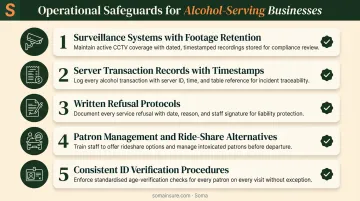
Operational procedures reinforce training and create the paper trail that matters when a claim is filed:
- Surveillance systems with adequate footage retention periods
- Server transaction records tied to specific timestamps and staff IDs
- Written refusal protocols with a clear chain of command
- Patron management procedures for visibly intoxicated guests, including ride-share alternatives to driving
- Consistent ID verification procedures — especially for plausible-looking fraudulent IDs presented by minors
Courts and insurance adjusters both look for evidence that the establishment operated responsibly. Documentation creates that evidence.
Carry the Right Insurance — and Confirm What It Actually Covers
This is where many businesses have a critical gap. Standard ISO Commercial General Liability policies include a liquor liability exclusion that applies to any insured in the business of manufacturing, distributing, selling, serving, or furnishing alcoholic beverages. If your bar or restaurant relies solely on a CGL policy, alcohol-related claims may be entirely excluded.
Liquor liability coverage is a separate, specialized policy — the ISO CG 00 33 occurrence form is the standard framework — that protects against third-party bodily injury claims, defense costs, and liquor law violations.
Soma places liquor liability coverage for bars, nightclubs, restaurants, hotels, and off-premise liquor retailers through specialty markets including Markel, Nationwide, and Liberty Mutual — including late-night venues, high-occupancy establishments, and businesses with prior claims history that standard carriers decline.
For hospitality businesses operating across multiple states with varying liability standards, working with a broker who understands both the legal landscape and carrier appetites is the practical difference between appropriate coverage and a gap that leaves a seven-figure claim undefended.
Frequently Asked Questions
What does dram shop liability cover?
Dram shop liability covers civil claims against alcohol vendors for injuries caused by intoxicated patrons they served : drunk driving accidents, on-premises assaults, and harm to third parties are the most common. The scope and limits of coverage vary significantly by state statute.
What act imposes strict liability?
State dram shop statutes impose strict liability in jurisdictions like New York. A vendor can be held liable solely because a prohibited sale occurred (to a visibly intoxicated person or a minor), with no need to prove carelessness or bad faith.
What does it mean to impose strict liability?
Strict liability removes the requirement to prove negligence or fault. The business is liable because the prohibited act — the sale itself — took place, regardless of intent, precautions taken, or whether harm was foreseeable.
Does dram shop liability apply to social hosts?
Roughly half of U.S. states recognize social host liability for private individuals who serve alcohol at gatherings. Standards are generally stricter than for commercial vendors, often requiring actual knowledge of intoxication rather than mere over-service.
How can a bar or restaurant protect itself from dram shop claims?
Staff training, documented responsible service policies, and consistent ID verification all reduce exposure. Beyond operations, carry a dedicated liquor liability insurance policy: standard general liability coverage excludes alcohol-related claims, leaving bars and restaurants exposed when a claim hits.