Introduction
The U.S. and Mexico are each other's top trading partners. According to the Bureau of Transportation Statistics, U.S.-Mexico freight trade reached $839.9 billion in 2024, with trucks carrying 72.5% of that value — over $609 billion in goods crossing the border by road alone.
The most common — and costly — mistake shippers make is assuming their existing U.S. cargo coverage travels with their freight into Mexico. It doesn't.
Mexican carrier liability law operates on a completely different legal foundation than the U.S. system. Where American law holds carriers broadly accountable for actual cargo losses, Mexican law caps carrier liability by statute — often limiting recovery to a few thousand dollars regardless of what the freight is actually worth.
For a shipper moving a $200,000 load across the border with no separate coverage, that gap is a real financial loss — not a fine-print technicality.
This article breaks down how the two systems differ, what the liability caps look like in practice, and how shippers can close the gap before freight moves.
TL;DR
- U.S. carrier liability under the Carmack Amendment defaults to full actual loss; Mexico's statutory caps follow an entirely different framework.
- In Mexico, undeclared shipments are covered by a weight-based formula, not cargo value — often yielding only a few thousand dollars in recovery.
- Standard U.S. Motor Truck Cargo policies do not extend into Mexico. The Mexican leg requires separate coverage.
- Declaring cargo value before Mexico transit opens options but still does not guarantee full reimbursement.
- Protecting cross-border freight is the shipper's responsibility, not the carrier's.
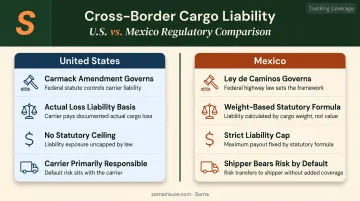
U.S. vs. Mexico Cargo Insurance: Quick Comparison
| Dimension | United States | Mexico |
|---|---|---|
| Governing law | Carmack Amendment (49 U.S.C. § 14706) | Ley de Caminos, Puentes y Autotransporte Federal (1993), Article 66 |
| Carrier liability basis | Actual loss or damage to cargo | Statutory weight-based formula (unless value declared) |
| Default liability limit | No statutory ceiling; carrier-set limits common (often $100K/trailer) | 15 days of federal minimum wage × shipment weight in tons |
| Separate shipper policy needed | Optional but advisable for high-value loads | Effectively required for any meaningful coverage |
| Primary financial responsibility | Carrier, subject to contractual limits | Shipper, unless value is declared and additional fee paid |
U.S. law defaults to carrier accountability. Mexican law defaults to strict statutory caps that heavily limit what a carrier must pay. The two systems operate from entirely different legal foundations — what protects a shipment north of the border offers little assurance south of it.
How Cargo Insurance Works in the U.S.
The Carmack Amendment
The Carmack Amendment (49 U.S.C. § 14706) has governed interstate cargo liability since the Hepburn Act of 1906. The rule is straightforward: carriers are liable for the actual loss or injury to property during transport, from the point of receipt through delivery.
There is no statutory ceiling under Carmack. Carriers can contractually limit their liability — but only if the shipper has an opportunity to declare a higher value and that limitation is reasonable under the circumstances. A carrier can't simply bury a $500 cap in fine print and call it done.
Carrier Liability Limits in Practice
Most U.S. carriers set their MTC policy limits per trailer, not per shipment. Common structures include:
- Standard limit: $100,000 per trailer
- Tiered options upon request: $250,000 / $500,000 / $1,000,000
- Excluded commodities: High-value electronics, fine art, pharmaceuticals, and other specialty freight are often carved out entirely
FMCSA Requirements and MTC Insurance
Federal regulations under 49 CFR Part 387 require for-hire property carriers operating vehicles over 10,001 lbs GVWR to maintain $750,000 in minimum public liability coverage — covering bodily injury, property damage, and environmental restoration.
FMCSA does not require for-hire carriers to carry cargo insurance for general non-hazardous freight. Motor Truck Cargo (MTC) policies — which cover physical loss or damage to freight in the carrier's possession — are purchased voluntarily. Most reputable carriers carry them, but there's no federal mandate forcing the issue.
When U.S. Carrier Coverage Falls Short
Even with a solid Carmack framework, carrier MTC policies have real gaps:
- Load value exceeds trailer limit — a $400,000 electronics shipment on a carrier with a $100,000 limit leaves $300,000 exposed
- Commodity exclusions — many MTC policies exclude certain freight types outright
- Proving fault — MTC pays when the carrier is liable; if fault is disputed, payment can be delayed or denied
This is where Shipper's Interest (All-Risk) policies fill the gap. Unlike MTC insurance, which belongs to the carrier, a Shipper's Interest policy belongs to the shipper. It pays based on actual cargo value regardless of whether carrier fault is proven — which matters significantly when cargo crosses into Mexico, where carrier liability rules operate differently.
How Cargo Insurance Works in Mexico
The Ley de Caminos Framework
Mexico's cargo liability law — the Ley de Caminos, Puentes y Autotransporte Federal (published December 22, 1993, last reformed November 14, 2025) — governs what Mexican carriers owe when freight is lost or damaged. Article 66 makes carriers responsible for losses from receipt through delivery, but subject to statutory caps that bear no resemblance to the Carmack standard.
The key provision: Article 66, Fraction V.
When a shipper does not declare cargo value, the carrier's maximum liability is:
15 days of the Mexican federal minimum wage × shipment weight in tons
Running the Numbers
Mexico's 2026 general minimum wage is 315.04 pesos per day (per CONASAMI). For a 10-ton shipment of undeclared value, the calculation looks like this:
- 315.04 pesos/day × 15 days = 4,725.60 pesos per ton
- × 10 tons = 47,256 pesos total maximum liability
- At roughly 17–18 pesos per U.S. dollar, that's approximately $2,600–$2,800 USD
A $150,000 shipment. A $2,700 recovery — that gap is total, unhedged financial exposure for the shipper.
Note: Mexico's 2016 UMA law introduced a separate reference unit (UMA) for obligations in federal law. Whether Article 66 calculations should use the CONASAMI minimum wage or the UMA value remains a point of legal ambiguity — consult legal counsel or a specialist broker for current guidance before publishing internal estimates.
The Declared Value Option
Shippers can declare cargo value before Mexico transit under Article 67, which allows them to pay an additional fee to the carrier for extended coverage. The catch:
- The additional charge is negotiated carrier-by-carrier — there's no standard rate
- Coverage rarely equals the full declared value in practice
- This is not the same as buying insurance; it's a contractual agreement with a carrier that may or may not honor it in full at claim time
These limitations make the declared value option unreliable as a standalone risk management tool — which is why the broader insurance gap deserves a closer look.
Why Standard Insurance Markets Don't Readily Cover Mexico
Mexico does not require carriers to carry a cargo insurance equivalent to U.S. MTC policies. The mandatory coverage under Mexican law is third-party civil liability — protecting other people and property from vehicle accidents, not protecting the cargo inside the truck.
Freight brokers handling cross-border Mexico shipments have historically required shippers to sign liability waivers, effectively transferring all cargo risk to the shipper once the load crosses the border. Combined with the statutory weight-based caps, shippers bear nearly all financial risk by default.
Key Risks During Mexico Transit
Cargo theft in Mexico is a documented, ongoing operational risk. According to the Mexico Annual Cargo Theft Report 2024 by TAPA and Overhaul:
- 87% of nationwide cargo thefts were concentrated in just ten states
- Puebla (23%) and the State of Mexico (22%) accounted for nearly half of all incidents
- 84% of robberies against carriers involved some form of violence
- 71% of cases involved units intercepted while in motion
Food and beverages represented 32% of stolen cargo by product type, followed by building and industrial materials at 14%. The MEX-150D highway (Mexico City to Veracruz) alone accounted for 11% of all thefts nationally.
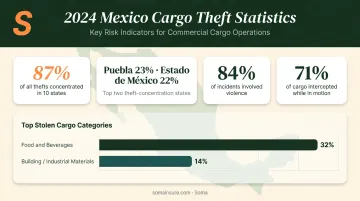
These are operating conditions on major corridors. Without adequate coverage, a single theft incident can become a total, unrecoverable loss.
How to Bridge the Coverage Gap for Cross-Border Freight
U.S. cargo insurance policies are underwritten under U.S. legal assumptions. They're written to respond to claims evaluated under Carmack, not Article 66 of the Ley de Caminos. When freight crosses the border, the legal environment changes — and the policy stays behind.
Two distinct policies are required for full coverage: one for the U.S. leg, one for Mexico.
Option 1: Extended Coverage Through Your Logistics Provider
Some Mexico-based carriers or logistics providers can arrange additional cargo coverage for the Mexican leg of transit. Before relying on this option, verify:
- The specific coverage limit and what it actually pays (not just what's promised)
- Whether it covers theft, not just accident-related damage
- Which insurer actually underwrites the policy and whether claims are paid in USD or pesos
- That the coverage is in place before freight moves, not arranged retroactively
This option can work, but it adds cost and requires active due diligence. Don't assume your logistics provider's coverage matches your cargo value.
Option 2: Shipper's Interest / Cross-Border Cargo Policy
A first-party Shipper's Interest policy is the most reliable solution for cross-border freight. Four features make it well-suited for this exposure:
- Pays the shipper directly for the full declared cargo value
- No proof of carrier fault required — if freight is lost or damaged, the claim is paid
- Covers the full transit chain: U.S. carrier → border warehouse → drayage → Mexican carrier → destination
- Removes the intermediary liability vacuum created by broker liability waivers
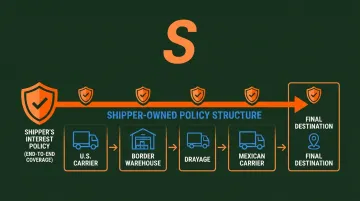
For cross-border freight specifically, these policies are often placed through specialty or surplus lines markets, since standard admitted markets rarely underwrite Mexico transit risk. Working with a broker experienced in this space matters — not all brokers have access to the carriers that will actually write this coverage.
Soma's trucking insurance program covers Motor Truck Cargo and related freight exposures through carrier partners including Chubb, Markel, and Liberty Mutual. For cross-border shipments requiring a Shipper's Interest or Mexico-leg policy, Soma's Risk Management Team can assess your specific route, commodity, and cargo value to match the right coverage structure.
Use the checklist below before any shipment moves across the border.
Cross-Border Coverage Checklist
Before any freight moves across the border:
- Declare shipment value with the Mexican carrier before transit begins
- Confirm your U.S. MTC policy territory — verify it ends at the border
- Obtain a separate Shipper's Interest or cross-border policy covering the Mexico leg
- Work with a broker who has access to specialty markets — standard online tools won't price Mexico transit accurately
- Document your cargo value with invoices and photographs before departure
Conclusion
U.S. and Mexico cargo insurance are not interchangeable. The Carmack Amendment and Mexico's Ley de Caminos reflect entirely different legal assumptions about who bears risk when freight is damaged or stolen. Treating them as equivalent — or assuming your domestic coverage simply continues across the border — leaves a gap that a weight-based statutory calculation won't come close to filling.
Before your next cross-border shipment, three steps matter:
- Declare your cargo value before Mexico transit
- Secure a separate policy for the Mexican leg
- Work with a broker who knows the specialty markets that write cross-border coverage
A standalone Mexico cargo policy typically costs far less than a single uncovered loss. The gap between those two numbers is the risk you're carrying if you skip this step.
Frequently Asked Questions
Does U.S. cargo insurance cover freight once it crosses into Mexico?
No. Standard U.S. Motor Truck Cargo and carrier liability policies are underwritten under U.S. law and are not designed to respond to claims governed by Mexican law. Shippers need a separate policy that explicitly covers the Mexican leg of transit.
What happens if I don't declare my shipment's value before it enters Mexico?
Under Article 66 of the Ley de Caminos, the carrier's liability is limited to a weight-based formula tied to the Mexican federal minimum wage (roughly 15 days of minimum wage per ton). For most shipments, this amounts to a few thousand dollars regardless of actual cargo value.
Is motor truck cargo insurance available for Mexico transit?
Coverage is available, but few standard insurance markets write it. Shippers typically need to work with a specialist broker who has access to specialty or surplus lines markets for adequate protection.
Do cargo carriers need motor truck cargo insurance for Mexico transit?
Mexican carriers are not required to carry MTC insurance equivalent to U.S. standards. Mandatory coverage under Mexican law is third-party civil liability — not cargo protection. Shippers cannot rely on carrier coverage and must secure their own cross-border policy.
How much does motor truck cargo insurance for Mexico transit cost?
Costs vary based on cargo value, commodity type, route, and carrier. Standard online quoting tools rarely price Mexico transit accurately. Consult a specialized broker for a quote tailored to your shipment profile.
What is the difference between Shipper's Interest insurance and Motor Truck Cargo insurance for cross-border freight?
MTC insurance is held by the carrier and only pays when carrier fault is established. Shipper's Interest is held by the shipper and pays for loss or damage regardless of fault. That makes it the more reliable option for cross-border freight moving through Mexico.