Introduction
Picture this: a consultant meets a new client at their office. On the way in, the client trips over a loose cable and breaks their wrist. Two weeks later, the consultant's advice leads to a costly business decision the client now wants to dispute in court.
Same day. Same consultant. Two completely separate lawsuits, and only one policy would respond to each.
Many business owners assume a single liability policy covers everything. That assumption gets expensive. According to The Hartford's 2025 small-business claims analysis, slip-and-fall claims alone average $45,000 — and that's just one category of physical risk. Professional mistakes create entirely different exposures that general liability won't touch.
Here's exactly what separates the two policies, where each one applies, and how to figure out which combination your business actually needs.
TL;DR
- General liability covers physical risks: bodily injury, property damage, and advertising injury from business operations
- Professional liability covers financial harm from errors, omissions, or negligence in services you deliver
- Clients, landlords, and contracts often require one or both — knowing which applies saves you from buying the wrong coverage
- Most service businesses with physical premises need both — each policy covers a distinct type of claim
- A GL policy won't respond to a faulty advice claim; a professional liability policy won't cover a slip-and-fall
General Liability vs. Professional Liability: At a Glance
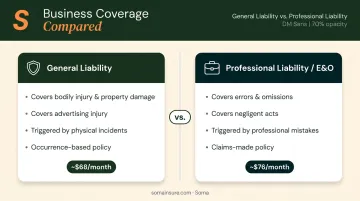
| General Liability | Professional Liability (E&O) | |
|---|---|---|
| What it covers | Bodily injury, property damage, personal and advertising injury | Errors, omissions, negligent acts, failure to deliver promised services |
| What triggers a claim | A physical incident: slip-and-fall, property damage, defamatory ad | A professional mistake: bad advice, missed deadline, flawed deliverable |
| Who needs it | Businesses with a physical location, employees on-site, or client interactions | Businesses providing advice, professional services, or deliverables clients rely on financially |
| What it does NOT cover | Professional errors, employee injuries, commercial auto | Physical injuries, property damage |
| Typical cost | ~$68/month (Hartford average) | ~$76/month (Hartford average) |
| Policy structure | Usually occurrence-based | Usually claims-made |
The table shows the structural differences. Picking the right coverage — or knowing when you need both — comes down to where your specific business operations create exposure. The sections below walk through that decision.
What Is General Liability Insurance?
IRMI defines commercial general liability (CGL) as a standard policy protecting businesses against liability claims for bodily injury and property damage arising out of premises, operations, products, and completed operations. It also covers personal and advertising injury. For most businesses, it's the foundation of any commercial insurance program.
The Three Core Coverage Areas
- Bodily injury: A customer slips on a wet floor at your retail store, or a delivery person trips over equipment at your job site. You're liable; GL responds.
- Property damage: A contractor accidentally breaks a client's custom flooring during a renovation. GL covers the repair cost to that third-party property.
- Personal and advertising injury: A competitor claims your marketing materials defamed their brand or copied their content. GL covers claims like libel, slander, and copyright infringement in advertising.
What General Liability Does NOT Cover
GL will not respond to:
- Professional errors or mistakes in the services you provide
- Employee injuries or illnesses (that's workers' compensation)
- Commercial auto accidents that occur while driving for work
- Damage to your own business property
Each of these requires a separate policy — and conflating them with GL is one of the most common ways businesses end up underinsured.
Who Needs It and What It Costs
Virtually every business with a physical location, client-facing staff, or employees working on-site needs general liability. It's especially non-negotiable in construction, retail, hospitality, and manufacturing.
According to The Hartford, small businesses pay roughly $810/year ($68/month) on average, with a $1M per-occurrence policy averaging $824/year.
Costs shift based on industry, revenue, location, employee count, and claims history. Lower-risk businesses — a solo IT consultant, for example — can find policies starting well below that average.
What Is Professional Liability Insurance?
Professional liability insurance (also called Errors & Omissions, or E&O) protects businesses and professionals against claims that their services, advice, or work caused a third party financial harm. The triggering event doesn't require a physical injury — a client can sue entirely based on a bad outcome they attribute to your work.
That distinction is what catches businesses off guard. An unhappy client doesn't need to get hurt. They just need to argue that your advice, your deliverable, or your failure to deliver caused them financial loss.
Common Claim Triggers
Industry makes a difference here:
- Financial advisor — A recommendation leads to significant client losses. The client claims negligence.
- Software developer — A code error takes down a client's e-commerce platform during peak sales season.
- Consultant — A missed deadline causes a client to lose a major contract they were pursuing.
- Healthcare provider — A misdiagnosis or treatment error results in patient harm and a malpractice suit.
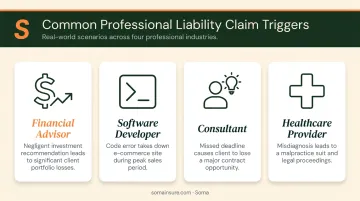
These claims don't look anything like a slip-and-fall. General liability isn't built to respond to them.
Industry-Specific Terminology
The underlying protection is similar across industries, but the label changes:
- E&O insurance — broad professional services (consulting, tech, finance, real estate)
- Medical malpractice — healthcare providers
- Design professional liability — architects and engineers
Some states mandate coverage outright:
- Pennsylvania — physicians and healthcare providers must carry it under the Mcare Act
- Massachusetts — doctors are required to maintain medical malpractice coverage
- Oregon — private-practice lawyers must carry coverage through the state bar's PLF
Even where not legally required, client contracts in construction, tech, and government work routinely demand proof of it.
Who Needs It and What It Costs
Industries where professional liability is essential — not optional:
- Technology (SaaS, software developers, IT consultants)
- Consulting and advisory services
- Finance, accounting, and investment management
- Healthcare
- Architecture and engineering
- Real estate and legal professionals
The Hartford reports small businesses pay about $76/month for standalone professional liability. Costs vary significantly by profession:
| Profession | Average Monthly Cost |
|---|---|
| Architects & Engineers | $239+ |
| Technology companies | $146 |
| Accountants | $73 |
| Healthcare professionals | $38 |
Which Coverage Does Your Business Need?
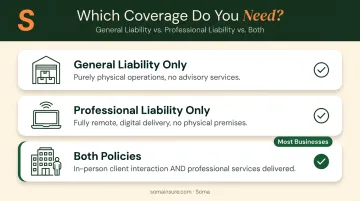
The clearest way to frame this: how does your business create risk?
If risk comes primarily from physical operations — people on your premises, products in the market, work performed at job sites — general liability is your foundation.
If risk comes from the advice you give, the services you deliver, or the work product clients depend on financially, professional liability is essential.
Most businesses that provide professional services don't get to choose just one.
The "Both" Scenario
A tech consultant with a leased office has physical exposure (anyone who visits that office) AND professional exposure (any client relying on their recommendations). One policy doesn't cover the other.
Choose general liability only if: You operate a purely physical business with no advisory or professional service component — a product manufacturer that doesn't consult, for example.
Choose professional liability only if: You work entirely remotely, deliver services digitally, and have no physical premises accessible to third parties.
Choose both if: You interact with clients in person AND deliver professional services or advice. That describes the majority of businesses in tech, finance, healthcare, and construction.
Contract Requirements Add Another Layer
Many clients and contracts require proof of both policies before work begins:
- Subcontractors in construction often need to show GL and contractor professional liability
- Tech and consulting contracts increasingly specify E&O minimums
- Government contracts commonly require both
Carrying both policies protects against claims and keeps you eligible for contracts that require proof of coverage before work begins.
Overlapping risks — a tech firm with a physical office, a construction company that also provides project management consulting — often require a tailored coverage mix that standard policies don't address cleanly.
Soma works with hundreds of carrier partners, including Chubb, Hiscox, Markel, Kinsale, and Liberty Mutual, to assess the full exposure picture and place both policies through a single application. That's especially useful when your risk profile doesn't fit neatly into one category.
Conclusion
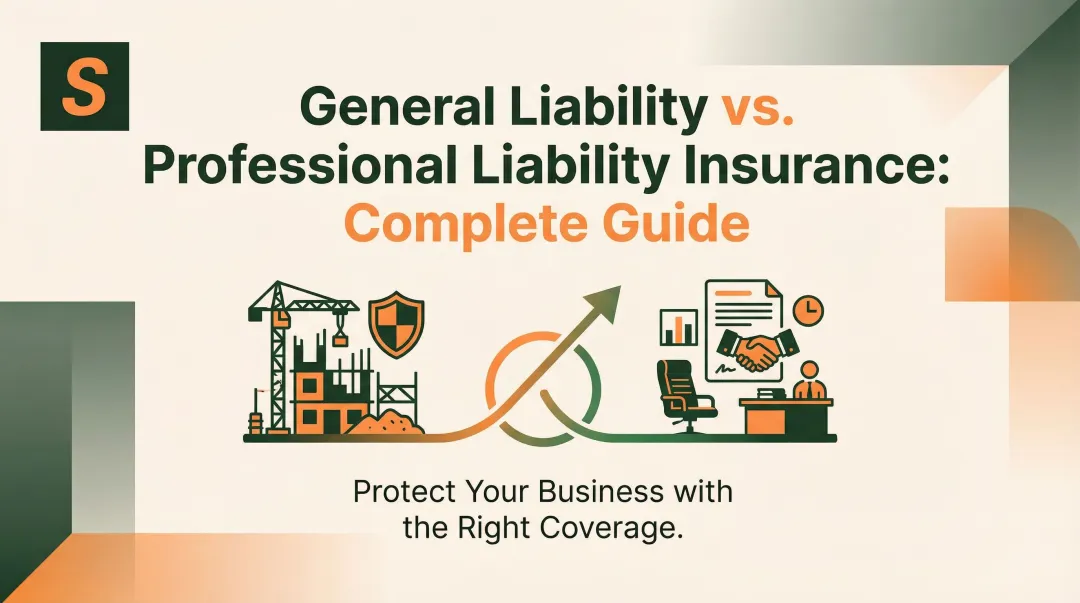
General liability and professional liability aren't competing choices — they respond to fundamentally different types of risk. The real question is whether your business carries one type of exposure or both.
For most businesses that provide professional services and have any physical presence or client interaction, the answer is both. A gap in either coverage can mean an uncovered claim, a lost contract, or a judgment you're paying out of pocket.
Start by mapping how your business creates risk. When the picture is clear, matching it to coverage is straightforward. If your operations cross multiple categories — or you're unsure where your exposures fall — connect with Soma for a fast quote built around your actual operations.
Frequently Asked Questions
Frequently Asked Questions
Do I need both professional and general liability insurance?
Most businesses that provide professional services and have physical premises or client interactions need both. Each policy covers a different type of claim — one cannot substitute for the other, and a gap in either direction leaves real exposure uncovered.
What is the main difference between general liability and professional liability insurance?
General liability covers physical risks — bodily injury, property damage, and advertising injury. Professional liability covers financial harm to clients resulting from errors, omissions, or negligence in the professional services you deliver.
Is professional liability insurance the same as E&O insurance?
Yes. E&O (Errors & Omissions) is simply another name for professional liability insurance. The label shifts by industry: malpractice in healthcare, design professional liability for architects and engineers, and E&O across most other service sectors.
Does general liability insurance cover professional mistakes?
No. General liability is not designed to respond to claims based on professional errors, negligent advice, or failure to deliver services as promised. That's the role of professional liability (E&O) insurance.
Which industries most commonly need professional liability insurance?
Technology, consulting, finance and accounting, healthcare, architecture and engineering, real estate, and legal services. Client contracts in many other industries are increasingly requiring proof of coverage even without a legal requirement.
How much does general liability vs. professional liability insurance cost?
General liability averages about $68/month for small businesses (The Hartford, 2026). Professional liability averages around $76/month for a standalone policy, though profession-specific minimums range from $38/month for healthcare to $239/month for architects and engineers. Bundling both policies with one broker may reduce overall cost.